
Most demo coaching tells you to read the room, follow the buyer's curiosity and click wherever the energy goes. That advice produces tours, not evaluations. The tell show do method does the opposite: it fixes the sequence before you open a screen, so the buyer always knows what's coming and you can't drift into whatever looks impressive.
It's an old idea borrowed from pediatric dentistry, and it's more useful to Solution Engineers now than it was when it was written down. Buyers do most of their research before they ever talk to you. The soft version often taught, "explain it, show it, let them try it," doesn't survive that. The version that works is a control structure: a Tell you write down before the call, a Show narrowed to the problem you agreed in discovery, and a Do the buyer performs against a pass condition you set in advance.
The method fails in one predictable way. The presenter disappears, the buyer keeps reading, and nobody corrects the misreading.
The Three Stages and What Each One Must Do
Addelston introduced Tell-Show-Do in 1959 as a three-stage sequence for preparing children for unfamiliar procedures, and the structure hasn't moved since, as a review of the technique in clinical practice sets out. Tell explains the procedure in language the child can follow. Show demonstrates the instruments and actions without performing the treatment. Do carries out exactly what was explained and shown.
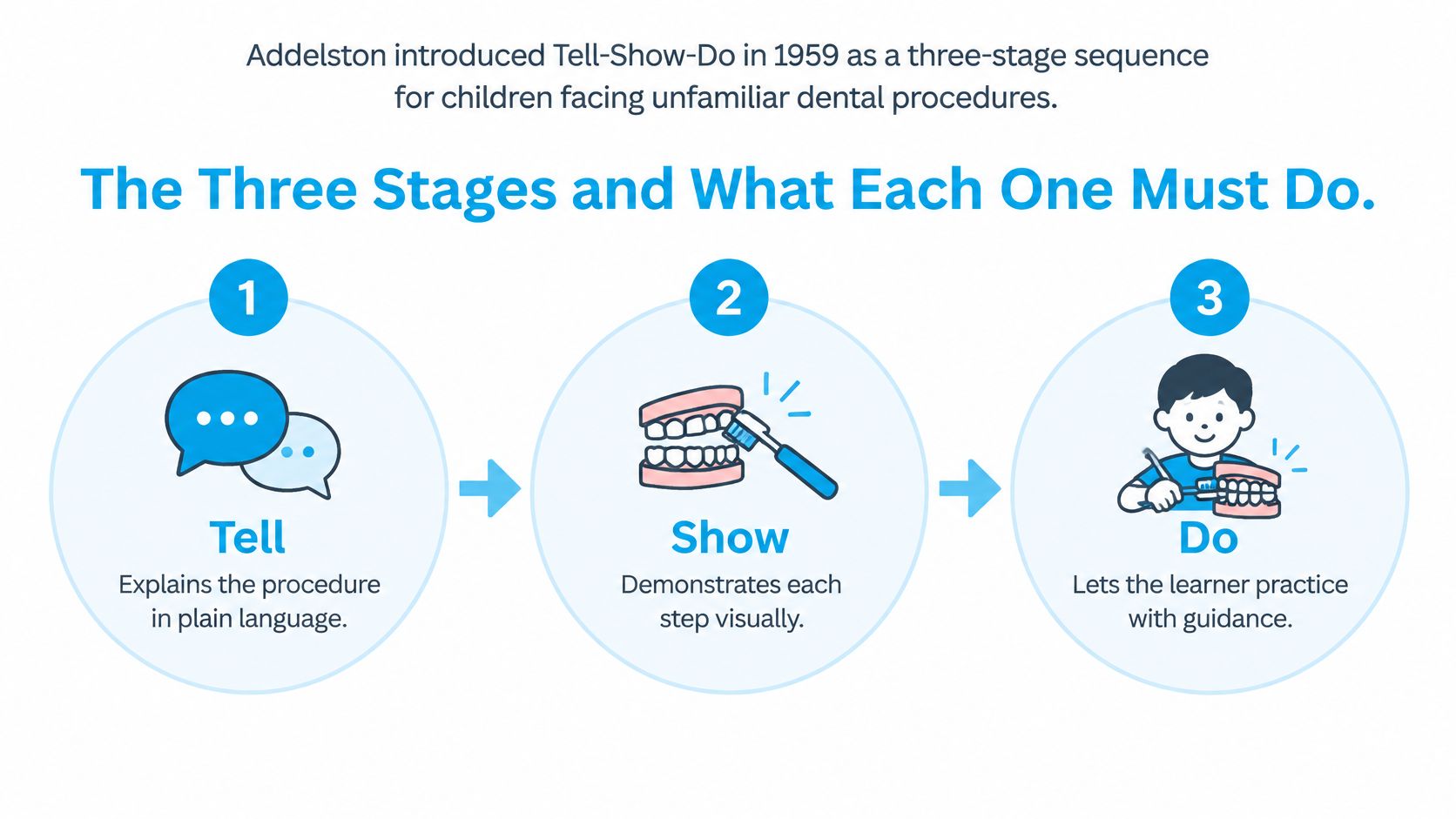
The mapping to a product demo is direct, and it's where most demos fall apart.
| Stage | Pediatric dentistry | Product demo | Done when |
|---|---|---|---|
| Tell | Explain the procedure in age-appropriate words | State the buyer's problem, the outcome and the steps | Buyer restates the goal in their own words |
| Show | Demonstrate instruments and actions without treatment | Preview only the workflow that solves that problem | Buyer names the step they would own |
| Do | Perform the procedure exactly as explained | Run the same path live, with no new features | Buyer completes or confirms the outcome |
The sequencing constraint is the whole point. The American Academy of Pediatric Dentistry defines the final stage as performing the procedure "without deviating from what was explained and demonstrated," per its behavior guidance reference. Translate that to PreSales and you get the rule that separates a controlled evaluation from a performance: nothing appears in the Do that wasn't in the Tell and the Show. No unpreviewed feature, no swapped dataset, no new success criterion.
The core rule: the final action matches what you explained and demonstrated. The moment the buyer sees something they weren't told to expect, you've turned a predictable sequence back into a surprise.
Hypothetical example. You're a Solution Engineer for an invoicing platform, in front of a finance director. The Tell is that reconciliation should close in under a day instead of three. The Show is the matching screen, one sample account, nothing else. The Do is the same reconciliation run live on the file they sent you last week. That's the method working. Swap the sample account for a demo tenant halfway through and the buyer has watched two different products.
Each stage has one test, and it's always the same test: can the buyer say what happens next in their own words?
- After Tell: they describe the outcome without repeating your phrasing back at you.
- After Show: they point at the step they'd own and say who else would touch it.
- After Do: they confirm the result matched what you promised, or tell you exactly where it didn't.
If a stage fails its test, you don't move on. You redo that stage.
How to Run a Tell Show Do Product Demo
The Scottish Dental Clinical Effectiveness Programme describes the mechanics plainly: explain what will happen, show the child the relevant object or action, then perform it, and its worked example tells the child what will be done and shows the handpiece before it's used, according to the SDCEP behaviour management guidance. Replace the child with a buyer and you have the rule most SEs break. Don't switch datasets, feature paths or success criteria after the audience has agreed to the preview.
Run the sequence in this order and the demo stops being a gamble.
-
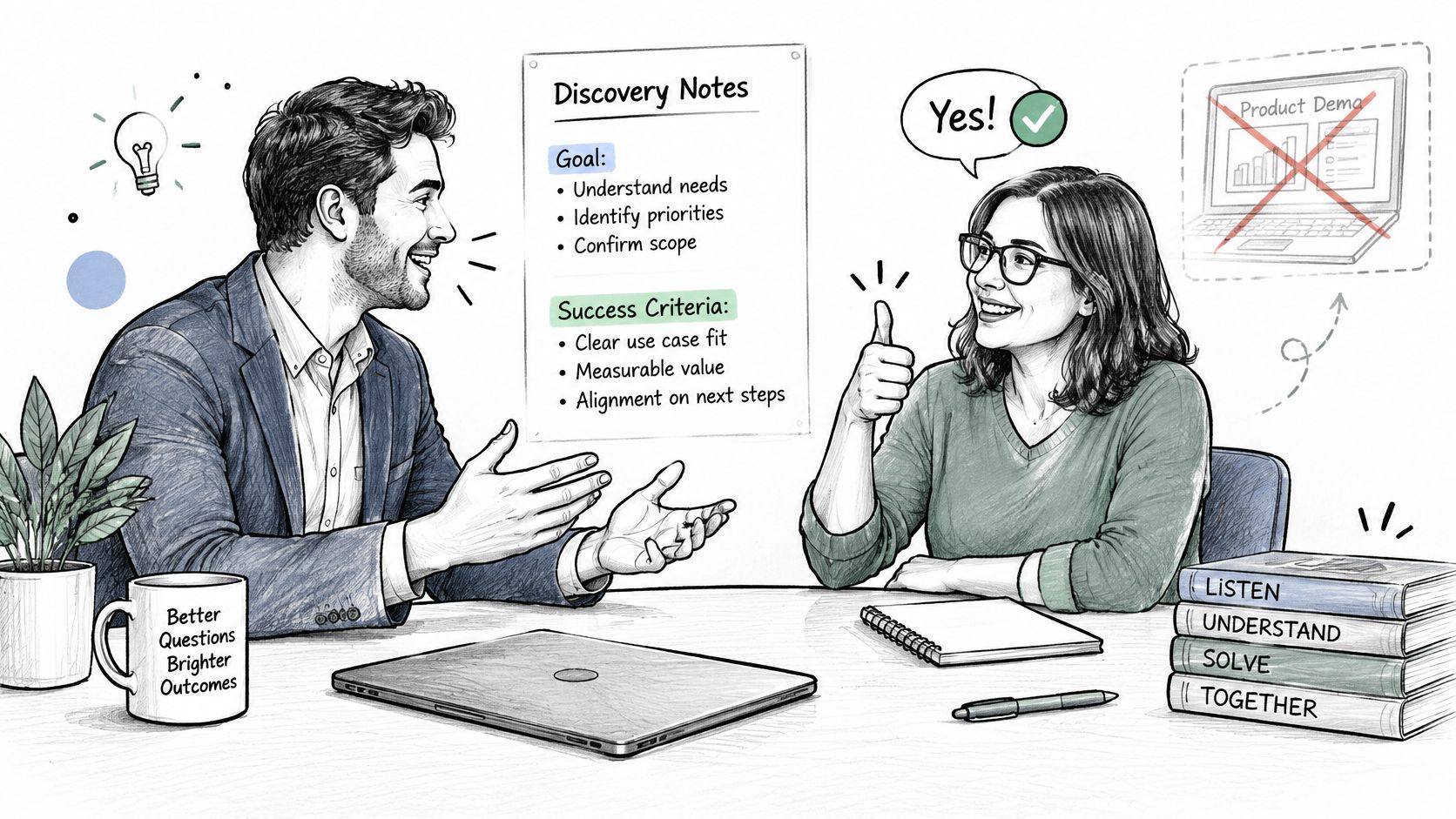
Confirm the problem before any screen opens. Restate the buyer's goal and success criteria in their words, then wait for a clear yes. A Tell built on assumptions produces a Show nobody asked for. Confirmed when the buyer agrees to the restated goal without editing it.
-
Tell the outcome and the path. Name the three steps they'll see and the time box you'll keep, then keep it. A visible sequence lowers uncertainty about what comes next, which is the entire mechanism behind the method. Confirmed when the buyer can predict what follows the current screen.
-
Show only the workflow tied to that problem. Three features at most, in the buyer's terms, on their sample scenario. Every extra feature pulls the demo toward a tour. Confirmed when the buyer names the step they'd own.
-
State the Do before you run it. Say exactly what you'll execute live, on which data, and what result you expect. The Do has to follow the Tell and Show without deviation, so the buyer can predict the outcome before it appears. Confirmed when they agree the stated path matches the preview.
-
Do the same path on the same data. Same dataset, same feature path, same success criterion. A changed dataset makes the Do look like a different product. Confirmed when the live run matches the previewed run.
-
Hand over the Do. Ask the buyer to click, enter a value or run the check themselves, then confirm the result matches what the Tell promised. Performance, not nodding, is the evidence the method worked. Confirmed when they complete the task or confirm the outcome unprompted.
-
Close with the check. Ask them to restate the outcome and name the next test. Restatement exposes a Tell that didn't land while you can still fix it. Confirmed when they state the outcome and the next test without help.
The pacing matters as much as the order, and this walkthrough shows how the sequence runs in real time.
| Step | Action | Reason | Confirmed when |
|---|---|---|---|
| 1 Confirm the problem | Restate the buyer's goal and success criteria from discovery and get a clear yes | No discovery, no demo: a Tell built on assumptions produces a Show nobody asked for | Buyer says yes to the restated goal in their own words |
| 2 Tell the outcome and path | Name the three steps the buyer will see and the time box | A visible sequence lowers uncertainty about what comes next | Buyer can predict what follows the current screen |
| 3 Show only the tied workflow | Three features at most, in the buyer's terms and their sample scenario | Extra features pull the demo toward a tour | Buyer names the step they would own |
| 4 State the Do before running it | Name exactly what you will execute live | The Do must follow the Tell and Show without deviation | Buyer agrees the stated path matches the preview |
| 5 Do the same path on the same data | Same dataset, same feature path, same success criterion | A changed dataset makes the Do look like a different product | The live run matches the previewed run |
| 6 Hand over the Do | Buyer clicks or enters a value and confirms the result | Performance, not nodding, is the evidence the method worked | Buyer completes the task or confirms the outcome unprompted |
| 7 Close with the check | Buyer restates the outcome and names the next test | Restatement exposes a Tell that did not land | Buyer states the outcome and next test without help |
Say you're running a hypothetical demo of a routing tool to an operations lead. On path: the Tell is that exceptions get resolved the same day, the Show is the exception queue on one sample batch, the Do is that same batch run through the rule they described in discovery. Off path: the Tell is "let me show you the platform," the Show wanders into analytics and permissions because they looked interesting, and by the time you reach the Do the buyer has forgotten what problem they came with.
If you want to see how buyers move between self-guided and live demos at different stages, this guide to plan demos for each buying stage is worth reading before you decide what stays live. And a written demo agenda template makes the Tell concrete enough to send ahead.
Why the Sequence Works for Complex Buyers
Complex buyers break a demo that only the presenter can interpret. Treat the sequence as a control structure for the evaluation: the Tell is written down before any screen opens, and the Do is a task the buyer performs against a pass condition. If those two pieces are loose, the Show has nothing to prove.
Predictability is the first control. A visible order tells the room what happens next, so attention stays on the problem instead of on managing you. Buyers who can see the shape of the next 20 minutes stop guessing where you are headed.
Modeling is the second. Watching the task once, on the path the written Tell already named, gives the buyer a version they can repeat for colleagues who were not on the call. That handoff matters more in B2B than in a clinical setting, because the people who decide often never saw the live run.
Practice with feedback is the third, and the one most demos skip. The buyer performs the Do and gets corrected while the reading is still wrong. A nod during the Show only shows they followed the explanation. It does not show they can do the task, or that they would defend the result to a skeptical colleague.
What to measure: observable behavior plus one other signal. Cooperation alone can hide residual doubt. A buyer who says "that looks great" and never touches the sandbox is still deciding.
The clinical evidence is narrower than a sales sequence needs. A randomized trial of 150 children aged 4 to 8 compared standard Tell-Show-Do with Tell-Play-Do, smartphone-supported Tell-Play-Do, Tell-Show-Play-Doh and Ask-Tell-Ask, and found that pulse-rate and Facial Image Scale measures generally showed reduced anxiety after treatment, though the Venham anxiety scale did not improve consistently in every group, according to the published trial. Anxiety scores from a dental chair are not a win rate, and a trial that mixed several modifications is a reason to use the sequence with judgment.
Use it as a dependable default, not a guaranteed fix. Judge success by whether the buyer can perform the Do against the pass condition without help. The method fails when the presenter is absent and cannot correct the buyer's reading: the champion retells the Show, drops the pass condition, and the committee scores a different product than the one you ran. For a buying group that evaluates over weeks, an account-based selling strategy guide keeps each later conversation tied to that same written Tell.
Adapting the Method for Buyer-Led Evaluations
Most explanations of the tell show do method treat it as a live presentation sequence: explain, demonstrate, ask the learner to repeat. That framing misses the shift already underway. A recent synthesis reports that 70% of buyers prefer a fully digital, self-service buying experience, and 82% of B2B SaaS marketing leaders use interactive demos before speaking with vendors, per Guideflow's interactive demo benchmarks.
That changes who performs each stage, not what the stages are.
I'd argue the polished live demo is often the weaker move. Handing the buyer a task they complete themselves, with your Tell framing it and your Show narrowing it, produces stronger evidence of fit than any amount of clicking on your side of the screen. The buyer's own hands are more persuasive than your narration.
The hard part is the Do, because your buyer isn't one person. Each stakeholder needs a different task and a different pass condition.
- The end user completes one real workflow end to end on their own data and confirms the output is usable without a workaround.
- The champion reproduces your Show internally, which means the Show has to be written down or recorded well enough to repeat.
- The security reviewer checks one control against evidence, such as a data residency statement or a single permission boundary, and records the result.
Two speeds make this workable. The Tell and the Show stay live when scope is complex, because that's where you correct misreadings. The Do goes self-service and repeats as often as the buyer needs. Attach acceptance criteria to the Do task and keep them with the written Tell, so the buyer can forward both without you.
The failure mode here is unguided exploration that turns into a feature tour with nobody steering. Acceptance criteria are the guardrail: a buyer poking around a sandbox is exploring, a buyer completing a defined task against a pass condition is evaluating. If you can't write down what the buyer should perform and how success gets judged, you don't have a Do stage yet, you have a trial login. Structuring that properly is the same discipline as POC project management, where an evaluation without a written exit condition runs forever.
Using the Method in Customer Training and Enablement
The same three stages work on your own team, with one change: the learner is an SE, not a prospect.
Tell means the trainer states the target behavior against a written standard. Not "ask better discovery questions," but a specific form: a discovery question that ends with a quantified business impact. Show means a trainer or senior SE models the behavior on a recorded or live scenario and pauses to name each decision as it happens, including the ones that didn't work. Do means the learner performs the same behavior on a real deal or a roleplay and gets feedback before the next attempt.
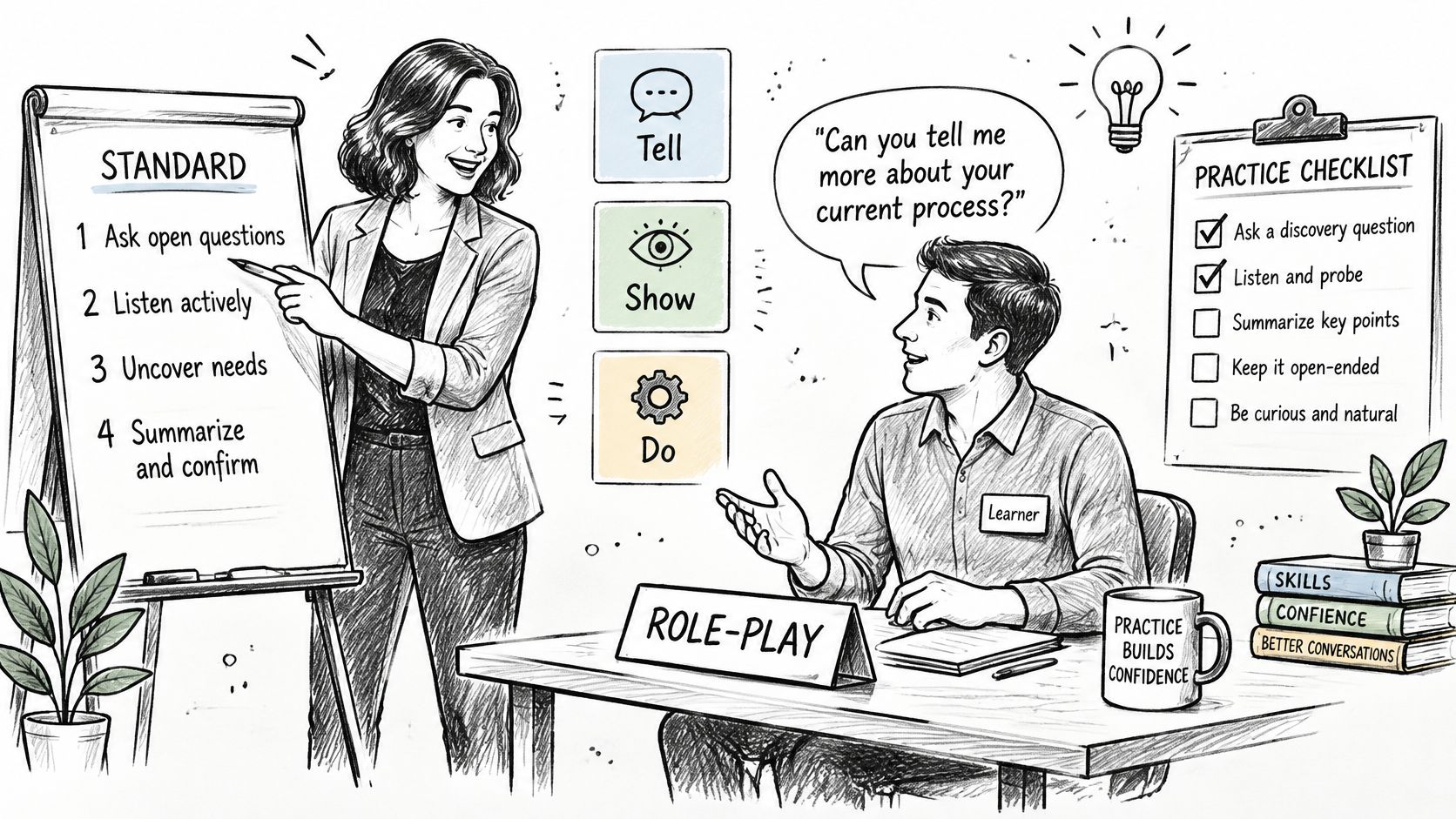
A hypothetical team example. Five SEs are learning to write a POC scope check. The trainer states the standard: a scope that names the success metric, the data required and the week it gets reviewed. Then they show a scoped plan from a closed deal, pausing to explain why two requirements were cut. Each SE then drafts a scope for a deal they're currently working, gets comments, and reruns it within the same week.
That last detail matters more than the first two. Feedback separated from a rerun is a comment, not training.
Training that stops at Show produces knowledge without performance. The learner can describe a good demo and still run a bad one on Thursday. Practicing on a live opportunity fixes this because the learner applies the method to something they're already accountable for, which is how our live sessions run: participants bring the deal they're working on, get feedback, and leave with a work product they can apply directly. Members apply frameworks to their current deals rather than theoretical exercises.
Recording the Show is usually the cheapest improvement available. A short screen capture of a senior SE narrating a focused demo becomes reusable material for every new hire, and if you'd rather not produce it in-house, corporate video production services cover the filming side. For a broader look at building the habit across a team, this guide to sales engineering training covers the sequencing.
What you measure is simple: does the learner perform the Do unprompted in their next live demo, without a checklist in front of them? If the answer is no, the Tell was too abstract or the Show skipped the decisions.
Where the Method Breaks Down and How to Fix It
The method assumes the presenter controls the Tell and can correct misunderstandings during the Show. That assumption is mostly false now. A synthesis of 2026 go-to-market strategy cites research finding that 45% of B2B buyers use AI to find software before consuming vendor content, and that buyers often delay vendor contact until roughly 61% of their evaluation is complete, according to Walnut's analysis of AI-powered buying experiences.
By the time you speak to a buyer, they've read an AI summary, a peer thread and two competitor pages. You are no longer first in the sequence. You're correcting for someone else's version of your Tell.
The fix in one line: make every stage survive your absence. If the buyer can't reconstruct your framing without you in the room, the sequence isn't portable yet.
Three changes do most of the work. Turn the Tell into a concise, evidence-backed problem statement the buyer can forward. Keep the Show narrow, with assumptions, limitations and proof points visible rather than implied. Turn the Do into a repeatable buyer test that produces an artifact others can inspect, such as a completed reconciliation, a configured workflow or a screenshot of a passing check.
There's a contrarian risk worth naming. Interactive and AI-assisted demos widen access while spreading a wrong interpretation faster when acceptance criteria are missing. A buyer who half-understands your Show will explain it confidently to a skeptical colleague. Version control compounds the problem: if a champion repeats a demo, which build are they repeating, on which data, with which limits stated?
| Symptom | Likely cause | Fix |
|---|---|---|
| Buyer asks about features before the Tell is finished | Show started before the problem was agreed | Restate the problem and get agreement before any screen opens |
| Demo drifts into a feature tour | The Do task was never defined | Write the Do as a buyer task with a pass condition and a time box |
| Buyer agrees to the demo but stalls afterwards | Show and Do used different data or paths | Use identical data and workflow in Show and Do |
| Champion cannot repeat the demo internally | The Show was never written down | Send a short written or recorded path with the three steps |
| Stakeholder misreads an AI-generated summary | The Tell lacked acceptance criteria | Put the success criteria in the written Tell and send it first |
Here's the test that catches most of this before the deal stalls: hand your written Tell to someone who wasn't on the call and ask them to explain the problem and the next step. If they can't, you have work to do.
Run Your First Tell Show Do Demo This Week
Pick one open opportunity where discovery is complete and write two artifacts before the next call.
The Tell is three sentences: the buyer's problem in their words, the outcome they'll see, and the path you'll take. The Do is one task with a pass condition you write down in advance, for example the buyer reconciles one sample account file and the totals match the statement. Keep both on a single page, and send the Tell first so an absent stakeholder can reconstruct your framing.
Choose three features for the Show, each tied to that problem, and nothing else. Then run the sequence and log two things afterwards: whether the buyer restated the outcome unaided, and whether they performed the Do without prompting. Across ten opportunities that log tells you more about whether the sequence works on your deals than any general claim about demos, because it separates agreement from performance.
If you want structured practice, the Trusted Advisor Academy's Demo module teaches focused 15-minute demos with 3 features that address the customer's exact problem instead of 40-minute product tours, and the Deal Sparring Sessions let members bring their actual opportunities for feedback. If your Tell is the weak stage rather than the Show, start with the discovery call guide instead.
The principle governing the whole method doesn't change with any of this. No discovery, no demo. Everything above is downstream of that.
PreSales Unleashed GmbH runs the Trusted Advisor Academy, a 12-month program that builds Solution Engineers through on-demand lessons, weekly live practice and immediate application to live deals, which is exactly what the tell show do method needs to become a habit rather than a one-off experiment. If you want the sequence drilled on your own opportunities, with feedback on the demo you gave, visit PreSales Unleashed GmbH and see how the program works.