
The most common advice about sales engineering training is to polish the demo. That's the wrong starting point. A smooth walkthrough of the wrong problem still loses the technical win, so train your team to make better deal decisions before you train them to click faster.
The Curriculum Experienced SEs Actually Need
Audit this curriculum against the work your team does this quarter. These six clusters aren't a beginner syllabus or a list of product features. Each should change a decision on a live opportunity, and each should leave evidence a manager can inspect.
| Cluster | What you practice | Deal moment it changes | Observable afterward |
|---|---|---|---|
| Discovery | Current state, success criteria, stakeholder pain | Before any demo is booked | A written problem the buyer agrees is real |
| Demo design | One agreed problem, not a module tour | The first tailored session | Demo scope matches discovery notes |
| Sales alignment | Shared MEDDPICC language with the AE | Pipeline reviews and stage changes | AE and SE use the same qualification notes |
| POC and pilot | Scope, success test, time box, exit | Evaluation kickoff | A mutual plan with milestones and an end date |
| Value articulation | Buyer language for business impact | Executive and economic-buyer meetings | Value stated in the customer's words |
| Qualification | When to decline or narrow | Late RFPs and unbounded asks | Unfit work exited before heavy SE time |
Start with the deal, not the deck
Discovery changes whether a demo should happen at all. The SE asks what the buyer does now, what outcome would make a change worthwhile, and who feels the problem. The behavior to inspect is simple: before anyone books a demo, there's a written problem the buyer agrees is real. Use a practical discovery call guide to build questions around the account, not a canned script.
Demo design turns that agreed problem into a focused session. Pick one path through the product that tests the buyer's stated need. If the agenda is a harbor cruise through every module, the SE hasn't designed a demo; they've avoided choosing what matters.
Sales alignment means the AE and SE work from the same qualification notes, not parallel versions of the deal. Practice reviewing MEDDPICC together, especially when a stage changes or the buyer introduces a new stakeholder. The MEDDPICC guide for Solution Engineers gives the team shared language for those conversations.
Make evaluation and qualification teachable
POC and pilot management changes how an evaluation starts. Before an environment opens, write down the test, who owns it, the time box, and what happens when it ends. A pilot without an exit is a request for unpaid, open-ended work.
Value articulation changes executive conversations. The SE should be able to explain impact in the buyer's words, not translate every capability into generic claims about productivity or innovation.
Qualification changes where the team spends its time. Practice narrowing a late RFP, declining a generic demo, or exiting an evaluation that has no defined outcome. Those are deal skills, not failures of helpfulness.
A common curriculum should also reflect the work, not the title. Compare what a Sales Engineer does with the distinctions between a Solution Engineer, Sales Engineer, and Solutions Consultant. Different titles shouldn't leave you with fragmented standards. The Trusted Advisor Academy is designed for Solution Engineers, PreSales Consultants, Sales Engineers, Solutions Architects, Technical Account Managers, and similar B2B SaaS roles.
Mark which clusters your team practices every week and which exist only as slides. That gap is your curriculum audit. Training should also protect the team's capacity: Acheloa Wellness, Inc. on avoiding burnout while leading sales offers a useful perspective on managing the demands placed on sales leaders.
On-Demand Lessons Plus Live Practice
| Model | Best for | Where it fades | Pair it with |
|---|---|---|---|
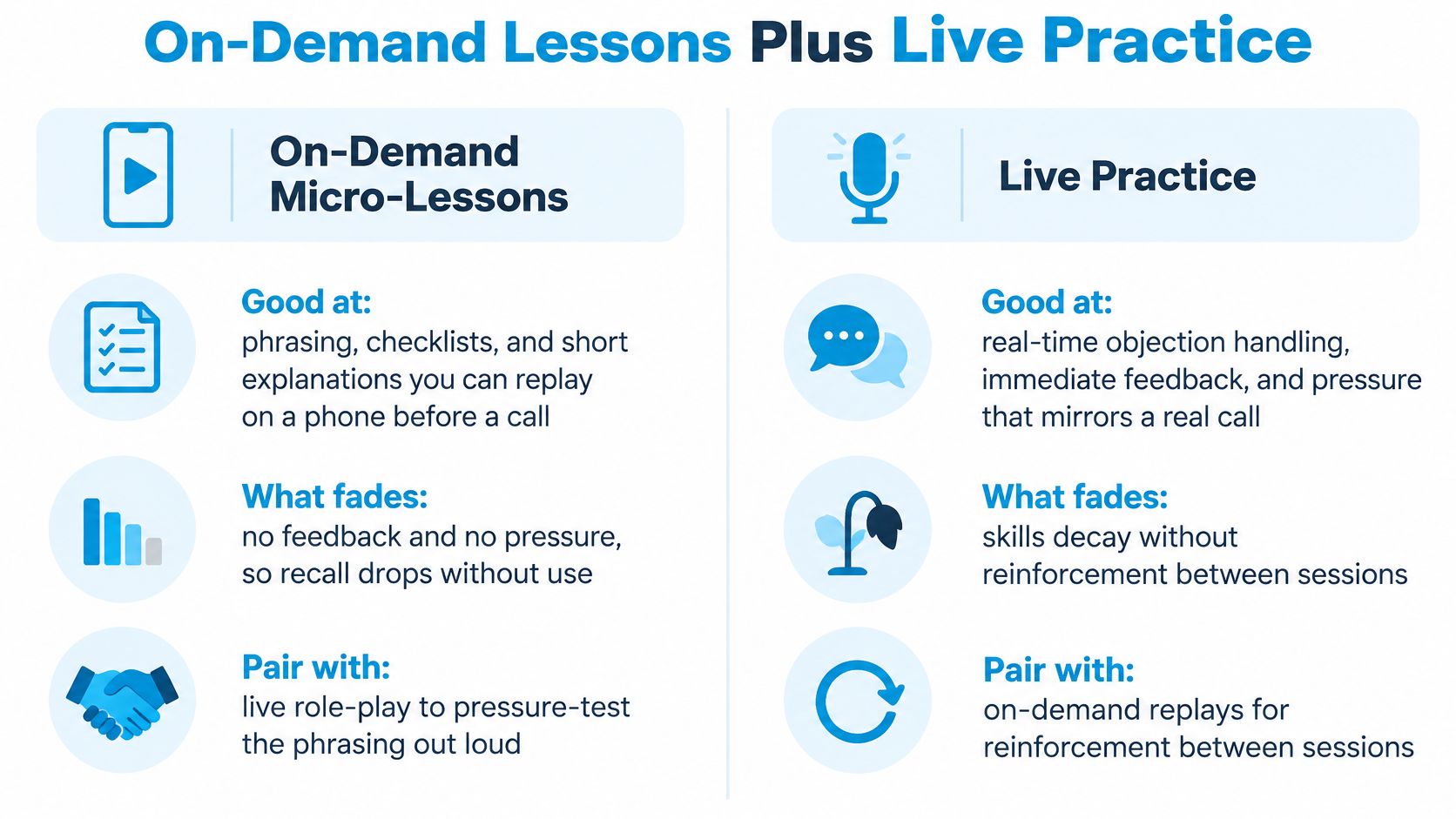
| On-demand micro-lessons | Definitions, phrasing, checklists before a call | Unused ideas that never hit a deal | A live rep the same week |
| Live roleplay | Saying the hard question out loud | Reps with no expert feedback | A scored debrief on one behavior |
| Deal sparring | An active opportunity | Generic scenarios that are not your deal | Discovery notes from that account |
| Multi-day workshop | A shared language in one burst | Skill that is gone within days | Weekly practice after the event |
| Manager coaching | One standard across the team | Coaching that is only slide review | The same observable behaviors as the curriculum |
| Peer community | Scenarios outside your pipeline | Advice with no deal context | A written scenario, not a vague ask |
Use lessons to prepare, not to claim proficiency
On-demand micro-lessons are useful when an SE needs a phrase, checklist, or short explanation before a call. They're easy to replay on a phone between customer meetings. But watching someone model a discovery question doesn't prove the SE can ask it when a buyer pushes back.
Live practice supplies the rep: roleplay with feedback, deal sparring on an active opportunity, pitch practice, or office hours for a question that's blocking the next step. The rep should end with one behavior to try on the deal, not a general feeling that the session went well.
A multi-day workshop can give a team a shared vocabulary. Its weakness is what happens after everyone returns to the calendar: if the language doesn't appear in Monday's deal work, the event fades. Deliberate practice and spaced repetition describe why focused practice repeated over time is more useful than a single burst of exposure.
Fit the practice around customer time
Manager coaching keeps one standard in use; it shouldn't become a second curriculum. Have managers review the same observable behavior the lesson taught, such as whether the SE confirmed the buyer's success criteria before planning the demo.
Peer exchange helps with situations your own pipeline hasn't produced yet. Make the ask specific: bring a written scenario and the decision you're trying to make. Vague requests invite generic advice.
The practical blend is straightforward: use an on-demand lesson to introduce an idea, schedule a live rep on an active opportunity that week, and ask the manager to review the same behavior. Customer time is the constraint. Short live blocks are easier to sustain than fixed offsites that pull the team away from deals.
SE Rockstars trains Solution Engineers and the people who lead them every week rather than relying on a two-day workshop. That's one example of putting recurring practice into the operating rhythm, not a substitute for choosing the right behavior to practice.
Why Discovery Comes Before the Demo
Demo polish doesn't decide the deal. Discovery does, because the demo should test a problem the buyer recognizes, not reward the SE for knowing the product.
Think of a pilot flying aerobatics before checking the route. The flight might look smooth, but it can still end at the wrong airfield. Sales engineering training that starts with slide craft and click paths risks the same outcome: an impressive session built around an untested assumption.

Discovery quality, not demo polish, decides deals.
Define the outcome PreSales owns
The technical win is the buyer accepting that the proposed approach solves their problem. It's distinct from the commercial close, which the AE owns. The guide to what PreSales is clarifies the function; the north-star view of technical win rate explains why the technical outcome deserves its own place in the team's operating language.
Discovery is how the SE earns the right to design a relevant demo. Ask about the current process, the cost or friction it creates, what a successful change must accomplish, and who will judge the result. The technical discovery questions guide can help you prepare questions that expose assumptions before they turn into demo scope.
Stop inheriting an untested story
The familiar failure starts late. An SE gets pulled in to “just demo it,” inherits an AE's partial account of the problem, and builds a generic session because there isn't enough context to tailor it. If the session gets interest, the SE may then inherit a POC with no agreed test or exit.
Training should make that pattern visible and give the SE language to pause it. Ask the AE to confirm the problem and the intended audience before building the session. If discovery is missing, schedule it first. If the buyer won't define an outcome, narrow the request or decline the evaluation.
A Hypothetical Deal Run Through the Curriculum
Hypothetical account: A mid-market B2B SaaS opportunity has a 45-minute Friday demo on the calendar. The SE has a one-page brief, and the economic buyer may not attend.
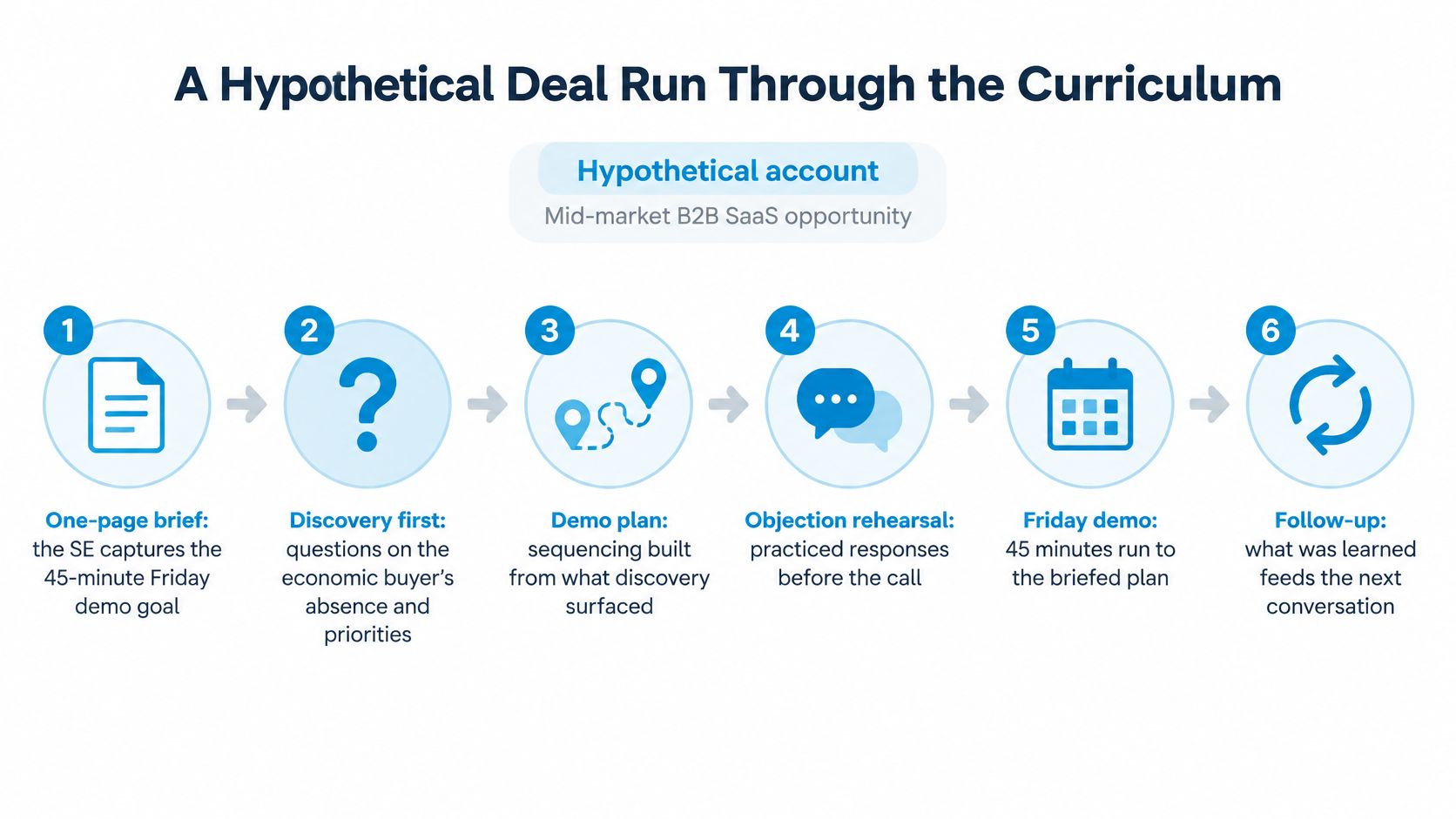
The trained sequence doesn't start by polishing slides. It starts by checking whether the team knows enough to show the right thing.
-
Pause the full demo. Ask for a short discovery conversation before committing the entire session to a product tour. If the buyer can't make room, clarify what the Friday meeting is supposed to decide.
-
Capture the decision context. Write down the current state, the outcome that would make the buyer switch, and who signs off. If the economic buyer won't attend, ask who will represent their concerns and how the team will bring the decision-maker into the evaluation.
-
Narrow or exit. Choose one problem that the demo can test. If the request is an unbounded evaluation with no success condition, explain what needs to be defined before the SE commits further time. A discovery call guide can help structure that conversation without turning it into an interrogation.
-
Set the evaluation terms before opening a pilot. If the opportunity is qualified, write a mutual plan with a success test, an owner, milestones, and an end date. Both sides should understand what result allows the buyer to move forward and what happens if the test misses.
-
Demo the path that matches the notes. Build the session around the agreed problem. When a feature doesn't connect to that problem, leave it out, even if it's a popular part of the product.
The untrained path is a full-module tour, then a POC with no owner, then weeks of SE time spent on an opportunity the team never qualified. The difference isn't stagecraft. It's whether the SE makes the missing decision visible before work expands.
At the next pipeline review, bring discovery notes, a yes-or-no view on fit, and a scoped next step. That gives the AE something concrete to act on and gives the manager a basis for coaching the decision, not just the performance.
Outcomes You Can See on Deals
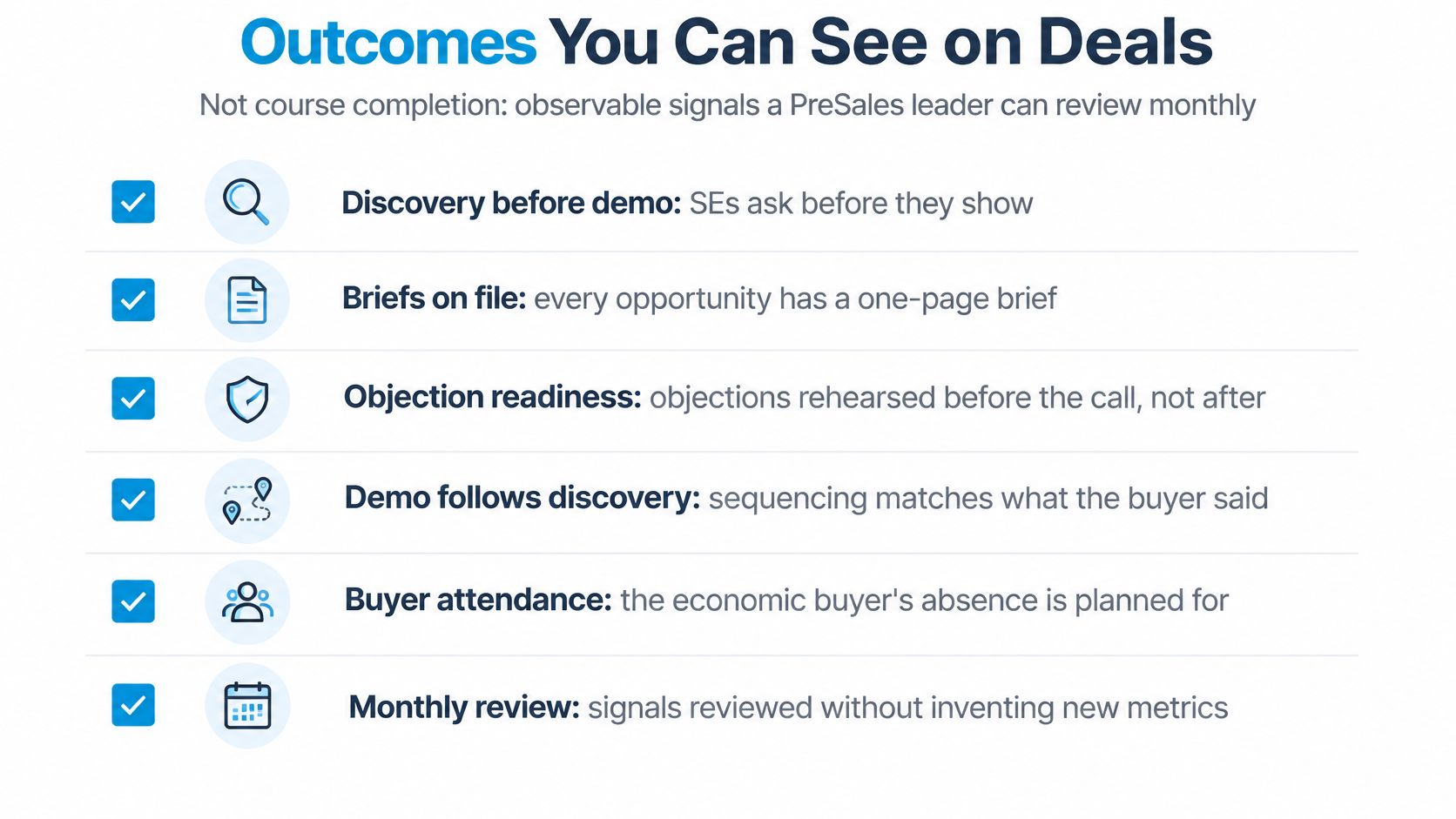
Don't score the program by course completion. A completed lesson says someone consumed material; it doesn't show whether the SE changed a deal decision. The useful evidence sits in the opportunity record and in the conversation itself.
Review behaviors, not a hero demo
Use this checklist in a monthly pipeline review. Look for recurring patterns across the team, not one unusually polished performance.
- Discovery before demo: The notes show the buyer's current state and agreed problem before the SE builds the session.
- Early SE involvement: The SE joins before a proposal is set, with enough context to challenge scope.
- POC discipline: The evaluation has a written success test and a stop date.
- Qualification decisions: The team narrows or declines unfit RFPs and open-ended evaluations before they consume substantial SE time.
- Shared qualification: AE and SE notes tell the same story about the opportunity.
- Buyer-language value: Executive conversations describe impact in the customer's terms.
Sample a handful of calls and score the same behaviors each time. A shared rubric helps you tell the difference between a repeatable team habit and one strong demo from an individual. For ideas about choosing measures, see this guide to Sales Engineer KPIs.
Keep the technical outcome distinct
The roll-up of these behaviors is the technical win: the buyer accepts that the approach solves the problem. Track that separately from closed revenue, which includes commercial decisions beyond the SE's control. Your own pipeline review is the instrument for examining whether training changed how opportunities move.
No universal percentage belongs here. Without a named source, a target would be made up, and a team can easily hit a tidy number while still running demos before discovery. Review the quality of the evidence and whether SEs make better choices under real deal pressure.
Training Bets That Waste a Quarter
A credential badge can confirm that someone completed a course or holds a credential. It doesn't prove they can run discovery on your product, challenge an AE's scope, or manage a buyer's evaluation. A serious practice program develops skill in the PreSales role; it isn't a state-recognized vocational qualification.
Product-only certification teaches the interface but leaves the SE sounding like technical support beside the AE. Product knowledge matters, but it won't supply the judgment to identify which buyer problem deserves a demo.
Demo-first training can make tours smoother while preserving the underlying mistake. If the team never checks whether the buyer has agreed on a problem, polished navigation is polish applied to an assumption.
A one-off event creates a burst of shared language and then leaves the team to maintain it without a practice rhythm. The issue isn't that workshops have no use; it's that an event alone doesn't make a behavior stick on live deals.
Consumption metrics reward attendance, video hours, and quiz scores. Those measures tell you who showed up and what they remembered in a learning setting. They don't tell you what changed in a customer conversation.
AI prompts without deal context return generic advice. “Talk to the economic buyer” might help when the buyer is setting the decision criteria, but it may be wrong for an end-user session focused on workflow. Give the tool the account context: who you sell to, what the last call established, and which problem the buyer agreed to solve. A longer prompt won't fix missing context.
Drop any program whose only proof is a certificate or completion report. The programme isn't aimed at a recognized formal vocational qualification; its goal is to improve the customer's skills in their PreSales role.
Choose Weekly Practice Over Another Workshop
If your team has capable individual SEs but no shared standard, start with the curriculum table and a weekly live rep on real deals, coached by managers. If managers can't build the assets, feedback loop, and peer environment themselves, choose a continuous program instead of booking another workshop.
Use the guide to choosing PreSales training to assess fit. Enablement-as-a-Service describes a team subscription that develops PreSales capability over time, while the PreSales community can expose the team to scenarios beyond its own pipeline. A spaced-repetition schedule can help managers plan reinforcement between live sessions.
The training offered by PreSales Unleashed GmbH is called the Trusted Advisor Academy. It gives a solution engineering team weekly training, coaching, and a community of 350+ Solution Engineers, and the Academy has trained 350+ Solution Engineers. The Trusted Leader path is for managers who need coaching systems.
Your next step is either to read the curriculum against your team's gaps or book a conversation through the discovery-call page.
PreSales Unleashed GmbH offers the Trusted Advisor Academy for teams that want sales engineering training tied to active deals, with weekly practice and coaching. Visit PreSales Unleashed GmbH to review the Academy and decide whether its approach fits your team.