
Your AE forwards the PDF at 4:40 on a Friday with one line attached: "Looks like a fit, can you take it?" Sixty pages. Forty numbered requirements. A mandatory security questionnaire. Eleven days to submission. Two live deals already need demo builds next week.
That forward is a qualification call, not a writing assignment. Surveyed proposal teams commonly report using a formal go/no-go process to decide which requests deserve an answer at all. Make that call before anyone drafts a sentence. The gate is whether this bid is worth scarce SE hours, and whether you can attach evidence to every claim the buyer will score, in the format the score sheet expects.
Capacity rule: An RFP does not create hours. It competes for the same demo, architecture and proof-of-concept hours your live deals already need. It usually competes badly, because someone else fixed the deadline.
If the evidence is thin, or those live deals cannot spare the builds, decline on the record this week. A thin bid still consumes the week, and it rarely wins the score.
What an RFP Is and Where It Fits in the Buying Cycle
The version I'd say out loud on a call: the buyer writes down what it needs, publishes it to a group of suppliers, takes written answers, scores those answers on a sheet it published in advance, and signs with the top scorer. An OECD procurement lifecycle study frames it as a comparable, auditable basis for competing offers rather than a set of informal sales conversations or unsolicited quotations, and that framing is the whole point.
What separates a solicitation from a chat with a friendly buyer is the audit trail. Every bidder answers the same questions against the same criteria on the same timeline, so the buyer can defend the choice to a CFO, a board or an auditor. An unsolicited quote has none of that, which is why procurement rebuilds a deal as a formal tender even when the business unit already likes your product.
The parts of the document that do the damage
Open the RFP and read these in this order, because they decide the outcome long before your prose does:
- Statement of work: the buyer's own description of scope. If it names a competitor's module names, you've learned something.
- Functional and technical requirements: the numbered list your compliance matrix will mirror line by line.
- Commercial terms: pricing model, payment terms, currency, and what happens at renewal.
- Submission instructions and deadlines: page limits, file formats, portals and exact times with time zones.
- Evaluation methodology: criteria, weights, and whether mandatory items are pass/fail.
- Contractual conditions: liability, data rights, termination, and the exceptions you'll be asked to sign.
- Rules for supplier questions and amendments: the channels you're allowed to use, and the date after which the document stops changing.
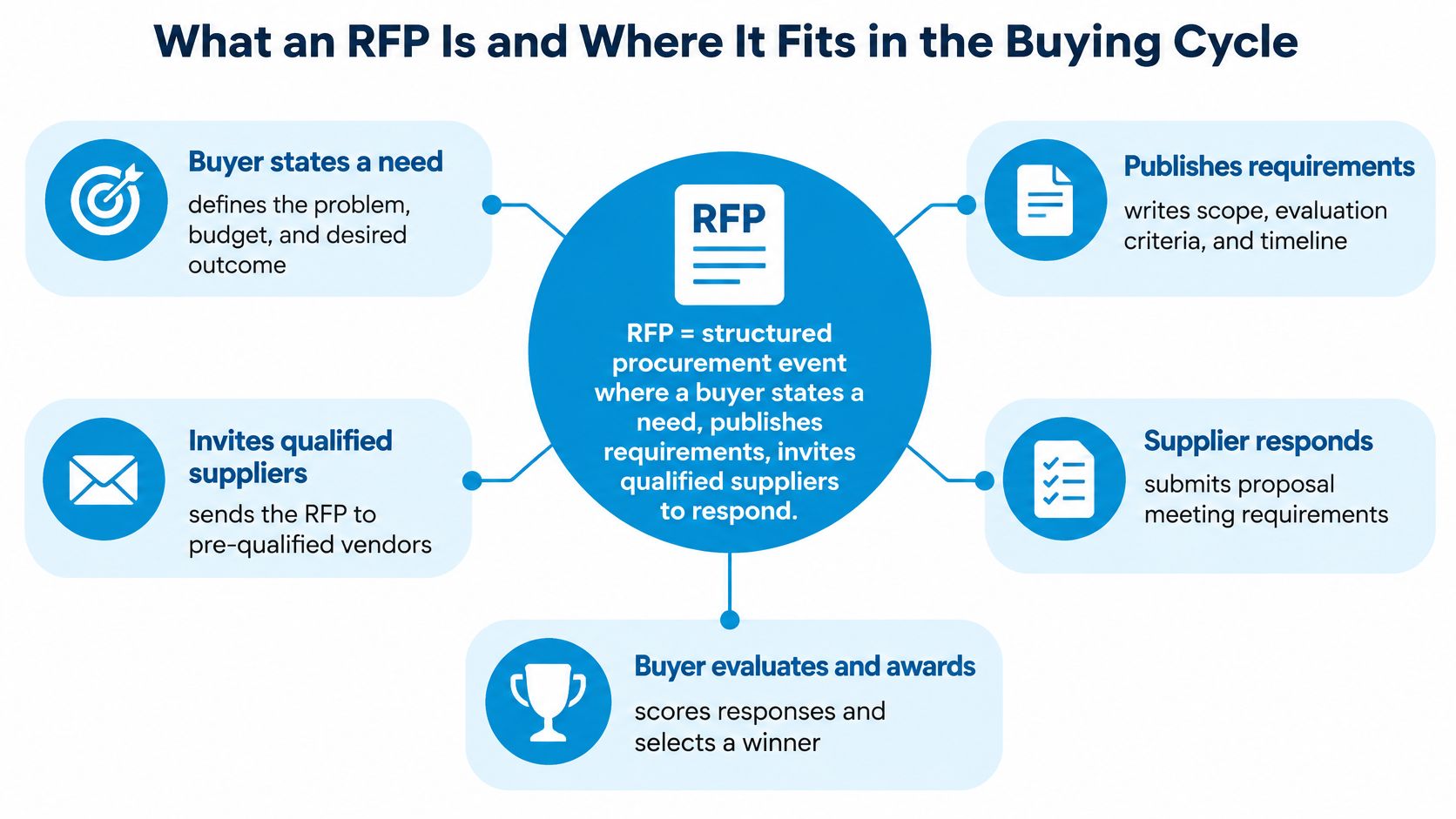
Widen the lens and the tender becomes one stage of a longer lifecycle. The OECD notes that procurement risks can occur throughout the life of the contract or procured asset, not only during tendering, so a competent buyer is also running needs analysis, market research, supplier due diligence, implementation, performance management, acceptance and renewal. If your response treats go-live as the finish line, you're answering a narrower question than the one being scored.
Take a hypothetical: a mid-size insurer publishes an RFP for claims software after two informal demos with three vendors. The SE reads the document and finds the scoring weights already written, and the technical section weighted above price. That weighting didn't appear by accident. Someone in that business spent six weeks deciding what "best" means before the solicitation went out, and the vendor that treats those weights as the brief will beat the vendor that treats them as decoration.
Learn four words and use them precisely. Solicitation is the published document. Bidder is you. Evaluation is the scoring event. Award is the decision. The outcome PreSales owns inside all of it is the technical win, and if the role is new to you, start with what PreSales actually covers.
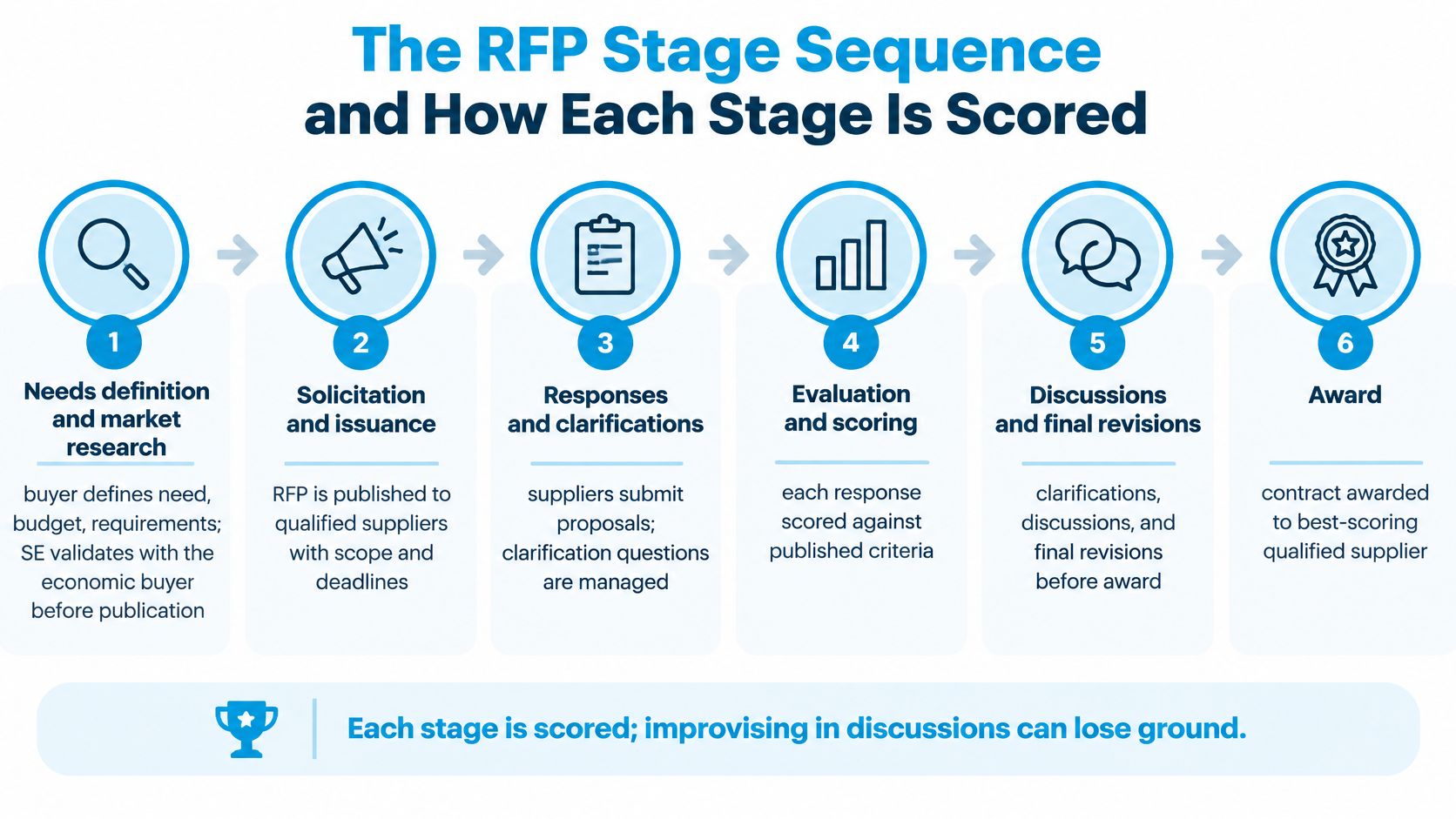
The RFP Stage Sequence and How Each Stage Is Scored
The column that matters in this sequence is the third one. Most of those items are yours whether or not anyone assigns them to you.
| Stage | What the buyer does | What the SE owns |
|---|---|---|
| Needs definition and market research | Defines the business need, budget and requirements | Validate requirements with the economic buyer before publication |
| Solicitation issued | Publishes scope, criteria, weights and deadlines | Set a bid or no-bid review date |
| Questions and addenda | Answers bidder questions and issues amendments | Log every question and check each amendment against the response |
| Submission deadline | Receives written proposals | Submit a complete package that has been checked against the requirements |
| Responsiveness check | Confirms mandatory items and eligibility | Flag any pass/fail gap before scoring begins |
| Technical evaluation | Scores proposals against weighted criteria | Supply evidence for scored items and answer follow-up questions within scope |
| Discussions or competitive range | Where the process permits, clarifies with top-ranked bidders | Run a controlled clarification plan with named owners |
| Award and contract | Selects the supplier and negotiates terms | Support technical terms and keep scope commitments consistent with the proposal |
Two mechanics change how you should work this sequence, and neither shows up in most vendor playbooks.
The first response is often a gate, not a price fight
Under World Bank procurement rules, an RFP is normally a multistage competitive process. The buyer can evaluate applicants against published rated criteria, rank them, and invite only the highest-ranked to submit proposals. In a two-stage RFP, Stage 1 may request technical proposals only, with financial proposals evaluated later under criteria specified in the document.
The practical consequence: the first elimination happens before anyone sees your number. A bid team that treats every RFP as one document plus a price sheet will lose deals it never knew it was out of. Before writing anything, check whether the document runs stages, what each stage requests, and what gets scored at each cut. That read decides where your best evidence goes and how much capacity the first response deserves.
Scoring is fixed before you write, so build the matrix first
The buyer must define the evaluation method before proposals arrive and apply it consistently. SIGMA/OECD guidance on tender evaluation and contract award states that tenders must be evaluated using the same terms, conditions and requirements in the tender documents and the same pre-announced award criteria, which may include price, life-cycle costing, and qualitative, environmental or social factors linked to the contract. Nothing you say in a demo reopens that model.
This is why the compliance matrix is the core artifact of an RFP response. It is not paperwork after the fact. It is the decision record that allocates your scarce hours: which claims get evidence, which gaps get declared, which sections get the demo time. Build it in six passes:
- Extract every requirement using the buyer's own ID numbers, so a reviewer can trace your answer to their line.
- Tag mandatory versus scored, and record the weight next to every scored row.
- Map each row to evidence: documentation, a reference, an architecture diagram, or a named demo scene.
- Assign an honest status: meets, meets with configuration, partial, roadmap, or not met.
- Name an owner and a reviewer per row, so nothing sits unowned on submission day.
- Re-check against the weights, then move demo time to the heaviest scored rows.
Take a typical failure pair. The first slip: a roadmap item gets marked as "meets" because the product team expects it next quarter. The moment an evaluator asks for the screenshot, a scored gap becomes a credibility gap, and credibility gaps contaminate every row near them. The second slip: eighteen of twenty demo minutes go to a low-weight workflow while the weighted security section gets two sentences and a link to the trust page. The scoring sheet does not care how good the demo felt. It allocates points where the weights sit.
Both failures trace to the same root cause, a matrix built for completeness instead of for score. Completeness means every row has an answer. Score means every high-weight row has proof attached and every pass/fail gap was caught before submission. You need the first to stay responsive. You win or lose on the second.
Before drafting anything, find the three matrix rows that would lose points if an evaluator checked your evidence today. Fix those first. For a working view of how testable criteria look from the buyer's side, this guide to writing RFP requirements with examples shows the structure your matrix is grading against.
Stakeholders Who Decide and What Each One Scores
Every stakeholder reads a different part of your response, and each one can stop the deal for a different reason. Map them before you write.
| Stakeholder | What they decide or score | What to bring them |
|---|---|---|
| Procurement lead | Owns process, compliance and the scoring sheet | Answers mapped one-to-one to requirement IDs, plus a clean exceptions list |
| Economic buyer or executive sponsor | Decides whether the money moves | A business case tied to their metrics, not a feature tour |
| End-user champion | Decides whether the product gets used | Named demo scenes drawn from their daily work |
| IT and security | Reviews architecture, data handling, certifications and integrations, and can veto | A completed security questionnaire and architecture diagram at the start, not the end |
| Legal | Tests liability, data rights and termination | A written position on every exception you take |
| Finance | Tests total cost and the pricing model | Every assumption behind a number, written down |
The procurement lead is the one most SEs underestimate. Their job is to protect the process, which means they check pass/fail items and the scoring sheet before anyone reads your narrative. An answer that doesn't map to a requirement ID reads to them as a partial response, and partial responses lose points.
The veto you'll miss in the first draft
Security and IT review more than a checkbox. They read architecture, data residency, identity model, integration pattern, audit logging and incident history, and they usually sit late enough in the sequence that a failed review arrives after the technical score is already banked.
Treat the security questionnaire as a scoring section, not an attachment. Answer it with the same care as the highest-weighted functional requirement, and get the architecture diagram in front of their reviewer before the submission deadline rather than after.
The economic buyer needs the case in their language. Your champion needs a scene they can picture on a Tuesday morning. Legal needs a position, not a mood. And the SE's role across all six is one job: turn each stakeholder's requirement into evidence the other five can check.
One process caution. Many public-sector solicitations restrict which contacts a bidder may approach during evaluation, and some require all questions through a single channel. Confirm the contact rules in the issued document before you email anyone, including the champion who gave you their mobile number.
Before you write a single answer, build a one-page stakeholder map for the RFP in front of you: who scores, who can veto, who will champion, and what each one needs to see. If a name is missing from that page, the page is telling you what's wrong with the bid.
Deciding Whether an RFP Is Worth Your Capacity
This is the decision many teams skip, then complain about later. Run seven gates, in order, and let any single failure stop the bid.
| Gate | Question to answer | Pass signal | Walk-away signal |
|---|---|---|---|
| Problem fit | Does the RFP describe a problem we solve better than the alternatives? | Requirements match the current product and roadmap | Requirements need a custom build |
| Access | Can we reach the decision-maker? | The economic buyer agrees to a discovery call | Only the purchasing contact will engage |
| Incumbent | Is an incumbent entrenched? | The incumbent is weak or the contract is ending | The incumbent's scope is written into the requirements |
| Mandatory requirements | Can we meet every pass/fail item? | All mandatory items are met or achievable | One mandatory item cannot be met |
| Evaluation transparency | Are the criteria and weights published? | Weights are published and stable | Weights are vague or change without notice |
| Path to award | Is there a credible route to a decision? | Dates and decision authority are clear | Dates or decision authority are unknown |
| Opportunity cost | What does this bid cost in demo, architecture and POC capacity? | Capacity is available without dropping active deals | The team is already committed to live deals |
A formal process isn't bureaucracy here. Teams that gate their bids protect scarce presales hours for pursuits they can win, and an ungated bid is a subsidy you're paying to someone else's pipeline. Every hour spent answering an unwinnable questionnaire is an hour not spent on a demo build, an architecture session or a proof of concept for a deal already in motion.
The clock argues for the same discipline. Formal procurements stretch across months of intermittent attention: clarifications, revised answers, security questionnaires, final revisions. That attention is a real cost, and it's paid whether or not you win.
Walking one RFP through the gates
Hypothetically, a 400-seat logistics company issues an RFP for a routing platform three weeks after a competitor finished a paid pilot there. You run the table.
Access fails first: procurement will answer process questions, but the operations director won't take a call before submission. Incumbent fails next: the requirements name the pilot's data model, two workflow steps and an integration that only exist in that product. Then mandatory requirements fail, because one line demands on-premise hosting you don't offer.
Three failures and one pass on problem fit. The answer is a no-bid, or a short written response that states the hosting gap plainly and asks to be considered for the next cycle. Neither option costs you a demo build.
Notice what the pass signal on problem fit did here. It was the only gate that cleared, and it didn't matter, because the table runs on any single failure. Problem fit is the gate teams most want to trust, since a good solution match feels like a reason to compete. In practice it's the weakest predictor of the outcome. Access to the decision-maker, a clean field with no entrenched incumbent, and a published, stable scoring scheme tell you far more about whether the evaluation can go your way.
Opportunity cost deserves the same honesty. Before you commit, count what the bid consumes: the discovery calls, the demo environment, the solution architecture time, the POC effort if you reach the shortlist. Then look at the live deals already on the team's calendar. A pursuit that forces you to thin out support for an active evaluation is rarely the right trade.
A structured discovery call tests these gates faster than reading the document alone, because buyers describe constraints they didn't write down. In the free discovery call we run, the team pressure-tests the funnel assumptions against your actual funnel, which is the same exercise at company level rather than deal level.
One more reference worth keeping open: a government RFP database lets you read how similar solicitations in your market are written, including the amendments that followed. Reading three published documents from one buyer teaches you more about their scoring habits than any briefing call will.
The gates only work if you write the outcome down. Capture the decision, the failing gate and the date, because a no-bid with a reason is a data point and a no-bid with a shrug is a rumor. If your team argues about when to enter and exit pursuits, borrow the logic in this entry and exit criteria framework and apply it to the next three RFPs that land.
The rule the table enforces is simple: no discovery, no demo, and no response plan without a confirmed path to a decision.
Clarifications, Discussions and Final Revisions
Submission is not the end of the technical conversation. Many processes separate technical evaluation from cost evaluation and include a formal competitive-range phase, which means your first document is a starting position rather than a final answer.

The Canadian Trade Commissioner Service describes a sequence worth memorizing: the agency evaluates technical and price factors, either awards without discussions or establishes a competitive range, holds discussions with the most highly rated offerors, requests final revised proposals, re-evaluates them, and then awards. Improvising inside that window is how a strong submission loses ground.
Keep a clarification log with four columns: the question as asked, the answer received, the date, and the proposal section it changes. Answer only what the solicitation permits. Name your assumptions in writing so scope stays protected. And never revise a technical claim in a way that contradicts what you originally submitted, because evaluators compare versions.
Hypothetically, a buyer asks during discussions for a faster implementation date than your plan supports. The right move is to check the plan with delivery, document the revised assumption and the conditions attached to it, and resubmit only the affected sections with a note explaining the change. The wrong move is to agree on the call and hope delivery finds a way.
For AI-enabled products, the discussion phase is where contract mechanics matter more than features. A New Mexico General Services Department RFP guide notes that master service agreements may permit vendors to introduce updates or features without a new RFP, which means the buyer is signing up for a system that can change after award. Put version-change notices, rollback provisions and explicit responsibility for inaccurate outputs on the table while you still have negotiating power, not after the award letter.
Before the next discussion round, confirm three things: named attendees on both sides, a written scope boundary, and one owner for the final revised response.
Decide This Week and Put the Decision on Record
Four actions, in this order. The sequence matters more than the effort.
- Pull the issued RFP and list the dates. Submission deadline, question deadline, addenda cutoff and the decision authority named by the procurement contact. If the decision authority is unknown, that's gate six failing.
- Run the seven gates and record an outcome. Go, no-bid, or conditional go with the condition written down in one sentence. A conditional go is the most common honest answer, and it's fine as long as the condition is testable.
- Book discovery with the economic buyer before drafting anything. Not a demo, not a technical deep dive. A conversation about the problem, the constraints and what happens after award. If that call can't be booked, you learned the answer without spending a week on a response plan.
- Build the compliance matrix after the decision, not before. Then allocate demo time to the heaviest scored rows and ignore the ones that can't move the ranking.
Add one line to the plan for AI-based products: how performance is measured, how versions change, and how the buyer gets notified. That single line covers most of the post-award risk a feature comparison never touches.
If you want a qualification framework behind the gates rather than instinct, the MEDDPICC guide for Solution Engineers maps directly onto access, metrics, decision criteria and paper process. And when the decision gets made, put the milestones in writing so both sides commit to dates, using this mutual action plan template.
The decision you're making this week isn't whether the product fits. It's whether this bid deserves the hours that two live deals already need, and whether you can name the evidence for every scored claim before the deadline. Record the answer either way.
If your team keeps losing weeks to RFPs that were never winnable, PreSales Unleashed GmbH runs the Trusted Advisor Academy, a year-round program where SEs work through qualification gates, compliance matrices and discovery on their live opportunities rather than on theory. Members get feedback on their own discovery calls, demos and POCs, so the next bid decision comes with evidence instead of instinct. Visit PreSales Unleashed GmbH to see how the Academy and the free PreSales Leadership Community fit a team like yours.