
A surprising amount of an SE's working day can disappear into work that isn't selling. A 2024 Gartner seller-skills survey summarized by Deelan found that 72% of B2B sellers felt overwhelmed by the number of skills their role requires. A separate Salesforce-linked data point in the same summary found that reps spent 70% of working time on activities other than selling.
For Solution Engineers, that gap shows up as reactive support. You answer technical questions without understanding the business problem, build demos for unqualified opportunities, and enter POCs without agreed success criteria. The deal moves, but you don't control the technical win.
The strongest B2B sales skills aren't about sounding polished. They're about diagnosing the buyer's situation, connecting technical decisions to business outcomes, and creating enough confidence for the technical team to recommend moving forward. That matters even more in software deals with multiple stakeholders, complex integrations, security reviews, and asynchronous communication.
You need a working skill portfolio, not a collection of isolated tricks. The ten capabilities below give you a practical development path. Each one includes competency levels and resources you can use on active deals. If you can't perform these skills consistently, you'll stay in reactive support mode. If you can, you'll become a commercial partner who owns the technical win.
1. Discovery-Driven Qualification
No discovery, no demo. A demo built on assumptions usually produces a feature tour, not a technical win.
Discovery-driven qualification means asking structured questions about the buyer's current environment, desired outcome, constraints, decision criteria, and path to purchase. You need to establish whether there is a meaningful problem, whether your solution fits, and whether the opportunity deserves technical investment. Ask about the current state and future state, then make the gap explicit.
SPIN Selling gives you a practical sequence: Situation, Problem, Implication, and Need-payoff. Neil Rackham developed the framework from research on more than 35,000 sales calls across 23 countries over 12 years, as documented in this field guide to SPIN Selling. The framework works because it moves the buyer from describing conditions to articulating the value of change.
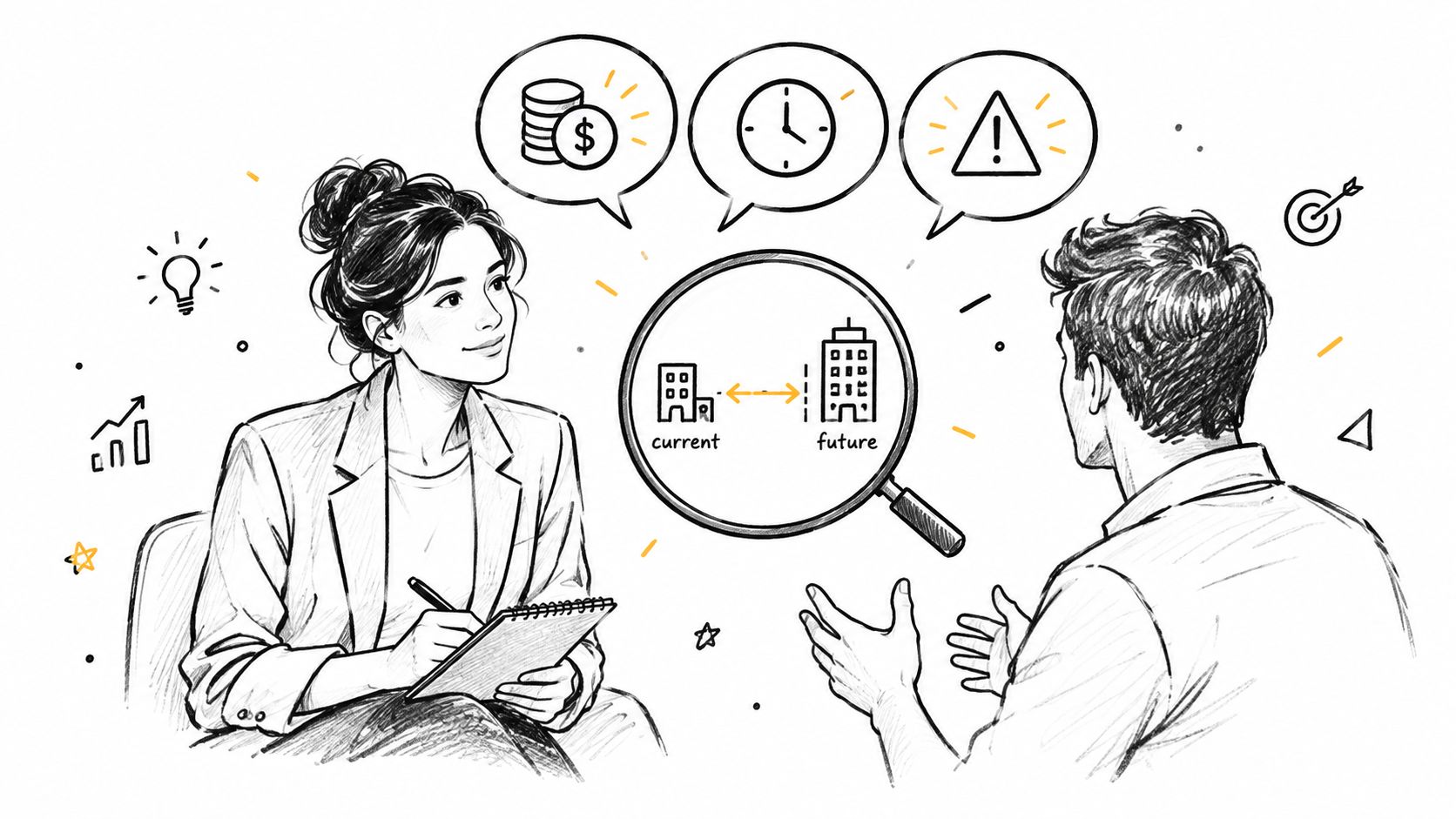
Prepare a small set of outcome-focused questions. Don't turn discovery into an interrogation.
- Start with context: Ask how the relevant workflow operates today and which systems are involved.
- Expose impact: Ask what the current problem delays, blocks, risks, or makes expensive.
- Clarify the buying path: Ask who evaluates the solution, how decisions are made, and what timeline matters.
- Close the loop: Summarize what you heard, identify gaps, and share the written findings with the AE.
Competency levels
Level one: You can ask about current process, pain, and desired outcomes without jumping into a demo.
Level two: You connect discovery answers to demo scope, technical requirements, stakeholders, and next steps.
Level three: You can disqualify a weak opportunity, explain why, and protect the team's capacity without damaging the relationship.
Practical rule: If the prospect can't explain the problem, impact, decision process, or desired outcome, don't build a custom demo yet.
Use the SE Rockstars discovery call guide to structure practice conversations, and review this resource on how to qualify B2B leads for additional qualification context. Apply both to your next call, then send the AE a concise written summary before anyone schedules a demo.
2. Demo Precision and Scope Control
A strong demo answers one buyer question: “Can this solve the problem we agreed matters?” It doesn't attempt to prove that your product contains every available feature.
Build the demo from discovery. Write a one-page outline with the buyer's main outcomes, the workflow you'll show, the technical proof each step provides, and the decision it should support. Open by restating the buyer's situation and explain the path through the demo. That creates a shared agenda and gives you permission to stop when the point has been made.

Use the prospect's workflow where possible. If real data can't be used, create a clearly labeled anonymized version that mirrors their environment. When a buyer asks about an unrelated feature, capture the question and return to the agreed narrative. You can say, “That's a useful question. Let's note it and finish the workflow tied to your reporting problem first.”
A hypothetical example makes the distinction clear. If a security leader needs evidence of policy enforcement, don't spend the meeting touring every dashboard. Show policy creation, enforcement, exception handling, and the report that the buyer's governance team would review.
Competency levels
Level one: You can run a reliable demo of the standard workflow and explain each feature in plain language.
Level two: You tailor the flow to discovery findings, manage interruptions, and connect every technical proof point to a buyer outcome.
Level three: You can change scope in real time, protect the central narrative, and guide a mixed technical and business audience toward a defined next step.
Finish with a summary of what the buyer saw, what remains unproven, and whether the next step is a pilot, POC, or deeper technical review. Practice focused delivery with the SE Rockstars demo skills training resource, and don't confuse visual polish with deal control. The buyer's problem should determine the demo, not the product menu.
3. Buyer-Centric Storytelling and Narrative Architecture
Technical buyers need facts. Business stakeholders need a reason to care. Your narrative has to connect both without turning the conversation into a product monologue.
Start with the buyer's trigger. What changed? A new compliance requirement, an acquisition, an implementation deadline, a broken workflow, or pressure to reduce operational risk can make an old problem urgent. From there, use a simple situation, complication, resolution structure. Establish where the buyer is, explain what blocks progress, then show how the proposed approach closes the gap.
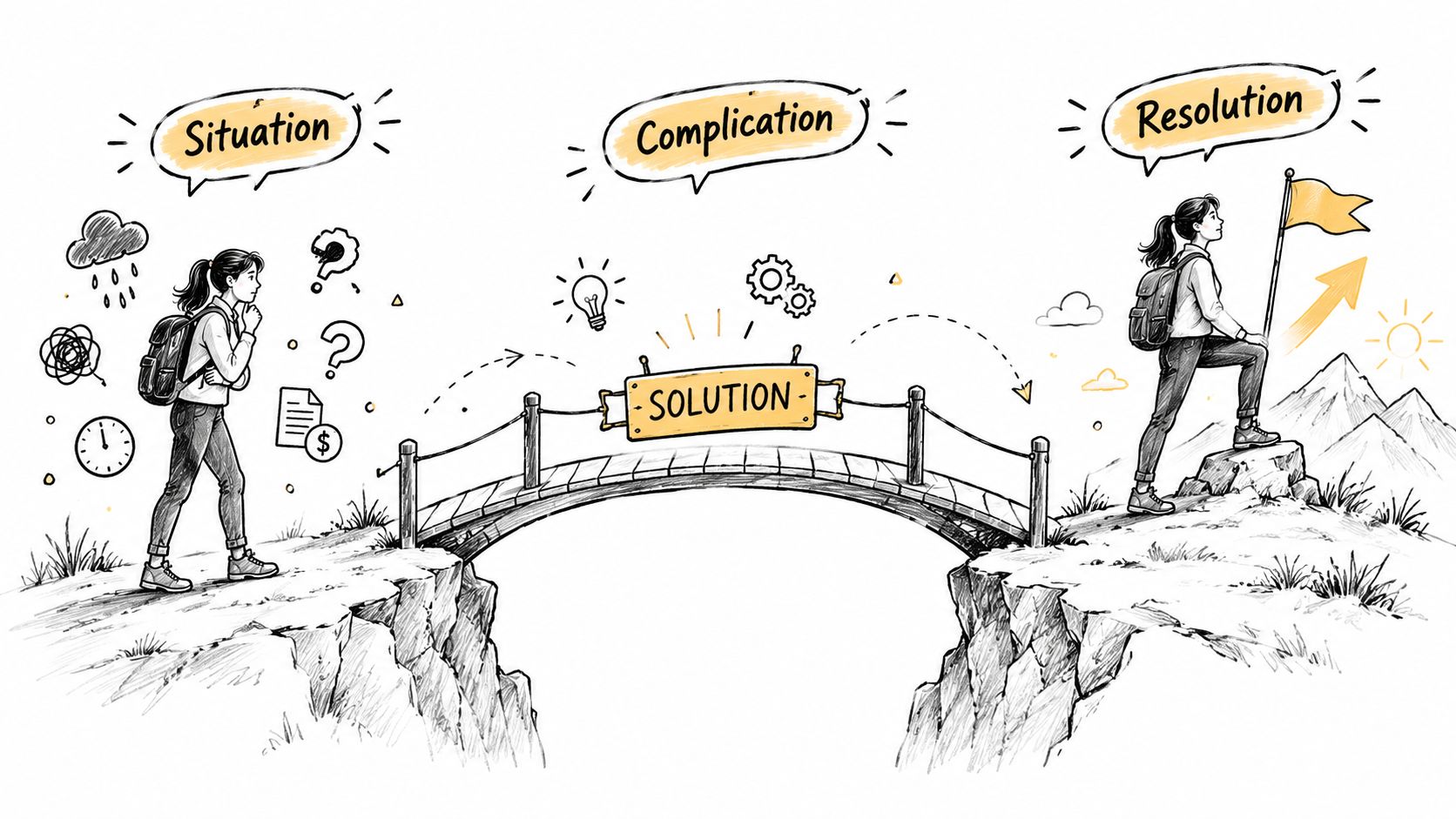
A hypothetical example might begin with a SaaS company expanding into regulated markets. The situation is a fragmented approval process. The complication is that every new region adds manual review and inconsistent evidence. The resolution is a controlled workflow that gives security, operations, and leadership a shared view of status and risk.
Don't tell the same story to every stakeholder. An architect may need integration boundaries and operational control. A finance leader may need a credible explanation of avoided work and implementation risk. A security leader may care about identity, data handling, and auditability. The underlying solution stays consistent, but the narrative must reflect each person's decision criteria.
Competency levels
Level one: You can explain the buyer's problem before discussing your product.
Level two: You can adapt one narrative for technical, operational, executive, and procurement stakeholders.
Level three: You can maintain a coherent story across qualification, demo, POC, reference calls, and final technical recommendation.
Use the SE Rockstars value selling training resource to practice outcome-based messaging. Record yourself explaining the same solution to an architect and a CFO. Remove product language that doesn't help either person make a decision, then replace it with specific workflow, risk, timing, or business context.
4. Technical-to-Business Translation
Technical accuracy isn't enough. You need to explain why an architecture decision matters to the buyer's timeline, cost, risk, operating model, or ability to achieve the desired outcome.
Build a translation matrix for your product. For each major capability, write the technical fact, the operational effect, the business consequence, and the buyer who cares. For example, an API with event-driven integrations may reduce manual handoffs and simplify near-real-time updates. The business relevance depends on the prospect's workflow, but your job is to make that connection visible.
Don't hide in jargon. Explain the technical detail when it matters, then connect it to the buyer's reality. If a prospect asks how identity federation works, answer the architecture question and ask which implementation constraint matters most, such as user provisioning, access control, audit evidence, or deployment timing.

A hypothetical scenario shows the difference. Saying, “The platform supports webhooks,” gives the buyer a feature. Saying, “Webhooks can keep your existing system updated without repeated manual exports, which matters because your operations team needs current status during the approval workflow,” gives the feature a reason to exist.
Competency levels
Level one: You can explain product architecture without unnecessary jargon.
Level two: You can map technical capabilities to the prospect's workflow, constraints, and business priorities.
Level three: You can help the AE and buyer document measurable business outcomes before and after implementation, while remaining honest about assumptions and limitations.
Practice with a nontechnical listener. If that person can't explain the business value back to you, simplify the message. Then document the translation in the opportunity record so the commercial team can use the same language after the technical conversation ends.
5. Sales Alignment and Collaboration
The AE shouldn't discover your position on an opportunity during a customer meeting. You and the AE need a shared view of qualification, stakeholders, risks, ownership, and the next decision.
Alignment starts before the call. Hold a short pre-call huddle and agree on who leads, what you need to learn, which technical concerns matter, and what outcome would justify the next meeting. After the call, send a written debrief promptly. Keep it useful, not long.
Your debrief should answer four questions:
- What did we learn: Record the buyer's problem, technical environment, priorities, and concerns.
- What changed: Note whether qualification improved, weakened, or stayed uncertain.
- What remains unproven: Identify missing requirements, stakeholders, or technical evidence.
- Who does what next: Assign owners and dates for the next action.
Review active opportunities against a shared scorecard. MEDDIC provides six qualification elements, Metrics, Economic Buyer, Decision Criteria, Decision Process, Identify Pain, and Champion. MEDDPICC adds Paper Process and Competition, giving PreSales teams a clearer view of procurement and competitive risk. The MEDDPICC guide for Solution Engineers shows how to apply that model in a technical role.
Competency levels
Level one: You share accurate call notes and agree on meeting ownership.
Level two: You challenge weak qualification privately, contribute to account strategy, and keep technical risks visible.
Level three: You help the sales team run a repeatable opportunity process and use technical evidence to improve forecast quality.
A hypothetical example is an AE who wants a demo because an executive attended a webinar. You should ask what problem was confirmed, who owns the evaluation, and what the buyer needs to see. That isn't resistance. It protects the deal from premature technical work.
6. POC and Pilot Planning with Success Criteria
An open-ended POC is a service project disguised as a sales opportunity. A controlled POC proves a defined claim, within an agreed scope, by a known decision date.
Start planning during discovery. Write the charter with the buyer and define the problem, use case, stakeholders, data, environment, responsibilities, acceptance criteria, timeline, and next step if the criteria are met. Define what you won't do as clearly as what you will do. That boundary protects your team and prevents the buyer from treating the POC as free implementation.
The buyer must agree to the success criteria before technical work begins. Criteria should describe observable outcomes, such as completing a workflow with required permissions, connecting a specified system, or producing an accepted report. Avoid vague language such as “demonstrate value” or “prove scalability.”
Competency levels
Level one: You can write a POC plan with scope, owners, technical requirements, and acceptance criteria.
Level two: You can run kickoff, progress reviews, blocker management, and evidence collection with the buyer's stakeholders.
Level three: You can determine whether a POC is commercially justified, stop scope expansion, and connect the final results to a clear contract decision.
Hold the kickoff with technical contributors and the business sponsor. Schedule regular check-ins based on the timeline, surface blockers early, and document configurations, test data, deviations, and results. Before the end date, review the evidence against every acceptance criterion and agree on the next step.
A hypothetical example is a data integration POC where the buyer provides test data and internal resources while your team provides a sandbox and technical guidance. If the buyer can't provide the data or sponsor access, the POC isn't ready. State that before work starts.
7. Objection Handling and Reframing
An objection is information about risk, priority, trust, fit, or decision friction. Treating it as an argument to defeat makes the buyer defend the concern instead of helping you understand it.
Pause before responding. Repeat the concern in neutral language and confirm that you understood it. Then ask what condition would make the risk acceptable. This sequence prevents you from answering a question the buyer didn't ask.
Suppose a prospect says integration looks too complex. Don't immediately list connector features. Ask which part creates concern, such as identity, data mapping, internal ownership, testing, or ongoing maintenance. You can then respond to the actual constraint and identify evidence that would reduce uncertainty.
“I hear the integration concern. Which part creates the most risk for your team, implementation effort, ongoing maintenance, or data control?”
Use relevant proof when you have it. That might be a technical reference, documentation, a controlled test, or a published benchmark that actually matches the buyer's situation. Don't use a generic customer story to dismiss a legitimate limitation. If you don't know the answer, say so and commit to a specific follow-up.
Competency levels
Level one: You can listen, restate the concern, and ask a useful follow-up question.
Level two: You can separate symptoms from the underlying risk and match the response to the buyer's decision criteria.
Level three: You can reframe competitive, commercial, and technical concerns without overpromising or turning the discussion adversarial.
Build an objection library with the team. Record the concern, likely cause, diagnostic question, acceptable evidence, and owner for follow-up. Review it after real calls, not as a theoretical script. Your aim is shared clarity, not a clever comeback.
8. Technical Win Definition and Influence
The technical win is the point at which the buyer's technical team has enough confidence to recommend moving forward. It is separate from the business win, and PreSales owns its definition, evidence, and status.
Ask the technical buyer early: “What do you need to feel confident this solution works for you?” Write down the answer. Then map every concern to a proof point, such as a targeted demo, architecture review, test, security document, POC result, or peer reference.
Technical influence grows through a sequence of completed commitments. You don't win the technical side with one impressive presentation. You win it by reducing specific risks in the order the buyer needs them reduced.
Competency levels
Level one: You can identify technical requirements and record the buyer's definition of confidence.
Level two: You can create a proof roadmap, manage technical stakeholders, and track unresolved risks.
Level three: You can define technical win criteria, report progress to sales leadership, and recognize when a deal has technical momentum versus technical approval.
Track useful indicators such as whether the opportunity has a defined technical win, how long it takes to reach that point, and whether the technical buyer recommends moving forward. Don't treat these as vanity metrics. They tell you whether the SE is shaping a decision or merely responding to requests.
A hypothetical example is an enterprise security evaluation with three open risks: identity integration, data residency, and operational ownership. Create one proof action for each, assign an owner, and schedule a review with the technical buyer. If data residency is a product limitation, name it early and explain whether it disqualifies the use case.
Bring technical references into the process before the final stage. Ask reference customers about implementation challenges, architecture decisions, and operating experience, not only business outcomes.
9. Peer-to-Peer Engagement and Credibility Building
Technical stakeholders recognize quickly when an SE understands their operating reality and when the SE is reciting enablement language. Credibility comes from useful questions, accurate answers, clear trade-offs, and reliable follow-through.
Research the company before the meeting. Review public technical writing, product direction, hiring signals, regulatory context, and the likely systems around the problem. You don't need to perform research theatrically. Use it to ask sharper questions about architecture, ownership, constraints, and priorities.
Speak as a peer, not as a vendor narrator. If one approach is faster to implement but creates more manual oversight, say that. If another creates stronger automation but requires more upfront design, explain the trade-off. Buyers trust recommendations more when you name the cost of the recommendation.
A hypothetical example is an architect choosing between a direct integration and an event-driven design. You should discuss latency, failure handling, monitoring, ownership, and change management. The right answer depends on the buyer's requirements, not on which architecture sounds more advanced.
Competency levels
Level one: You can answer known technical questions clearly and admit when you need to verify something.
Level two: You can discuss architecture, constraints, trade-offs, and implementation ownership with experienced technical buyers.
Level three: You can influence peer recommendations by bringing relevant insight, evidence, and technical references into the decision.
Use customer references carefully. Match engineer to engineer or architect to architect when possible, and prepare both sides for a focused discussion. When you don't know an answer, say you'll verify it, identify who will verify it, and follow up when promised. That behavior builds more trust than improvising.
10. Qualification and Deal Filtering Based on Technical Fit
Your credibility with sales depends partly on your willingness to say no. A technically poor-fit opportunity consumes SE capacity, creates false expectations, and can leave the customer with an implementation problem after signature.
Create a technical fit scorecard for the requirements that matter most to your solution. Include architecture, integrations, data handling, security, deployment model, performance needs, operational ownership, and known product limits. Use the scorecard consistently, not only when an opportunity already feels risky.
Ask direct questions early. Which systems must connect? What nonfunctional requirements are mandatory? Who owns implementation? What data must move? Which security controls are nonnegotiable? What happens if the proposed workaround takes more time or internal effort than expected?
When you find a problem, involve the AE and sales manager. Don't veto an opportunity in isolation. Explain what you found, why it matters to the buyer's success, and whether a workaround exists. If customization changes scope or timeline, state that clearly.
Competency levels
Level one: You can identify basic technical requirements and escalate obvious fit concerns.
Level two: You can assess architecture, integrations, security, and implementation constraints against a consistent scorecard.
Level three: You can recommend a no-decision, alternative path, or competitor when that protects the buyer, while helping the team learn from filtered opportunities.
A hypothetical example is a prospect whose required data residency model isn't supported. You should not bury the limitation in a late-stage security review. Tell the AE, frame the issue around the prospect's success, and explain whether an approved alternative exists. If the solution isn't suitable, recommending another path can protect the relationship and your company's reputation. This ICP guide from LeadBeast can help sales and PreSales align technical fit with the broader ideal customer profile.
10-Point B2B Sales Skills Comparison
| Practice | Implementation complexity | Resource requirements | Expected outcomes | Ideal use cases | Key advantages |
|---|---|---|---|---|---|
| Discovery-Driven Qualification | Medium, skilled questioning and listening | Low–Medium, time upfront, coordination with AE | Cleaner pipeline; fewer wasted demos | Early-stage prospect screening and qualification | Filters tire‑kickers; establishes business fit |
| Demo Precision and Scope Control | Medium, requires discipline and tailoring | Medium, custom demo prep, sales alignment | Shorter cycles; higher buyer engagement | Demo meetings for complex products or focused buyers | Shows what matters; protects credibility |
| Buyer-Centric Storytelling and Narrative Architecture | Medium, preparation and tailoring per persona | Low–Medium, time to craft narratives and examples | Stronger emotional buy‑in; memorable positioning | Cross‑stakeholder presentations and value selling | Differentiates message; unifies stakeholders |
| Technical-to-Business Translation | High, deep product and business fluency needed | High, training, product knowledge, translation matrix | Faster approvals; clearer ROI and reduced friction | Conversations with CTOs/CFOs and integration planning | Bridges tech and business; enables justification |
| Sales Alignment and Collaboration | Medium, process and behavior changes | Medium, regular syncs, shared tools and notes | More predictable, faster sales process | Team selling and complex/long‑cycle deals | Consistent messaging; efficient handoffs |
| POC and Pilot Planning with Success Criteria | High, formal scoping and governance | High, SE time, sandbox environments, stakeholder time | Objective validation; smoother post‑sale rollout | Enterprise deals requiring proof before purchase | Limits scope creep; defines measurable success |
| Objection Handling and Reframing | Low–Medium, emotional control and technique | Low, practice, playbooks, third‑party evidence | Preserves trust; surfaces real concerns | Negotiation and pricing or risk objections | Moves conversation forward without defensiveness |
| Technical Win Definition and Influence | High, structured proof points and cadence | High, demos, POCs, references, coordination | Reduced technical risk; higher technical approvals | Deals needing technical recommendation before buy | Clarifies technical acceptance; improves forecastability |
| Peer-to-Peer Engagement and Credibility Building | High, genuine subject‑matter expertise required | Medium–High, research, references, preparation | Strong trust; enduring advisor relationships | Senior technical stakeholder meetings and references | Positions SE as advisor; uncovers trade‑offs early |
| Qualification and Deal Filtering Based on Technical Fit | Medium, requires scorecards and courage to decline | Low–Medium, fit checklist, discovery time | Fewer failed implementations; healthier pipeline | Early qualification and enforcing ICP | Protects resources; maintains company reputation |
Next Steps to Level Up Your Sales Engineering Game
Don't try to improve all ten skills at once. Pick the capability that currently creates the most deal friction. If demos keep expanding, work on discovery and scope control. If POCs stall, work on success criteria and stakeholder ownership. If technical evaluations go quiet after a strong demo, work on technical win definition and peer-level influence.
Use the competency levels as an honest assessment, not a badge. At level one, you can perform the activity with a framework. At level two, you can adapt it to a real buyer and coordinate it with the sales team. At level three, you can influence the opportunity, protect capacity, and produce evidence that helps the buyer decide. Your development plan should move one active behavior from one level to the next.
Practice on current deals. Write the discovery questions for your next call. Build the demo outline before opening the product. Draft the POC charter before promising technical work. Create the translation matrix for the feature you explain most often. Ask your AE for direct feedback on whether your work made the next decision easier.
Training only sticks when you apply it repeatedly. A Wilson Learning study involving 246 salespeople and managers over 18 months reported that an environment-enhanced approach combining training with manager coaching and job aids improved performance 67% over baseline in the first three months after training, with 4.2 times the improvement of the control group and 56% more than training alone. The same study estimated a three-year return of about $20 for every $1 invested in the full approach, compared with about $12 for training alone.
The lesson is practical. A course without practice fades. A framework without manager reinforcement becomes a document no one opens. Build feedback into deal reviews, roleplays, demo rehearsals, POC checkpoints, and technical win reviews.
Adoption matters as much as framework selection. A 2026 sales enablement summary reports that about 89% of teams have a documented enablement process, while only around 36% of reps consistently follow it. The reported difference between documented process and actual behavior is the management problem you need to solve. Make the desired behavior visible, inspect it in opportunity reviews, and give SEs practical assets they can use without slowing down the field.
AI can help with research, first-pass notes, follow-up drafts, and account preparation. It can't replace judgment about whether the problem is real, whether the architecture fits, or whether a technical buyer is ready to recommend the solution. Apollo's B2B sales research cites a projection that 58% of sellers will need AI-related reskilling by 2026, while Mercuri International's research says sales training averages only four days per year. Use AI to remove low-value preparation work, then spend the recovered time on discovery, diagnosis, stakeholder orchestration, and decision design.
Choose one skill this week. Run through its competency levels, use the linked resource, and apply the framework to a live opportunity. When you're ready for structured development across discovery, demos, sales alignment, and POC management, schedule a discovery call with SE Rockstars or explore the Trusted Advisor Academy at SE Rockstars.
PreSales Unleashed GmbH provides the Trusted Advisor Academy, a 12-month development program for Solution Engineers and PreSales leaders with on-demand lessons, live practice, deal sparring, coaching, and reusable assets. Visit PreSales Unleashed GmbH to build the B2B sales skills that help you run stronger discovery, focus demos, manage POCs, align with sales, and own the technical win.