
Most advice on B2B sales training starts in the wrong place. It assumes the AE motion is the main motion, then treats PreSales as a supporting variation that needs lighter versions of the same content. That's why so many programs produce polished demos, decent workshop feedback, and very little change in the deals that matter.
For B2B SaaS, the lever is earlier. Discovery quality decides the technical win. If your team misses the actual pain, the buying group, the integration constraints, or the decision path, no amount of demo polish fixes it later. The demo only exposes the quality of the discovery that came before it.
That's the position here. AEs and Solution Engineers need a shared language, but they do not need the same training track. If you want technical wins, lower POC waste, and cleaner deal progression, you build the tracks separately and measure them separately.
Why Most B2B Sales Training Misses the Real Lever
Most B2B sales training still rewards the wrong behaviors. It puts visible moments first: pitch delivery, objection handling soundbites, talk tracks, presentation confidence. Those matter, but they sit downstream from the decision point.
In enterprise SaaS, deals usually don't fail because the SE couldn't click through a demo cleanly. They fail because the team never got clear on who owns the problem, what has to change technically, which stakeholders can block the evaluation, and what proof the buyer needs to move forward.
Demo-first training creates late-stage pain
When training starts with demo performance, teams learn to perform before they learn to diagnose. That creates a familiar pattern:
- Generic discovery: reps ask broad questions, collect surface pain, and rush to show product.
- Weak technical positioning: the SE gets pulled in after the buyer has already framed the project their way.
- Messy evaluations: the POC becomes a fishing expedition instead of a proof plan.
- Forecast noise: everyone says the deal is active, but nobody can explain how the customer will decide.
A lot of SKO-style training feeds this problem. It creates short-term excitement, but not a durable operating habit. If you want a sharp critique of event-based training, this SKO training episode is worth your time.
Practical rule: If training doesn't change what your team asks before the demo, it won't change what happens after the demo.
The market is large, but scale doesn't mean quality
Sales training isn't some fringe budget line. Industry roundups summarized by Worldmetrics on the sales training industry estimate the B2B sales training market at roughly $40.3 billion in 2022, with projections to $45.2 billion by 2027 at 8.1% CAGR, and note that sales training represented about 12% of corporate training spending in 2022, up from 10.5% in 2019.
That spend tells you two things. First, leaders clearly believe training matters. Second, the default model still survives because it is easy to buy, not because it maps cleanly to technical selling.
PreSales needs its own operating system
AEs and SEs are in the same deal, but they aren't doing the same job. The AE is driving commercial momentum. The SE is reducing technical uncertainty, shaping the buyer's evaluation, and earning the technical win. If you collapse both into one generic enablement path, you undertrain both sides.
That's why the right unit of analysis isn't course completion. It's behavior change in live deals.
Core Components Every B2B Sales Training Program Must Cover
A credible B2B sales training program needs six components. Not because they sound complete on a slide, but because each one moves deal quality.
The six components that matter
-
Consultative discovery
This is the foundation. You need a repeatable way to uncover business pain, technical blockers, current-state workarounds, required integrations, security concerns, and the buyer's proof threshold. If your team can't run discovery, they're just setting up demos. -
Qualification tied to stage exits
Qualification only works if it changes deal movement. A useful example is MEDDPICC for Solution Engineers. The underlying MEDDICC framework centers on six core elements: Metrics, Economic Buyer, Decision Criteria, Decision Process, Identify Pain, and Champion, as described in this overview of MEDDICC elements. For SEs, that means proving technical clarity before the team burns cycles on a custom demo or POC. -
Demo methodology
Feature tours are not demo strategy. Your team needs a method for connecting the discovery to the story, sequencing proof points, and showing enough to move the deal without turning the call into a product training session.
What most programs leave out
The usual off-the-shelf sales curriculum covers discovery and objections at a high level, then stops. The omissions are costly.
- Structured objection handling: buyers will challenge risk, timing, migration effort, fit, and internal change load. You need a method, not improvisation. For a useful outside reference on how sales teams can handle sales objections, Intonetic has a practical primer that fits well as a supplement.
- Multi-stakeholder mapping: enterprise deals die in the whitespace between meetings. If nobody owns stakeholder coverage, your champion ends up carrying the whole deal alone.
- Deal review habits: a real training program changes how managers inspect deals. If reviews only ask “when will it close,” coaching arrives too late.
Core Components and Their Deal Impact
| Component | Primary Metric Moved | AE vs. SE Emphasis |
|---|---|---|
| Consultative discovery | Technical win quality | Shared, with deeper technical questioning for SEs |
| Qualification framework | Deal velocity and forecast confidence | Shared, with stronger technical evidence burden for SEs |
| Demo methodology | Demo-to-next-step conversion | SE-heavy |
| Structured objection handling | Discount pressure and stall recovery | Shared |
| Multi-stakeholder mapping | Evaluation progress and consensus | Shared, different depth by role |
| Deal review discipline | Forecast accuracy and coaching quality | AE manager and SE leader both involved |
The best programs don't try to teach everything. They teach the few behaviors that change what the buyer sees in the next live deal.
If a program skips stakeholder mapping and deal review, it's not complete. It's just easier to deliver.
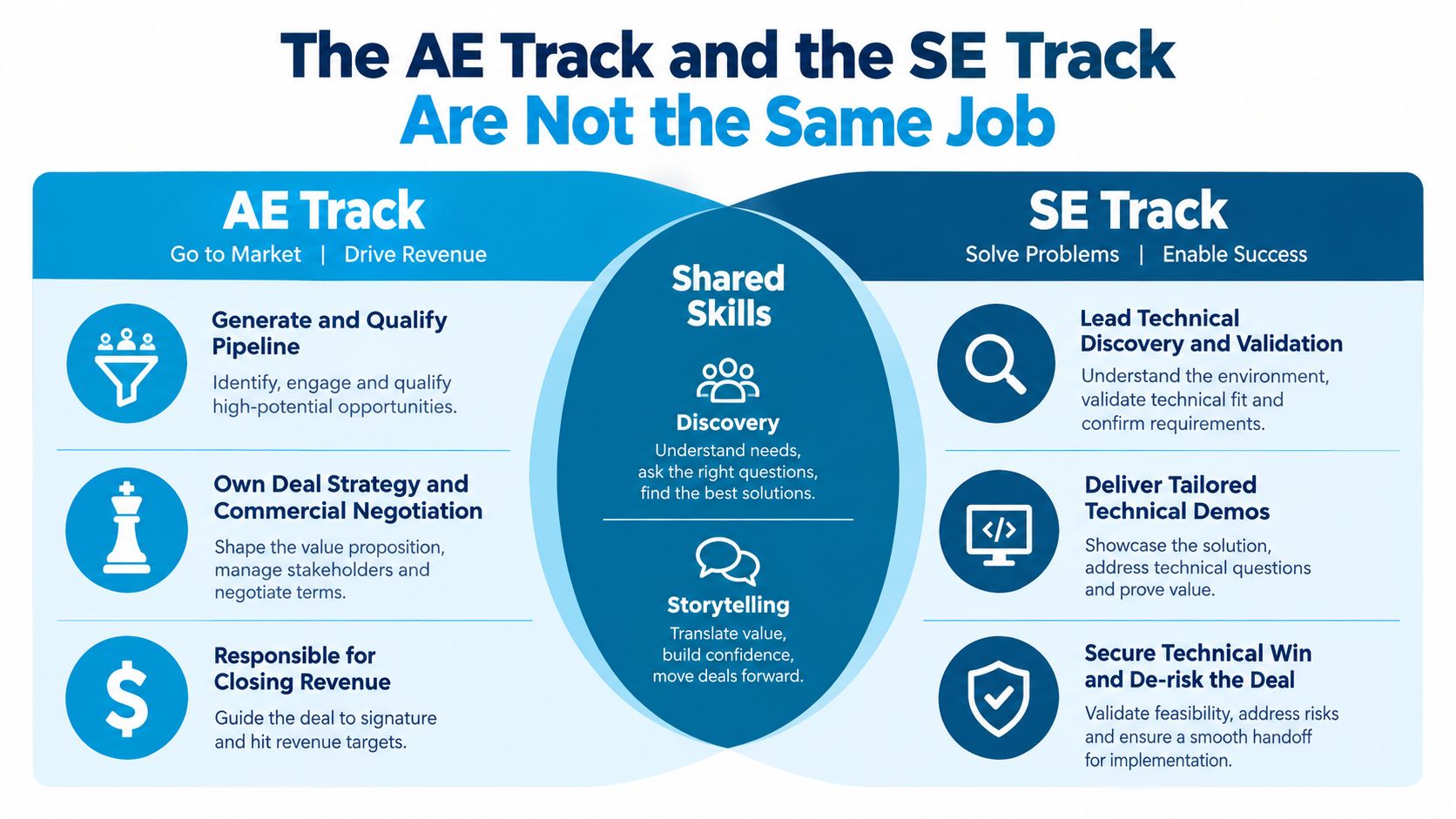
The AE Track and the SE Track Are Not the Same Job
Treating AE and SE training as the same curriculum with different examples is lazy enablement. The overlap is real, but the job isn't.
Where the tracks overlap
Both roles need a common deal language. That includes discovery discipline, stakeholder mapping, mutual action planning, and basic qualification hygiene. It also includes knowing when an opportunity is real versus merely active.
That shared layer matters even before the AE owns a full cycle. Teams with strong BDRs often create more early opportunities, but without clean AE-SE handoff and role clarity, extra volume just creates more bad demos.
Where the tracks split
The AE track should focus on:
- Pipeline creation and progression
- Commercial strategy
- Political mapping inside the account
- Negotiation and close planning
- Forecast judgment
The SE track should focus on:
- Technical discovery
- Solution design
- Use-case-based demo storytelling
- Architecture and integration framing
- POC orchestration and success criteria
If you need a plain-language definition of the role, this guide on what a Sales Engineer does is a good reference point.
One curriculum undertrains both sides
Here's what usually happens with one-size-fits-all B2B sales training:
- AEs get too much demo mechanics. They don't need to become backup SEs.
- SEs get too little commercial context. They end up technically right and commercially disconnected.
- Managers get fuzzy coaching signals. They can't tell whether the problem is discovery quality, qualification discipline, or technical proof design.
Field test: Ask whether your SE training includes architectural questioning, evaluation planning, and technical risk handling. If it doesn't, you don't have an SE track. You have AE content with product screenshots.
The split doesn't mean silos. It means role-specific practice, role-specific coaching, and role-specific scorecards. Shared framework. Separate reps.
How Discovery and SE Involvement Change the Deal
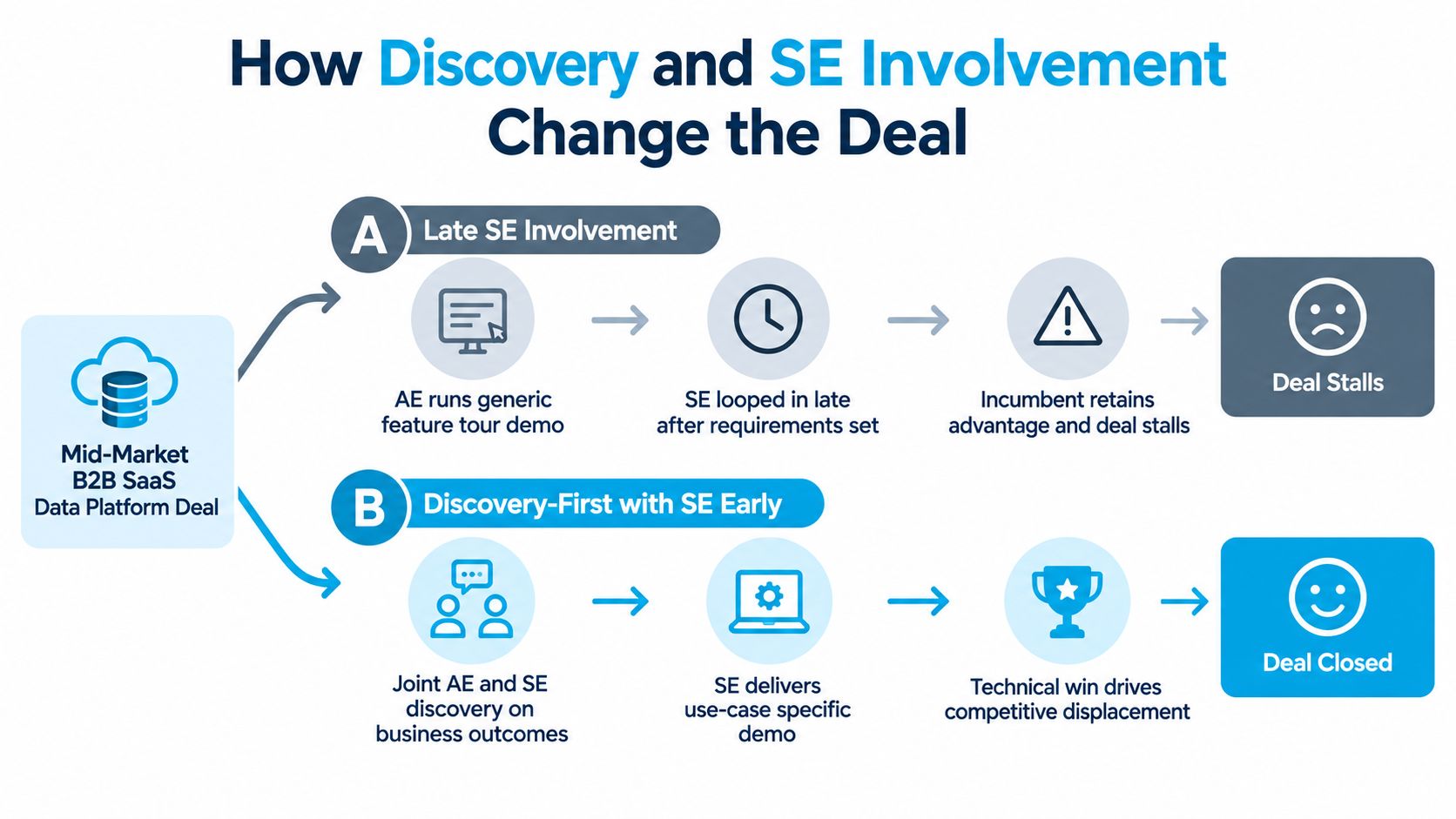
Take a mid-market data platform deal. The customer is using an incumbent. They're unhappy with reporting lag, integration overhead, and internal trust in the current setup. The account looks competitive from the start.
There are two common ways this deal runs.
For the first path, the team starts too late on technical depth.
Path A with late SE involvement
The AE runs an early feature tour. The customer sees dashboards, connectors, automation, and admin controls. The meeting feels productive because the product looks capable.
Then the questions appear. How will migration work? Which team owns implementation? What security review is coming? Which legacy workflows can't break? The SE gets looped in after requirements have already started to harden.
That deal now has three problems:
- The incumbent keeps framing the comparison
- The buyer's technical criteria were never shaped early
- The SE is defending scope instead of guiding evaluation
The result is usually a bloated POC, more discount pressure, and slower momentum.
Path B with joint discovery before demo
The better path starts with a joint AE-SE conversation. Before anyone shows product, the team gets clear on problem priority, affected teams, current architecture, data dependencies, proof requirements, and who signs off technically.
If your team needs a sharper structure for this part, use a dedicated discovery call guide and inspect whether it produces usable demo inputs, not just more notes.
Later in the motion, it helps to see the sequencing in action:
Now the demo has a job. It validates the buyer's most important scenarios. The SE can attach each proof point to a known pain, known workflow, and known stakeholder concern. The evaluation plan is set before the POC starts, not invented halfway through it.
Early SE involvement doesn't make the deal more technical. It makes the deal more specific.
The gap between these paths isn't rep talent. It's sequence. And sequence is trainable.
Delivery Models Ranked by What Actually Sticks
Teams don't need more content. They need a delivery model that survives contact with the quarter.
Academic work has treated sales training as measurable for a long time. One university-hosted review notes that 95% of organizations conduct some form of sales training and that organizations spend more than $30 billion annually on sales training programs, while also pointing to Kirkpatrick's four levels of evaluation, reaction, learning, behavior, and results, as a standard way to assess training effectiveness in this Old Dominion University research review. That matters because behavior and results are the test, not whether people liked the session.
What learning science says about retention
For SE teams, one-off workshops decay fast because the job is performance under pressure. Discovery, whiteboarding, objection handling, and demo transitions don't stick because someone watched them once.
A summary on the forgetting curve problem in sales training notes that distributed practice consistently outperforms massed practice for long-term retention in this spaced practice overview. A PubMed-indexed review also states that repetitions spaced in time create stronger memories than repetitions massed close together, and reports a 200% improvement in long-term retention versus no spacing in one repeated retrieval finding, covered in this PubMed review on spaced repetition.
B2B Sales Training Delivery Models Compared
| Delivery Model | Retention @ 90 Days | Behavior Change | Ramp Impact | Manager Coachability |
|---|---|---|---|---|
| On-demand video library only | Low | Low unless paired with live application | Useful for baseline knowledge | Weak |
| Live cohort workshops | Moderate right after training, then fades without reinforcement | Moderate when role-play is strong | Good for concentrated onboarding | Moderate |
| Manager-led reinforcement | High when managers inspect live deals and calls | High | Strong if managers coach consistently | Strong |
| Continuous enablement embedded in the sales motion | Highest | Highest because practice is tied to active deals | Strong and steady | Strongest |
My ranking
-
Continuous enablement embedded in live deals
This wins because the rep or SE applies the skill immediately. -
Manager-led reinforcement
Coaching is where habits either stick or disappear. -
Live cohort workshops
Good for launch, reset, or onboarding. Not enough by itself. -
On-demand libraries alone
Useful reference. Weak training model.
A blended design usually works best. Live instruction sets the standard, micro-learning supports recall, and manager inspection forces use. If you're comparing options, a provider like PreSales enablement as a service is one example of a continuous model built around recurring practice instead of an isolated event.
When budget gets cut, drop passive libraries before you cut live practice.
Outcomes and KPIs You Should Hold the Program To
If a training program can't tell you what business behavior it is trying to change, it isn't a training program. It's content distribution.
Start with the outcomes that matter
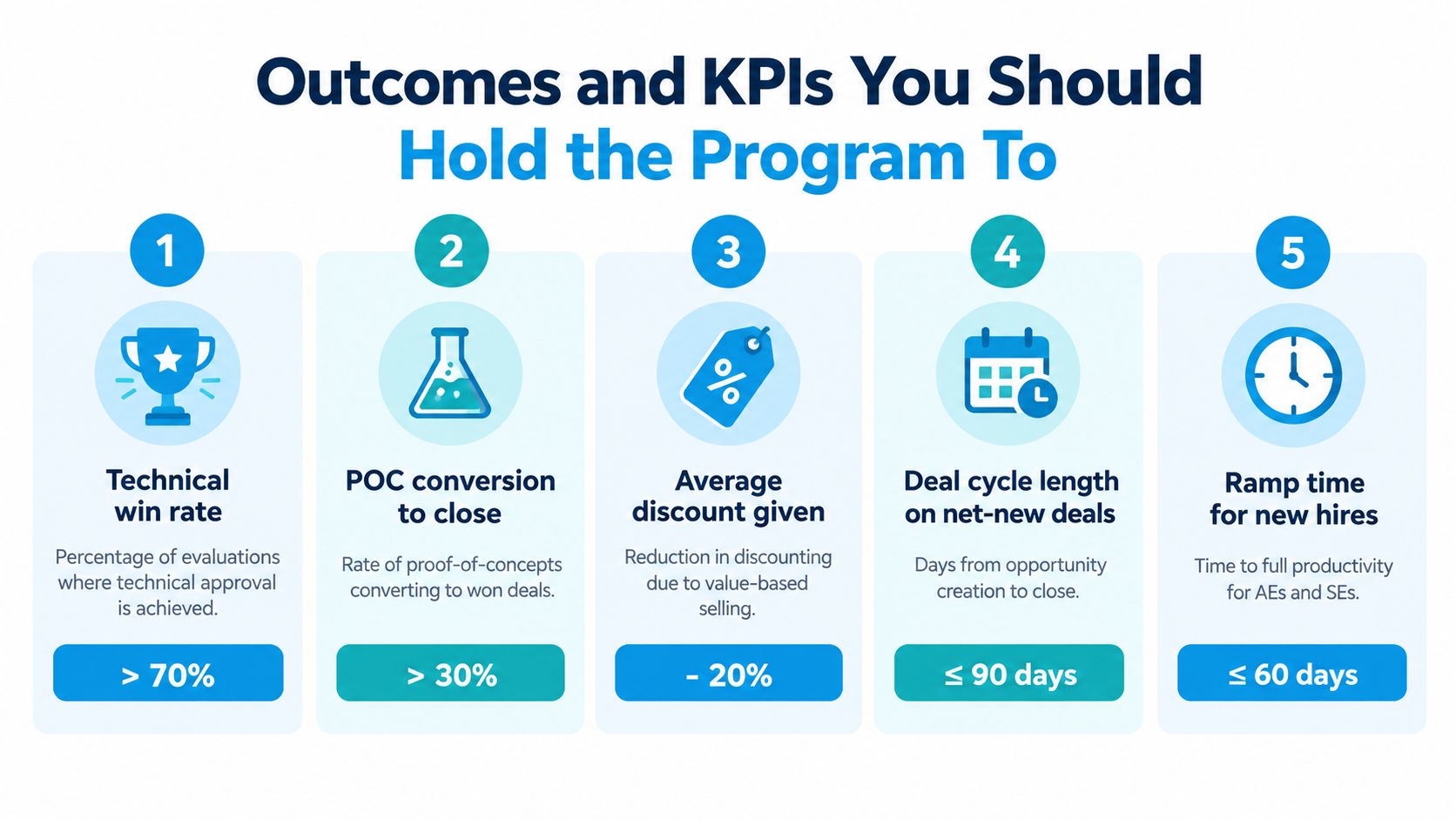
Use a KPI stack in this order:
- Technical win rate
- POC conversion to close
- Average discount given
- Deal cycle length on net-new deals
- Ramp time for new AEs and SEs
For a deeper look at the first one, this piece on the north star technical win rate is the right anchor.
Pair each KPI with an observable behavior
Don't wait for closed revenue to tell you whether the program is working. Inspect the leading indicators first.
- Technical win rate: look for stronger discovery depth before demo.
- POC conversion to close: check whether the SE documented an evaluation plan with explicit proof criteria.
- Average discount given: inspect whether the team is tying technical proof to business value instead of reacting late on price.
- Deal cycle length: look for cleaner stakeholder coverage and fewer generic follow-up demos.
- Ramp time: inspect whether new hires can run a discovery, build a demo path, and defend a recommendation in deal review.
A newer randomized study summary on spaced repetition in applied education also makes an important point for enablement leaders: cadence can be measured, compared, and improved, as described in this background on spaced repetition study design. That's exactly how you should think about reinforcement in sales training.
Completion rates tell you who logged in. They don't tell you who changed.
Ignore vanity metrics like course completion, certificates, and training satisfaction if they aren't tied to actual deal behavior.
A Short Checklist for Choosing the Right Program
Most buyers over-focus on curriculum topics and under-focus on operating design. That's backwards. Plenty of programs can list discovery, demo, and objections on a webpage. The question is whether the design produces different behavior in live opportunities.
Use this filter before you buy
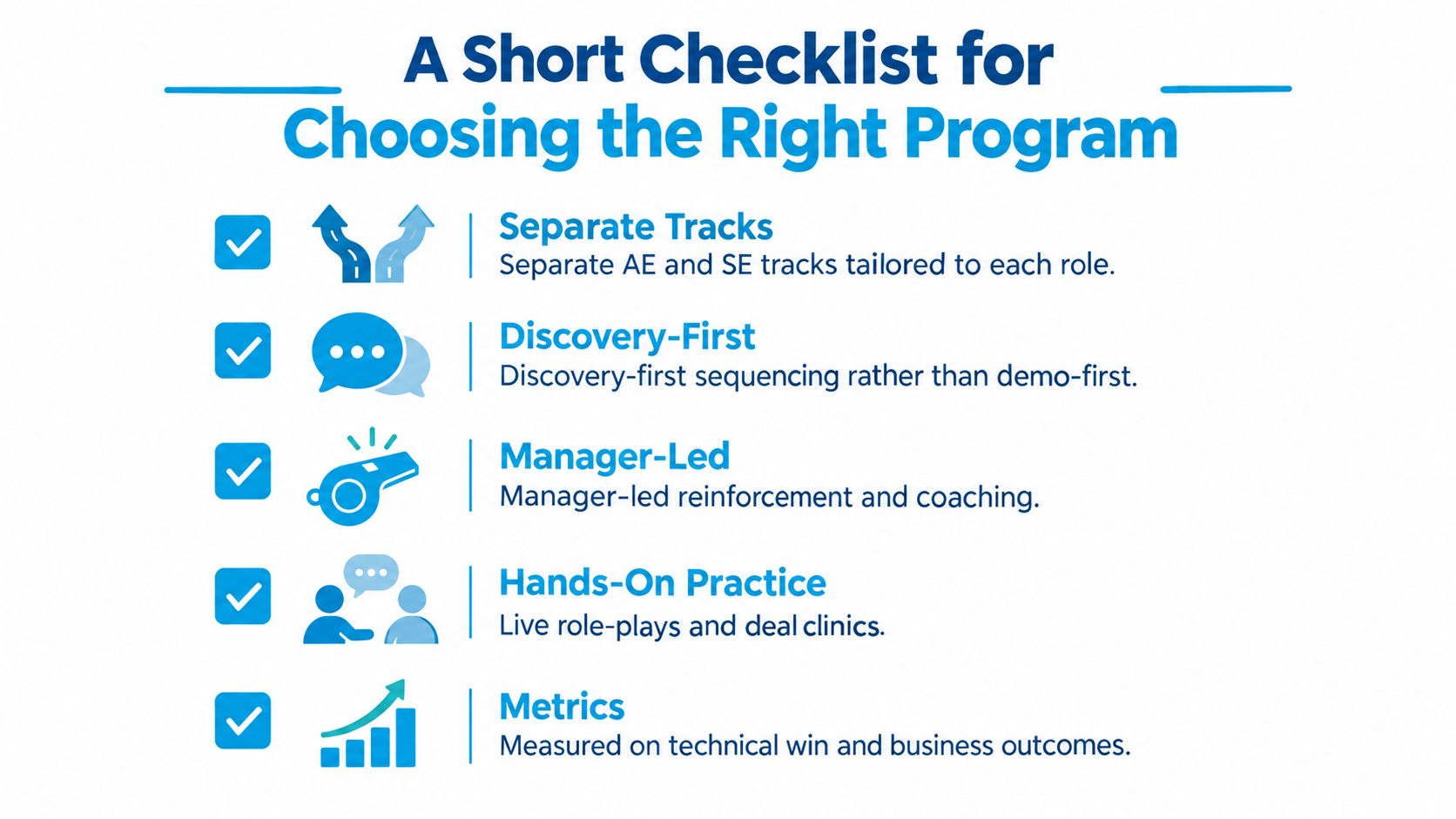
- Separate tracks: if the provider treats PreSales as a subset of AE enablement, disqualify it.
- Discovery-first sequencing: if the centerpiece is demo polish, keep looking.
- Manager reinforcement: if the manager's role ends when the workshop ends, the training won't last.
- Hands-on application: role-plays, deal clinics, and call review should be part of the program, not optional extras.
- Business measurement: the scorecard should include technical win and POC quality, not just attendance.
Two questions expose weak programs fast
Ask these in the first call:
- How do you train AEs and SEs differently while keeping a shared deal language?
- What behavior do you expect to see change before revenue changes?
If the answers are vague, the program probably is too.
For teams evaluating role-specific options, how to choose PreSales training gives a useful buying lens, and the SE Rockstars community shows what ongoing peer reinforcement can look like beyond a single workshop. If you want the broader role context first, what is PreSales and Sales Engineer vs. Solutions Engineer vs. Solutions Consultant are helpful starting points.
The right program should make you stricter, not more optimistic. You should leave the evaluation with a clearer standard for discovery, separate tracks for AEs and SEs, and a measurement window long enough to judge behavior change.
PreSales Unleashed GmbH builds training specifically for the SE track through the Trusted Advisor Academy, with structured content, live practice, and application tied to active deals rather than one-off event training. If you want B2B sales training that treats discovery, technical storytelling, and POC control as core PreSales skills, visit PreSales Unleashed GmbH.