
The most popular advice about get a demo is wrong. You're told to treat the form fill as high intent, book fast, and put on a polished show. Don't.
A demo request is a decision-readiness checkpoint. Your job as a Solution Engineer (SE) is to test whether there's a real problem, a real owner, and a real way to prove fit. No discovery, no demo. Discovery quality, not demo polish, decides whether you earn a technical win.
Why Get a Demo Starts Before the Form
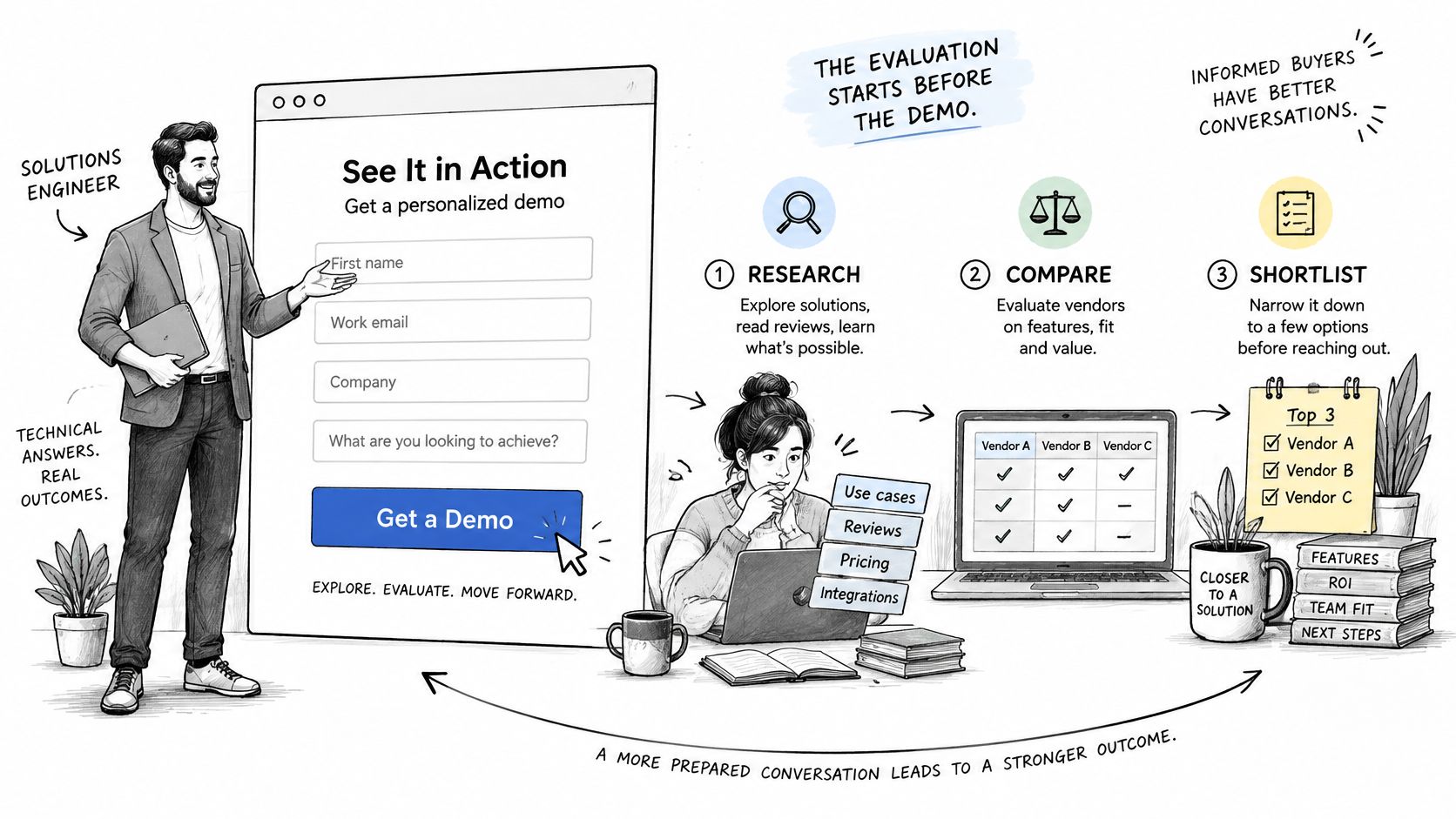
Buyers don't start with you. They research vendors, compare alternatives, and cut a shortlist before they ever book a call. By the time someone clicks to get a demo, the buyer has often narrowed the field, so you're not opening a conversation. You're being tested against a list that already exists.
The numbers back that up. In 2025, 97% of surveyed B2B buyers already had personal experience with at least one shortlisted vendor, first seller contact occurred around 61% of the way through the journey, and the eventual winner was already on the initial shortlist 95% of the time, per the 2025 B2B buyer journey statistics from Empact Partners. Read that plainly. You rarely win by being first to show product. You win by giving the buyer better evidence than the vendors already on their list.
That makes the click ambiguous. It can mean three different things, and you need to sort out which one you're holding before you schedule anything.
Three Things the Click Can Mean
- Exploration: The buyer is learning the category and can't yet describe the problem in business terms.
- Self-serve validation: The buyer knows what to check and wants to inspect workflows without a live tour.
- Late-stage confirmation: The buyer has a shortlist, criteria, and stakeholders, and wants you to prove fit.
Only the third one earns a full live demo on the spot. The first needs discovery. The second needs guided material and a shorter working session. If you run the same harbor tour for all three, you'll burn SE hours and teach the buyer nothing they can use internally.
Role clarity matters here. PreSales isn't product support, and it isn't a demo service desk. If your team needs that frame, start with what PreSales actually covers and what a sales engineer does day to day. The person who owns the technical win has the right, and the obligation, to ask whether the meeting should happen at all.
A demo request is a question, not an order. Your first answer is a check for readiness.
If you want a public example of the self-serve end of this spectrum, you can see Yellow.ai in action and note how much a buyer can learn before a live conversation even starts. That kind of inspection doesn't replace you. It frees your live time for the questions a page can't answer.
Check Readiness Before You Book
Run a short gate with the buyer before anyone sends a calendar invite. You're not interrogating them. You're checking whether a live session can produce a decision anyone trusts.
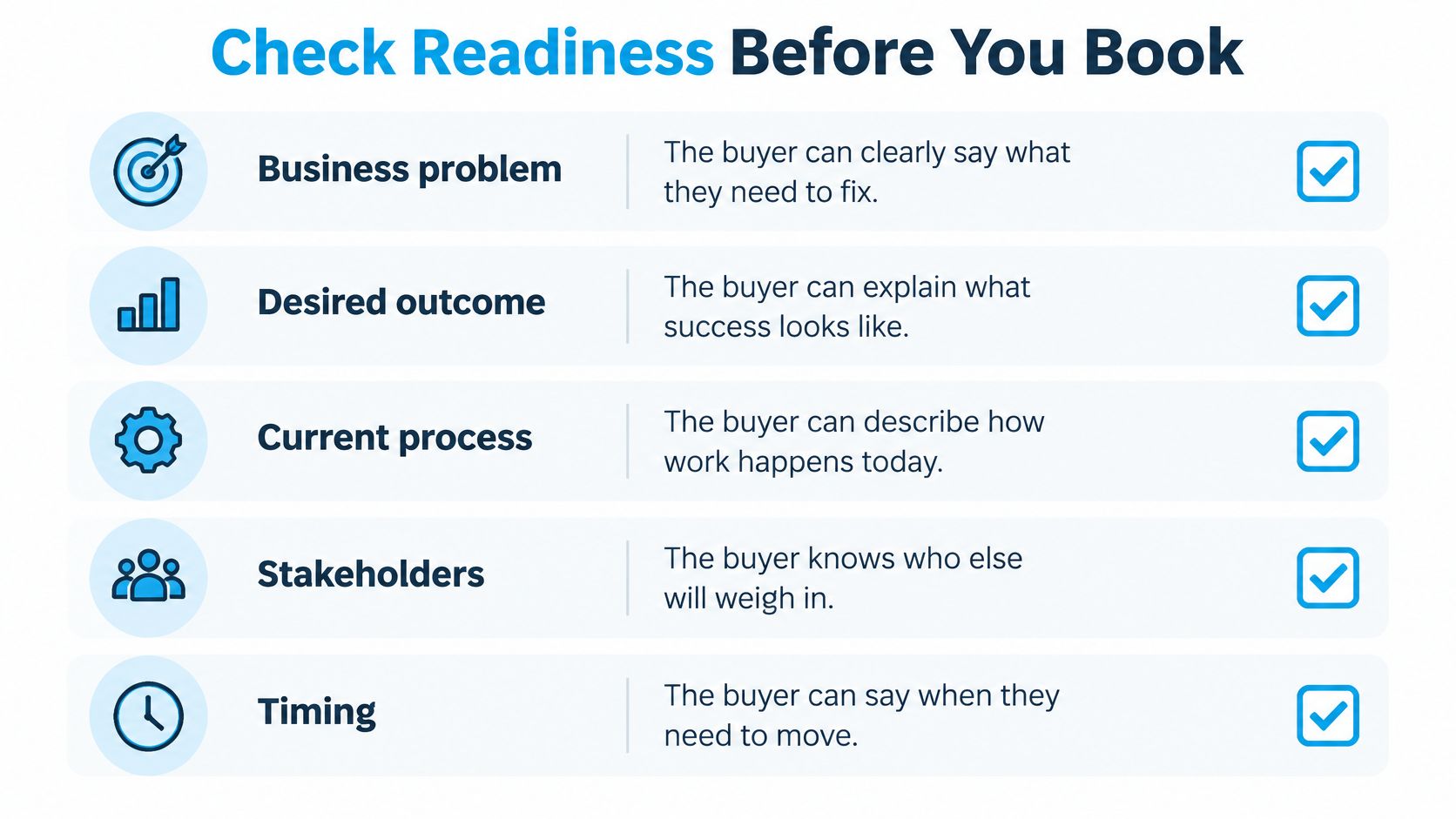
The buyer should be able to say five things in their own words. If they can't, route them to discovery or to material they can inspect alone.
The Pre-Book Checklist
- Business problem: What's broken, slow, risky, or expensive today, and who feels it?
- Target outcome: What changes if this works, and how will they know?
- Internal owner: Who owns the decision and the result after go-live?
- Constraints: Which integrations, security rules, or compliance reviews must the product pass?
- Timeline and evidence: When do they need to decide, and what proof would count as success?
Say the quiet part out loud. Don't book when the buyer can't describe the problem, can't name an owner, or can't offer realistic success criteria. Offer a discovery conversation instead. The discovery call guide gives you the structure to build that context before product enters the room.
This approach matches how buyers want to buy. Gartner reports that 75% of B2B buyers prefer a sales experience without direct representative involvement, and its survey of 148 people involved in technology purchase decisions found that 64% preferred a completely digital experience when they were already familiar with the product or service, according to Gartner guidance on the B2B buying journey. The same source notes buyers were 1.8 times more likely to complete a high-quality deal when they used supplier digital tools together with a sales representative rather than independently.
So do both. Give them something real to inspect alone, then reserve your live hour for workflow fit, integration risk, and stakeholder concerns. That pairing respects their preference and protects your calendar.
The short video below is a useful reference point for how a buyer-facing session can be framed before the live meeting takes over.
Qualify the Demo Request First
Treat the demo as a qualification and evaluation instrument. You're not there to tour modules. You're there to test whether observable product behavior matches the buyer's stated criteria, and whether the deal deserves more SE time.
Work in a fixed order. Confirm the use case, business impact, stakeholders, decision criteria, and evaluation timeline. Then map each criterion to one observable workflow. Show those workflows. Refuse to show the rest. This discipline matters because 42% of sales demonstrations reportedly fail to connect with the buyer's actual pain points and 77% of B2B buyers feel their time is wasted in generic sales meetings, per the sales demonstration data summarized by Eubrics.
Use your existing qualification language rather than inventing a second one for demos. MEDDPICC for Solution Engineers gives you shared terms for metrics, decision process, and paper process. If the discovery notes are thin, tighten them first using the discovery call framework. A demo built on thin discovery is a guess with screen sharing.
Demo Quality Gate
| Gate | Accept the demo | Push back or redirect |
|---|---|---|
| Business problem | Stated in the buyer's words | Vague request to see the platform |
| Target outcome | Named result with an owner | Feature interest with no result attached |
| Evaluators | At least one decision-maker or technical evaluator identified | Requester only, no path to the buying group |
| Success definition | Agreed before the session | We'll know it when we see it |
| Next step | Technical validation, proposal, or mutual evaluation plan is realistic | No calendarized action expected |
Measure the right output. Your operating metric is demo-to-next-step conversion, segmented by lead source, industry, persona, qualification status, and demo type. Track attendance, discovery completeness, relevant workflows shown, stakeholder coverage, objections resolved, next-step acceptance, opportunity creation, and eventual win rate.
Operating rule: Booked-demo volume is activity. Demo-to-next-step conversion is evidence that the session changed the deal.
Booked volume alone will lie to you. Generic meetings fill the calendar, consume scarce SE capacity, and produce weak pipeline. If a request fails the gate, say so early, offer the right alternative, and keep your live slots for buyers who can move.
Build a Demo That Survives the Buying Group
You're rarely demoing to the person who clicked. You're demoing to a group that will judge your evidence after you've left the call.
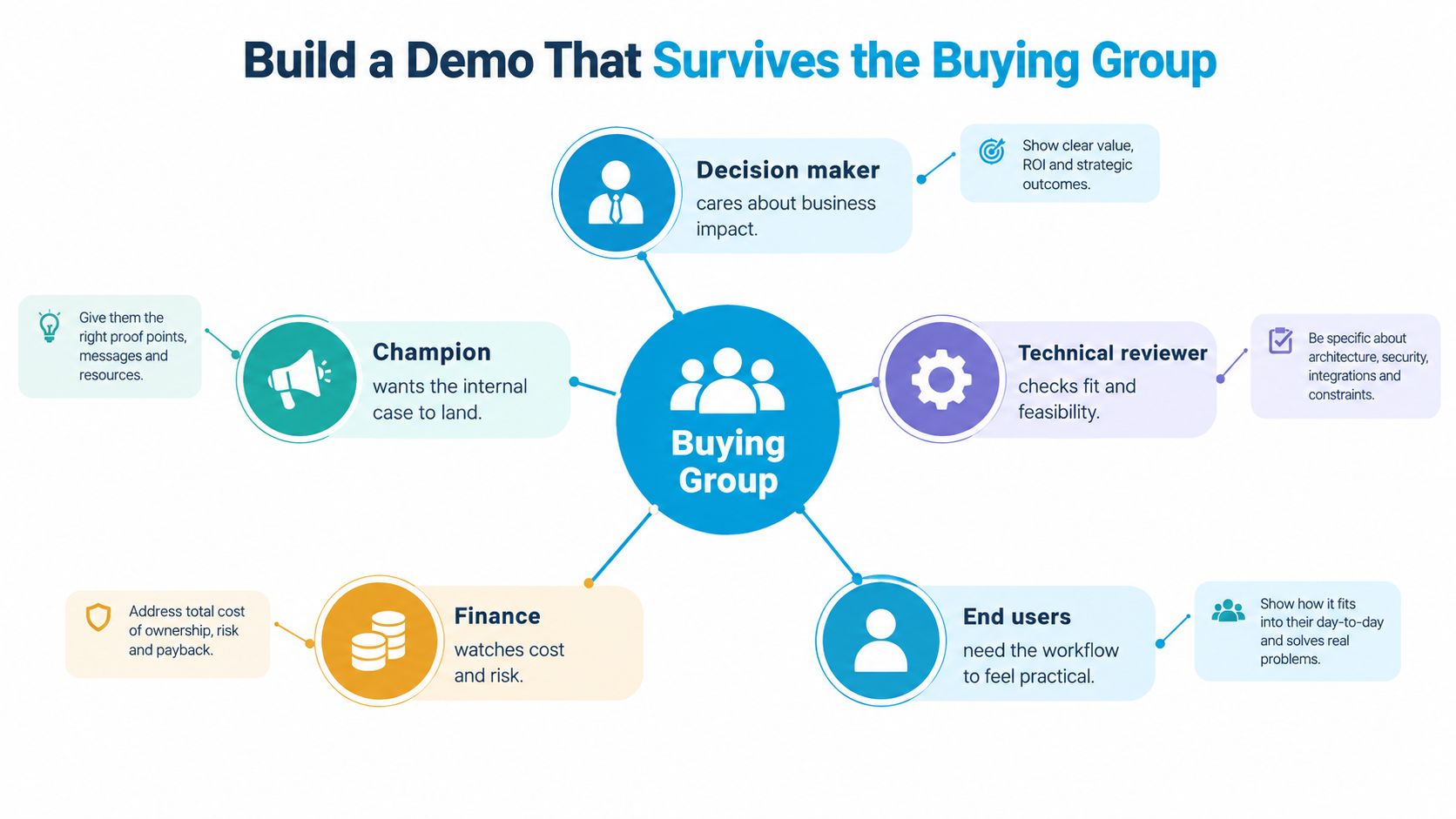
Gartner's dated 2025 public survey describes buyer teams ranging from five to 16 people across as many as four functions, based on research involving 632 buyers, as summarized in the 2025 B2B buying committee benchmarks from The Starr Conspiracy. The requester may not be the economic buyer, technical approver, security reviewer, end user, or procurement owner. Build for that reality.
Name the Roles Before You Prepare
- Technical fit: Who signs off that the workflow, data model, and integrations work?
- Business outcome: Who owns the result and defends the spend?
- Security and compliance: Who reviews access, data handling, and controls?
- End users: Who lives in the workflow every day and can block adoption?
- Procurement: Who runs terms, vendor checks, and the paper process?
Then prepare with a repeatable method. Segment the account by role, industry, workflow, pain point, and evaluation stage. Pick a small number of scenarios. Use realistic data or configuration. Label each step with the buyer outcome it proves, not the feature it shows. Personalization isn't a logo on slide one. It's the buyer's vocabulary, their process, and their edge cases in the data.
Build the leave-behind at the same time as the session. Take a hypothetical example. A security reviewer who missed the call still needs the control you showed, plus the audit evidence, in a one-page note. A full recording of twelve modules won't get watched and won't answer their question. Write the note for the person who wasn't there, because that person may hold the veto.
Tie that prep to a measurable outcome. The north star technical win rate article explains how to track whether sessions like these produce technical validation rather than polite interest. If your demo can't be forwarded and understood by four functions, it isn't ready.
Ask for Proof Not a Product Tour
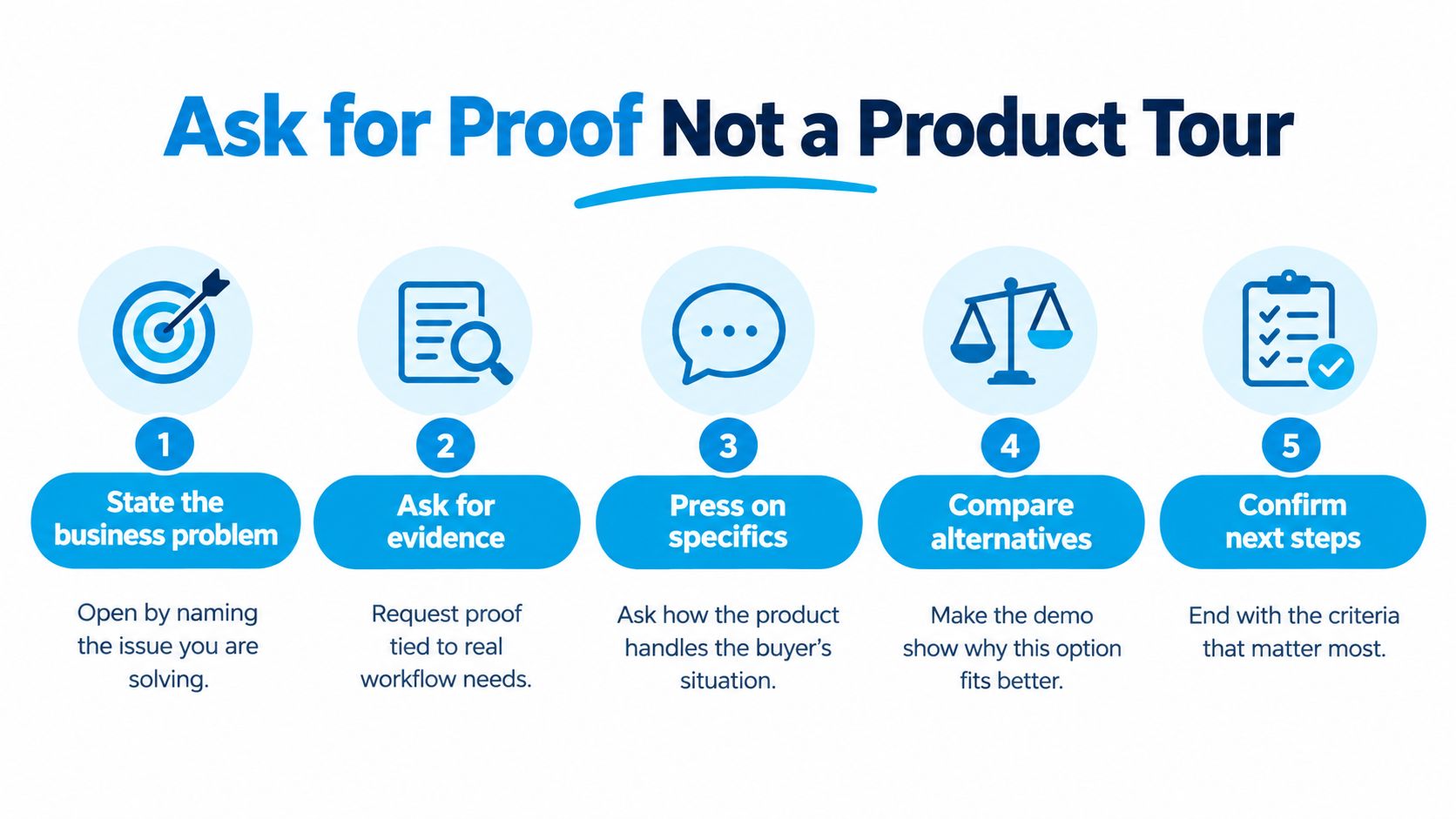
Run the live hour tight. Open by restating the agreed problem in the buyer's words. Show only the mapped workflows. After each scenario, ask a confirmation question: does this match how your team works, and if not, where does it break? Log unresolved requirements on screen. Use the final minutes to test whether the buyer's evaluation status changed.
Questions That Turn a Demo into Diligence
For AI products, move past ease-of-use theater. Recent procurement guidance flags risks including inadequate or biased training data, insufficient transparency, skills gaps, data lock-in, and vendor lock-in, and notes that 62% of buying groups in 2025 were reported as evaluating AI capabilities, per the OECD report on AI in public procurement. That makes AI diligence a normal demo topic, not a special track.
Ask these live, and write down the answers:
- Training and updates: How was the model trained, and how is it updated?
- Real examples: Can we run our own cases, including edge cases that usually fail?
- Human control: Where's the human override, and who approves an output before it ships?
- Audit trail: What gets logged, for how long, and who can read it?
- Ownership and exit: Who owns the data, outputs, and fine-tuned models, and what happens if we leave?
Bring a small test set with you. Define measurable acceptance criteria before anyone says pilot. The POC success criteria template gives you a clean pattern for pass and fail conditions, owners, and dates. Agree a written exit if the pilot fails. Credibility comes from showing controls and constraints, so show the limits on purpose.
Security buyers will ask for evidence in a form they can forward. If you need a model for how that evidence gets organized, the pentest report structure and evidence reference shows the level of structure technical reviewers expect. Match that discipline in your own proof notes. Feature claims fade. Documented test results travel.
The best demo sometimes proves where the product stops. Buyers trust an SE who names the boundary before the pilot finds it.
Choose How You Build Demo Skill
You can train the click path, or you can train the judgment. Only one of those holds up on a live deal.
Isolated workshops have a known failure pattern. A team learns a demo flow, returns to a full calendar, and the standard decays within days. Polish improves for a week. Discovery habits don't change, the gate doesn't get enforced, and unqualified requests keep landing on SE calendars.
Compare that with a year-round practice system. PreSales Unleashed GmbH runs the Trusted Advisor Academy as a 12-month membership built on Learn, Train, and Adapt, with 37+ hours of on-demand micro-video and 100+ assets including templates, checklists, phrasing guides, and KPI tools. Learning paths cover discovery, demo work, sales alignment, and POC or pilot management. Weekly live practice runs up to four sessions, including deal sparring, roleplays, and pitch practice on current opportunities. Members earn certificates and badges, and work alongside a community of 100+ SEs. For managers, the Trusted Leader Academy adds a monthly mastermind, quarterly playbooks, and coaching rhythms.
Delivery runs in English and German, scheduled in CET hours, so mixed regions can join the same sessions. If you're comparing options, the guide to choosing PreSales training lays out fit criteria, and enablement as a service covers the managed option for teams that want the operating rhythm handled for them. For demo-specific practice, start with the demo skills training overview.
A Simple Decision Test
- Choose a workshop if your only gap is presentation polish on already qualified deals.
- Choose ongoing practice if your gap is judgment: gating requests, running discovery, and converting demos to next steps.
- Choose a leader track if the standard exists on paper but varies by SE.
The honest question is whether your team practices the gate or only rehearses the click path. If demo-to-next-step conversion isn't moving, more polish won't fix it. Repetition on live opportunities will.
Turn the Session into a Technical Win
Supplier time is a small slice of the purchase. Gartner-derived reporting places supplier interaction at about 17% of total purchase time, with a typical buying group of six to ten people, and other reported research shows buying interactions for a significant B2B purchase rising from 17 in 2019 to 27 in 2021, according to the B2B buyer journey breakdown from LeadJourney. One generic demo can't cover that path. The session has to leave behind something the buying group can use when you're not in the room.
End every accepted session with one defined next step. A technical validation, a proposal, or a mutual evaluation plan. On the calendar, with a named owner, before you hang up. If you can't get that commitment, the demo didn't land, whatever the polite feedback says.
Define success before the session so the technical win is observable. Agree which workflows must work, which reviewers must see evidence, and what a pass looks like. When the criteria are written down, the technical win stops being a feeling and becomes a verdict the buying group reached themselves.
Three Field Rules for the Hour After
- Send the proof note the same day. One page per role that missed the call, tied to the criterion they own.
- Don't add modules for late arrivals. A stakeholder who joined at minute forty doesn't get a second tour. Send them the note and book a focused follow-up.
- Stop the POC if criteria were never agreed. An open-ended pilot with no pass conditions is unpaid support work. Renegotiate or walk away.
Now pressure-test your next request. Book a discovery call with SE Rockstars and bring one live opportunity where the demo gate feels shaky. If you want to see the full practice system first, review the Trusted Advisor Academy. If you want peer scenario exchange before buying a program, the SE Rockstars community is the low-commitment way in.
If your demos are polished but your deals stall, the problem is discovery, not delivery. PreSales Unleashed GmbH offers the Trusted Advisor Academy, a year-round program where Solution Engineers practice discovery, gating, and demo conversion on live deals with expert feedback. Visit to see the learning paths and bring one real opportunity to the first session.