
A discovery call feels sharp. The buyer describes a painful workflow, your demo maps cleanly to it, and the POC produces the expected result. Then the evaluation stalls. A new stakeholder questions the architecture, the timeline expands, and the champion starts comparing you against a familiar alternative.
The obvious explanation is usually “the buyer changed direction.” Sometimes that's true. Often, predictable judgment shortcuts shaped the opportunity long before anyone recognized the risk. The buyer anchored on an early estimate, the team overvalued a recent failure, or the SE mistook a familiar customer pattern for genuine qualification.
Heuristics and biases are the default operating system of a B2B software deal. The practical question isn't whether they exist. It's when to train judgment, when to redesign the workflow, and which shortcuts become more dangerous once AI enters discovery and demo preparation.
A Deal That Slipped and What Quietly Caused It
The opportunity looked healthy on paper. Discovery uncovered a real operational problem. The champion brought the right people into the demo. Your architecture answered the technical questions, and the POC met the agreed requirements.
Then the evaluation meeting changed tone.
A stakeholder opened with an implementation concern that hadn't appeared in discovery. The team treated a recent incident with another vendor as evidence that every similar project carried unacceptable risk. An early timeline estimate, created before the technical requirements were clear, became the reference point for every later discussion. Your team responded by adding scope, extending the POC, and explaining more features.
That response felt responsible. It may have made the problem worse.
The buyer was using familiar mental shortcuts to interpret uncertainty. Your team was doing the same. You accepted the opportunity because it resembled a successful customer. You kept investing because the POC already consumed significant effort. You treated the champion's original problem statement as the center of the evaluation, even after other stakeholders introduced different priorities.
Practical rule: When a deal feels “almost there,” inspect the decision mechanics before adding more product detail.
This is why no discovery, no demo remains a useful operating standard. Discovery isn't a prelude to the demo. It's where you identify the assumptions that will later control qualification, evaluation design, and the technical win. A polished demo can't correct a buyer's distorted reference point or an SE's untested conviction.
The rest of this guide treats heuristics and biases as field behavior. You'll see where they appear, what signals to watch, and which controls can change decisions rather than merely make people better at naming cognitive errors.
What Heuristics and Biases Actually Are
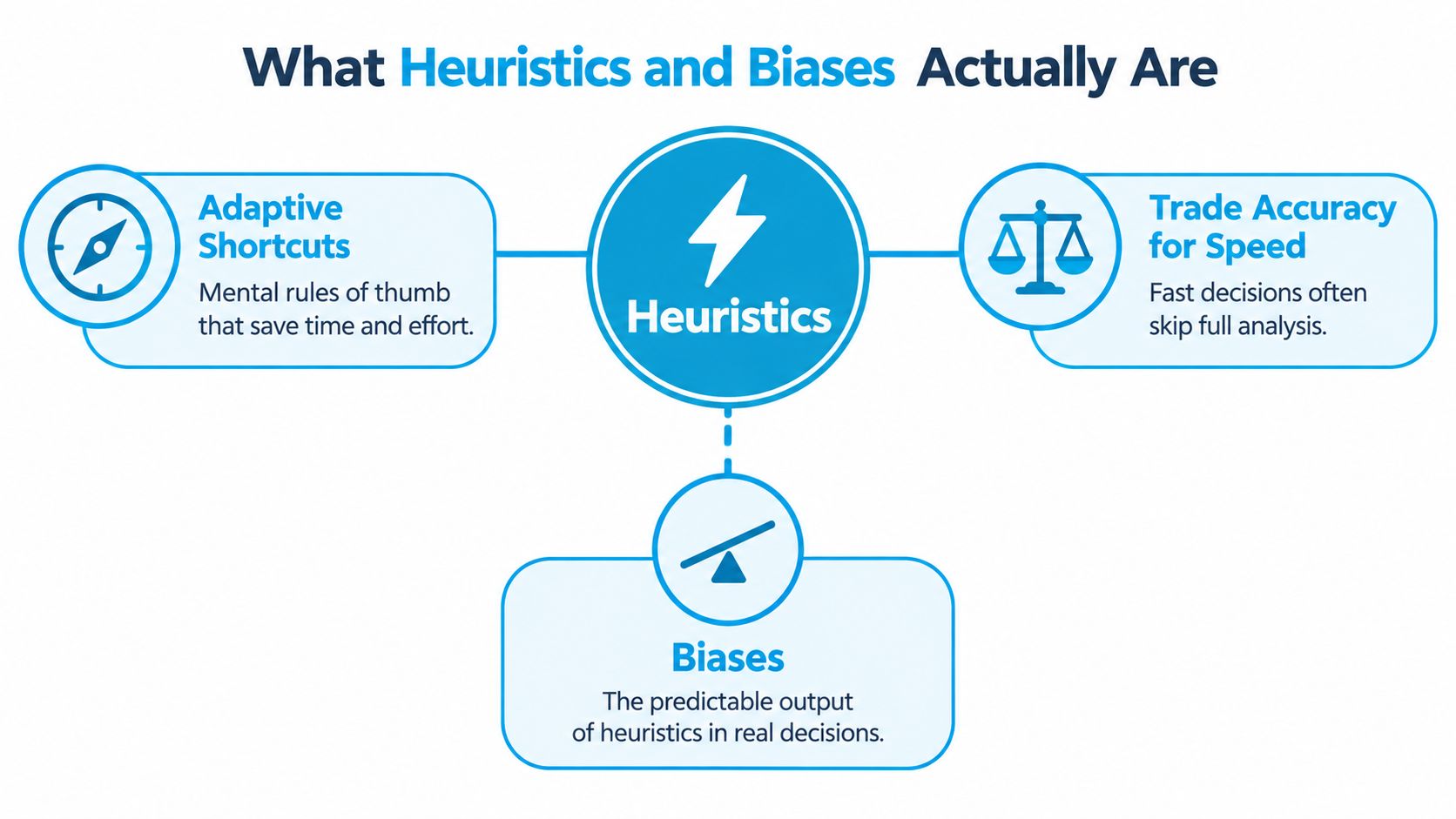
A heuristic is a mental shortcut. It reduces the time and effort needed to make a judgment when information is incomplete, expensive to gather, or difficult to interpret. A bias is a systematic and predictable error that can appear when the shortcut meets an unsuitable decision environment.
That distinction matters. Heuristics aren't automatically irrational. Research on fast-and-frugal decision-making describes them as adaptive rules whose performance depends on the environment, the quality of available cues, information costs, and the decision-maker's expertise. A short qualification checklist can help under pressure, but it can also fail when its cues are hard to retrieve or poorly matched to the opportunity.
Amos Tversky and Daniel Kahneman's 1974 paper, “Judgment under Uncertainty: Heuristics and Biases”, established three recurring shortcuts:
Representativeness
You judge probability by resemblance. In PreSales, a prospect has the same company size, technology stack, and stated use case as a successful customer, so the team assumes the opportunity belongs to the same category.
The risk is base-rate neglect. Similarity becomes a substitute for evidence about how often comparable projects succeed, what conditions made the earlier deployment work, and whether this buyer has the authority and resources to adopt.
Availability
You estimate likelihood by how easily examples come to mind. A recent implementation failure, security incident, or difficult migration becomes the reference point for a new evaluation because it's vivid and easy to recall.
The event may deserve attention. It doesn't automatically describe the current opportunity. Availability can make a memorable risk feel more common than the available evidence supports.
Anchoring and adjustment
You start with an initial value and revise it, but not enough. The anchor might be a timeline, business case number, implementation estimate, or an early architecture assumption.
The classic experiment associated with Tversky and Kahneman's work exposed participants to arbitrary anchors of 10 and 65 before asking them to estimate the percentage of African countries in the United Nations. The median estimates were approximately 25 and 45, a 20-percentage-point difference tied to an irrelevant starting value, as documented in the anchoring research.
For an SE, the objective isn't to remove every shortcut. It's to match the rule to the decision. Define which cues deserve trust, which require validation, and which should trigger escalation.
Biases That Distort Buyer Decisions
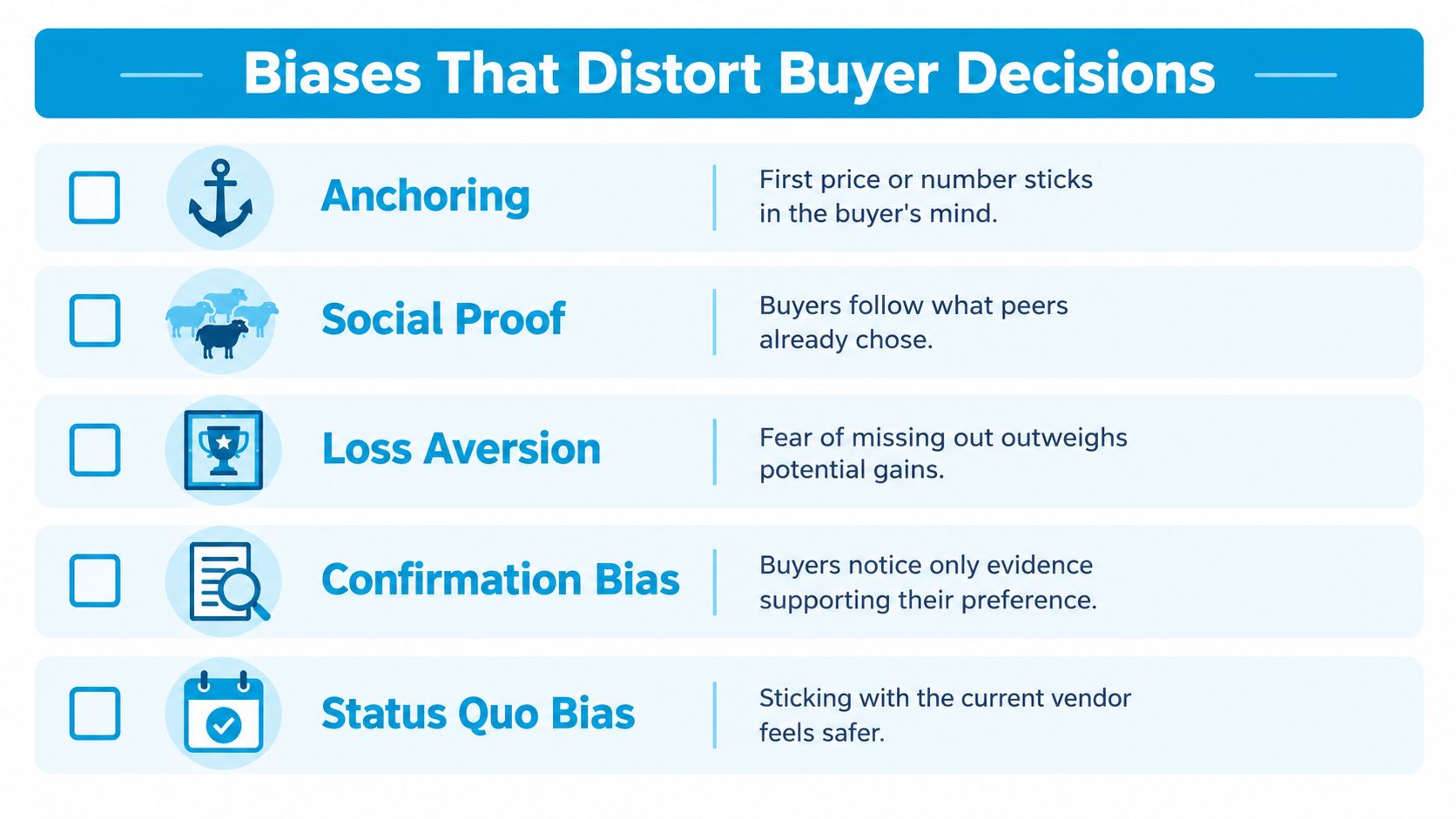
Buyers rarely announce, “I'm anchoring on the first number.” You hear it in the way they frame questions.
They ask whether your implementation can fit an estimate created before discovery was complete. They describe a recent failure and apply its risk profile to your architecture. They request proof from a peer company while ignoring evidence that challenges their preferred option.
The signals appear in evaluation design
Representativeness shows up when a prospect treats a familiar profile as proof of fit. The company resembles your ideal customer, so the buyer assumes the same architecture, adoption path, and outcome will apply. Ask what evidence confirms the underlying problem, measurable impact, decision authority, and conditions for adoption.
Availability appears when one vivid incident dominates risk discussion. A recent outage or failed rollout can become the buyer's mental model for every vendor. Separate the remembered event from the current controls, dependencies, and failure modes.
Anchoring freezes the evaluation around an early number or assumption. Tversky and Kahneman's original framework describes adjustment as insufficient revision from an initial value. In practice, ask which assumptions created the estimate, what changed since then, and whether the team would produce the same number independently today.
Confirmation bias filters the POC toward a preferred conclusion. The champion asks questions that validate the favored vendor, selects test cases that flatter the existing approach, or dismisses contradictory evidence as an edge case.
A senior SE watches the scoring criteria as closely as the questions. If the buyer keeps changing the test after an unfavorable result, the POC may be measuring reassurance rather than fit. If every concern gets answered with another feature, your team may be participating in the buyer's frame instead of testing it.
If the evaluation can't produce evidence that would change the buyer's mind, it isn't an evaluation. It's a justification exercise.
Write down the decision criteria before the demo or POC expands. Include disconfirming evidence, not only success conditions. That gives the champion a defensible buying process and gives your team a way to identify whether the technical win reflects genuine fit.
The Biases SEs Bring Into the Deal
SEs don't stand outside the decision system. Expertise can make a shortcut faster, but it can also make the shortcut harder to notice.
A familiar reference architecture may feel like pattern recognition. Sometimes it is. The difference is whether you can name the evidence that makes it appropriate for this buyer, rather than relying on the comfort of having used it before.
Where the shortcuts hide
You anchor on the first problem the champion mentions, then build the demo around it even after finance, security, operations, or an executive sponsor introduces a different decision criterion.
You anchor on the architecture that worked in a previous account. Instead of testing constraints, you translate the current environment into the old design.
You continue a POC because the team has already invested heavily. That's the sunk cost fallacy. Past effort can explain why a decision feels painful, but it can't improve the opportunity's current fit.
You overestimate the probability of success because previous deals went well. Confidence earned through experience becomes overconfidence when you stop checking the conditions that made those wins possible.
The IKEA effect can appear when an SE has built a custom workflow, integration, or demo environment. The work feels more valuable because you created it. A buyer's lack of enthusiasm then looks like a communication problem instead of evidence that the design may not matter to them.
Similarity bias affects stakeholder reading. You may trust a technical buyer who communicates like a previous champion and discount a quieter stakeholder whose concerns are less familiar. Rapport helps discovery, but rapport isn't validation.
A self-audit before the next high-stakes moment
Ask yourself:
- What evidence would make me disqualify this opportunity?
- Which assumption came from this buyer, and which one came from a prior deal?
- What did I learn from the latest stakeholder that contradicts my current plan?
- Am I extending the POC because the buyer needs it, or because we've already spent time on it?
- Would another SE reach the same conclusion from the documented evidence?
Use a MEDDPICC guide for Solution Engineers to keep qualification tied to observable buying conditions rather than personal confidence. A strong SE doesn't eliminate judgment. A strong SE makes the judgment inspectable.
Train Judgment or Redesign the Workflow
“Slow down” is advice, not an operating model. “Consider the opposite” can help, but it still depends on a person remembering the instruction at the exact moment pressure, familiarity, and deal momentum are shaping the call.
Debiasing works better when leaders treat it as a capability that requires practice, feedback, and measurement. A 2025 systematic review and meta-analysis synthesized 54 randomized controlled trials, 383 effect sizes, and 10,941 participants. Educational interventions produced a statistically significant but small reduction in bias likelihood, with Hedges' g = 0.26 and a 95% confidence interval of 0.14–0.39, according to the Nature Human Behaviour review. The same review found representativeness particularly difficult to reduce and cautioned that improvement on targeted tasks doesn't automatically transfer to real-world decisions.
That finding supports a practical decision rule.
Redesign the workflow when the decision repeats
Use structured criteria, review gates, escalation rules, and feedback loops when a decision happens frequently under similar conditions. Discovery qualification, POC entry, and forecast updates fit this pattern.
A workflow control can require independent scoring before group discussion. It can make disconfirming evidence mandatory. It can stop a POC when predefined exit conditions are met. These controls reduce reliance on memory and social pressure at the moment of decision.
Train judgment when context carries the decision
Use deliberate practice and feedback when the decision is rare, high-stakes, and context-rich. Executive discovery, complex architecture trade-offs, and politically sensitive evaluations need more than a checklist.
Training should explain the mechanism, provide a concrete strategy, and use realistic opportunities. The U.S. National Library of Medicine overview of heuristics notes that heuristic performance depends on conditions such as time pressure, information costs, and cue quality. Training that ignores those conditions may produce people who can define a bias without changing behavior.
Combine both for consequential decisions
A 2025 synthesis discussed by Bayes Business School's research summary distinguishes interventions aimed at decision-makers from interventions that redesign the decision environment. The practical answer for PreSales is rarely either-or.
Train the team to recognize the pattern. Redesign the workflow so the desired behavior happens even when attention is low. Then measure live decisions, not workshop completion or self-reported awareness.
Where AI Makes Bias Worse Instead of Better
AI can help an SE process more information. It can also make the first plausible interpretation feel authoritative.
That risk has two sources. The model may reflect bias in its data, prompts, or tuning. The user may apply human shortcuts to the output. A fluent recommendation can trigger automation bias, where the SE gives the output more weight than its evidence warrants. The first AI-generated account summary can become an anchor. A selective prompt can reinforce confirmation bias. A confident tone can create an authority effect even when the recommendation rests on missing context.
Where the shortcuts enter PreSales work
An AI discovery summary may fix on the champion's stated problem and underweight concerns raised by security or operations. AI demo preparation may select one use case because it appears most relevant, while ignoring an unspoken buying criterion. An AI-generated business case may produce a neat number that the SE adopts without testing the assumptions behind it.
The solution isn't to reject AI. It's to separate AI assistance from decision authority.
Use independent estimates before asking AI for a recommendation. Compare the unaided and AI-assisted versions. Record when users accept, modify, or override the output. For consequential decisions, require a written justification tied to customer evidence rather than fluency.
A useful adjacent practice is to audit how AI systems respond to framing, missing context, and leading inputs. A guide to AI search diagnosis for SEO offers a practical reference for examining whether an AI answer reflects the evidence or merely follows the question's framing.
For demo preparation specifically, read why LLMs give good demo advice only when context is the whole answer. The same principle applies to account research and discovery summaries. More output doesn't compensate for a weak problem definition.
Create an AI review record with four fields:
- Initial judgment: What did the SE believe before using AI?
- AI recommendation: What did the tool suggest, and on what evidence?
- Challenge: What alternative interpretation or missing stakeholder input was tested?
- Decision: What changed, and why?
That record makes automation bias visible without slowing every low-risk task. Use deeper controls where the decision affects qualification, architecture, POC scope, or the technical win.
An Operating Playbook for PreSales Decisions
A team doesn't need a long bias catalogue. It needs repeatable controls at the moments where judgment changes deal direction.
Use the table below as a starting operating checklist. The KPI should measure behavior in live opportunities, not whether someone completed a training module.
Decision Patterns for High-Stakes PreSales Moments
| PreSales Decision | Dominant Bias Risk | Structural Control | Observable KPI |
|---|---|---|---|
| Discovery qualification | Representativeness and confirmation bias | Score fit independently against documented problem, impact, authority, capability, and adoption conditions before calibration | Opportunities with evidence recorded for both fit and disconfirming factors |
| Demo design | Anchoring on the champion's first problem | Require stakeholder-specific outcomes and a review of alternative use cases before finalizing the narrative | Demos mapped to validated decision criteria, not only the champion's opening request |
| POC scoping | Sunk cost and confirmation bias | Set entry criteria, success measures, disconfirming tests, and exit criteria before build work begins | POCs closed or redirected when predefined conditions are met |
| Forecast calls | Anchoring and availability | Audit forecast changes against predefined triggers, recent evidence, and independent technical confidence | Forecast changes linked to documented evidence rather than meeting sentiment |
Independent scoring matters because group discussion creates a shared reference point. If the most senior person speaks first, later judgments can drift toward that view. Have each participant score the opportunity before calibration, then ask what evidence caused differences.
For POCs, use entry and exit criteria to make stopping a valid outcome. A POC that continues without new evidence consumes capacity and makes sunk cost harder to resist.
The same discipline applies to external inputs. If your team uses an AI-powered LinkedIn growth tool for account research or prospecting context, treat generated signals as inputs to validate, not facts to paste into discovery preparation.
Operating test: If a control changes documentation but never changes a decision, it's administrative work, not debiasing.
Review the KPI in deal retrospectives. Ask whether the control surfaced a contradiction, changed scope, stopped an unqualified POC, or improved stakeholder coverage. If nothing ever changes, the criteria may be decorative or the team may be avoiding honest evidence.
Making Debiasing Stick Beyond the Workshop
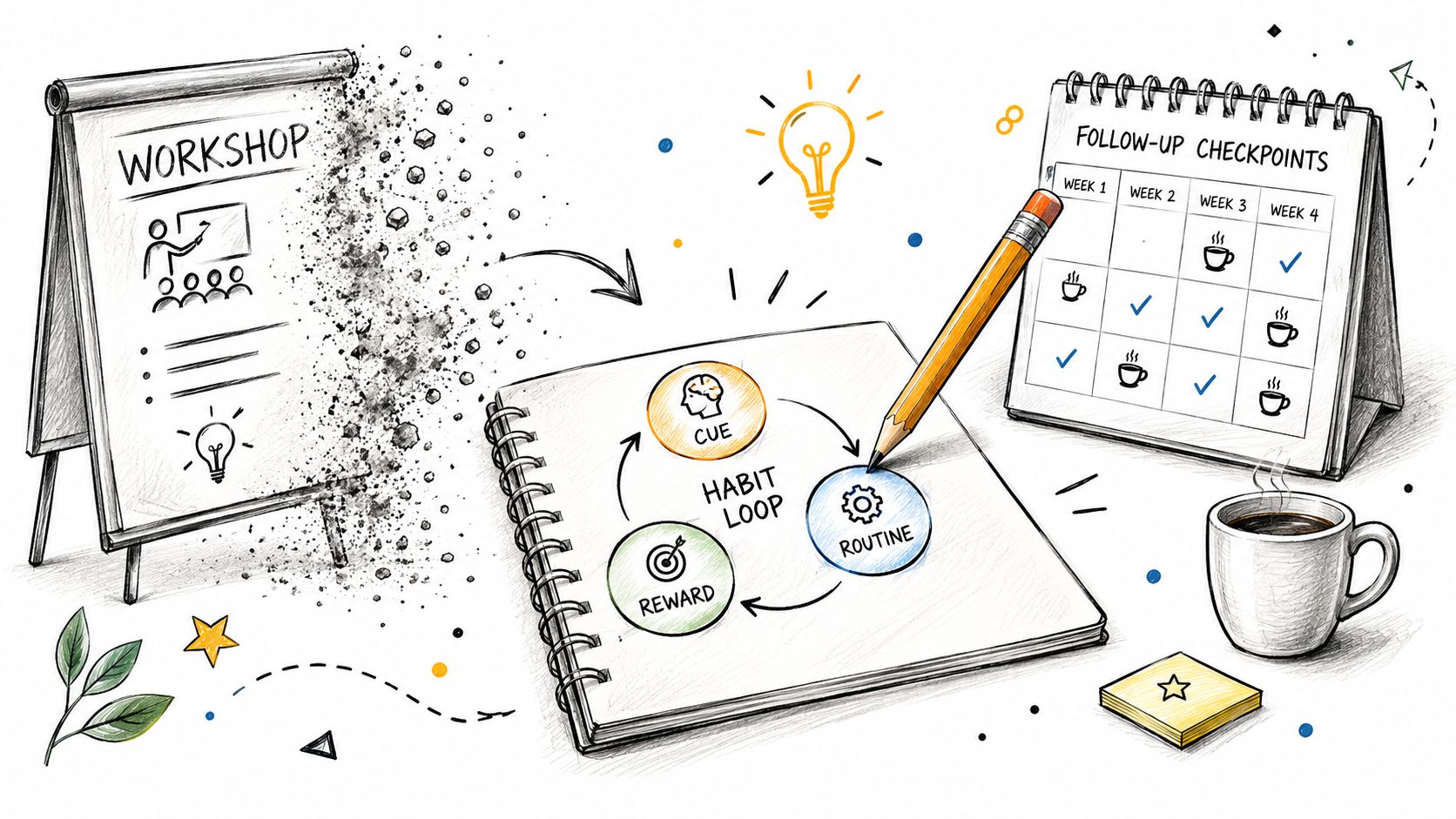
A workshop can give the team useful language. It won't create reliable behavior by itself.
The capability sticks when the team practices on active opportunities, receives feedback quickly, and revisits the same decision patterns over time. Spaced practice matters because the difficult moment isn't the classroom exercise. It's the forecast call after a strong demo, when everyone wants the opportunity to remain healthy.
Start, stop, and measure
Start with one recurring decision. Add independent judgment, explicit contradictory evidence, and a short review loop. Discovery qualification is usually a practical place because weak assumptions there contaminate the demo, POC, and forecast.
Stop rewarding activity that disguises uncertainty. More demo content, extra POC configuration, and longer evaluation cycles don't automatically improve the technical win. If the buyer's decision criteria remain unclear, more work can deepen the team's commitment to the wrong frame.
Measure observable behavior. Track whether SEs document alternative interpretations, record why forecast changes occurred, and close POCs against agreed criteria. Review delayed outcomes, not only whether the team felt more confident immediately after training.
A spaced repetition schedule can turn these behaviors into a recurring team rhythm. Pair it with deal sparring, roleplay, call review, and manager coaching on active opportunities. The target is not perfect rationality. The target is a team that notices when a shortcut no longer fits the decision environment.
This supports the central PreSales belief: discovery quality, not demo polish, decides deals. Bias awareness matters because it protects discovery, qualification, and evaluation design from predictable errors. The technical win becomes more reliable when the team tests assumptions before investing heavily in the answer.
Use the Trusted Advisor Academy as the structural model for this kind of capability building. Its Learn, Train, and Adapt approach connects practice, feedback, reusable assets, and current opportunities instead of treating debiasing as a single event. For SE leaders, that operating rhythm is more defensible than asking people to remember a list of bias names under deal pressure.
PreSales Unleashed GmbH helps PreSales teams build stronger judgment through structured discovery, live practice, deal feedback, and operating systems tied to the technical win. Visit PreSales Unleashed GmbH to build a repeatable capability that changes how your team qualifies, demos, scopes POCs, and forecasts.