
Stop chasing early adopters and writing off laggards as lost causes. That's the popular advice, and it's bad PreSales. Early adopters won't carry your number alone, and laggards aren't automatically irrational. They're buyers making different risk decisions. If you run the same discovery, demo, and POC for both, you'll bore one, scare the other, and lose the technical win you thought you'd already earned.
Why Treating Every Buyer the Same Costs You Deals
You know the pattern. The AE books the demo, you tailor the slides a little, and then you run your best flow for whoever shows up. A forward leaning CTO gets security checklists. A cautious operations director gets roadmap vision. Both nod politely. Neither moves.
That's not a demo quality problem. It's a discovery failure. You didn't identify what kind of adopter was sitting across from you before you built the proof.
The cost shows up late
Uniform motions don't fail loudly at the start. They fail at the end, where they're expensive.
- Wasted POC cycles: You scope for ambition when the buyer wanted safety, or for safety when the buyer wanted a strategic edge.
- Late stage stalls: A stakeholder you never read correctly raises risk objections after the technical evaluation should've closed.
- Weak champions: Your contact can't sell internally because your evidence doesn't match how their peers judge change.
- False technical wins: You win the demo and lose procurement, security, or operations.
If you're unclear on where PreSales owns that outcome, start with what PreSales actually does in a B2B sales cycle and why technical win rate works as a north star metric.
Practical rule: No discovery, no demo. If you can't name the buyer's risk posture, you're not ready to show product.
My position is simple. Branch your PreSales motion by adopter segment. Don't maintain one universal flow and hope personalization fixes it. Build distinct discovery paths, demo emphases, and POC scopes, then pick the branch early. Use a structured discovery call guide as the base, but adapt your questions once you spot the segment. Your job isn't to impress everyone the same way. It's to reduce the specific uncertainty blocking this buyer.
The Five Adopter Categories and the Diffusion Curve
Everett Rogers published Diffusion of Innovations in 1962, building on diffusion research that began in the United States around 1940, as summarized in Stanford's overview of Rogers's diffusion model. He divided adopters into five categories along an approximately normal distribution. Think of a new restaurant in your neighborhood. A few people try it on opening night. Respected locals go next and tell friends. Most residents wait for reviews. Some wait until everyone else goes. A few stick with their old place until it closes.
The model gives innovators 2.5%, early adopters 13.5%, early majority 34%, late majority 34%, and laggards 16%, according to the University of Oklahoma's summary of diffusion theory. Adoption often accelerates after roughly 10% to 25% of a social system has adopted, and innovators plus early adopters bring cumulative adoption to 16%, inside that range, as noted in the Stanford overview linked above.
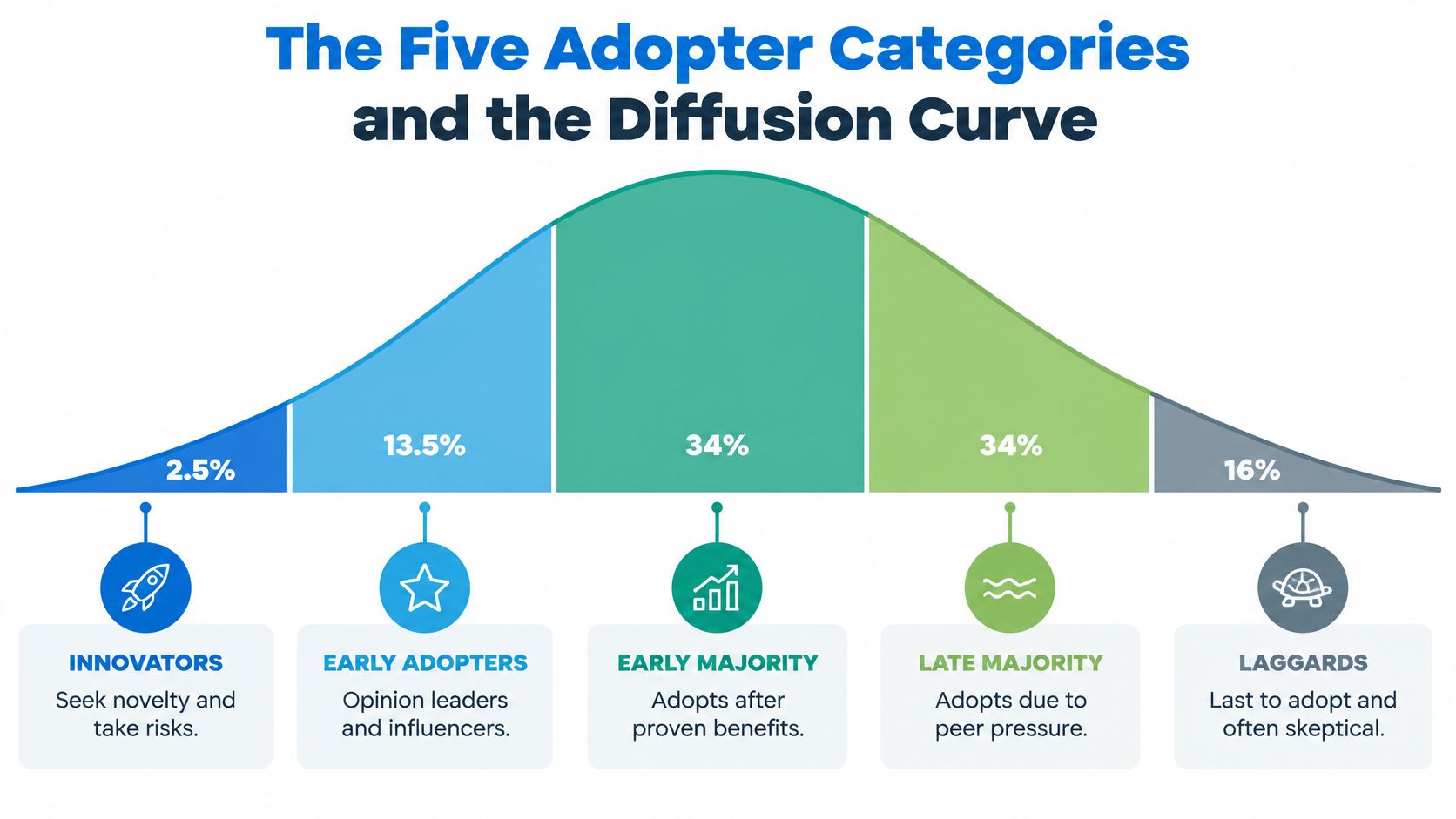
Adopter Categories at a Glance
| Category | Share of Population | Risk Tolerance | Evidence Threshold | SE Signal in a Deal |
|---|---|---|---|---|
| Innovators | First small slice | High | Low, novelty counts | Asks about architecture and limits |
| Early adopters | Second slice | High, calculated | Credible early proof | Wants strategic advantage, influences peers |
| Early majority | Large middle segment | Moderate | Peer proof, clear value | Asks who else uses it and how |
| Late majority | Large middle segment | Low | Broad acceptance, low risk | Focuses on support, cost, disruption |
| Laggards | Final segment | Very low | Established standard | Prefers current process, needs safety |
The commercial point matters more than the labels. The early majority and late majority together represent 68% of the population in Rogers's distribution, as described in the Stanford overview linked above. Innovator enthusiasm doesn't pay your quota. Mainstream readiness does.
Treat the curve as a planning heuristic, not a law of nature. Your work in a live deal is narrower. Spot the segment, adjust evidence and timing, and don't mistake early traction for mass market acceptance.
Early Adopters vs Laggards, What Actually Separates Them
Early adopters and laggards sit near opposite ends of the curve, but the gap isn't intelligence or openness to change. It's risk tolerance, resources, and evidence requirements.
The comparison below shows why one demo can't serve both groups well.
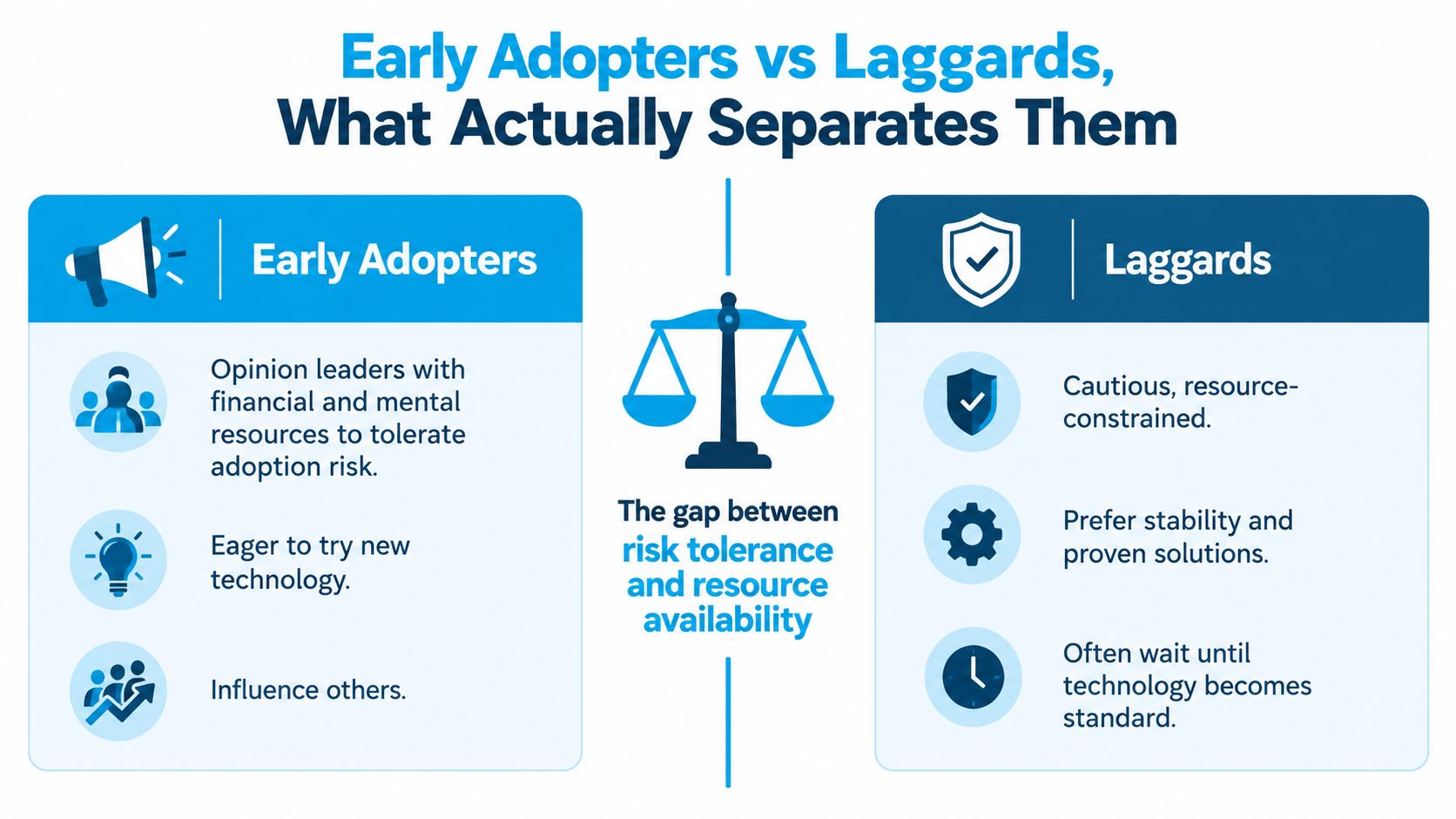
Rogers characterizes early adopters as opinion leaders with extensive connections inside and outside their social systems, plus the financial and mental resources needed to tolerate adoption risk, as explained in UCLA's summary of Rogers's diffusion framework. They evaluate something immature, translate it for peers, and lend it credibility. That makes them excellent reference customers, but poor proxies for mainstream buyers.
Laggards need the opposite conditions. They generally adopt later because they require stronger evidence, face greater constraints, or prefer established practices. Calling that irrational is lazy selling. It keeps you from asking about budget limits, staffing, compliance exposure, or a failed rollout that still shapes decisions. Those hidden shortcuts in judgment are worth examining through how heuristics and biases affect PreSales decisions.
What each group demands from you
- Early adopters: Give them influence, early access thinking, and room to shape the use case. They'll tolerate rough edges if the strategic payoff is clear.
- Laggards: Give them stability, compatibility, support, and a credible exit path. They won't tolerate ambiguity about disruption.
This short video gives a useful visual refresher on how diffusion moves through a population.
Don't confuse enthusiasm with representativeness. A POC that wins an early adopter can leave a late majority buyer cold because their success criteria differ. Both reactions give you information. Use them.
Reading the Buyer in Discovery
You don't identify an adopter segment by job title. You identify it by asking how this person has bought, implemented, and defended change before.
Early adopters must be distinguished from the much larger mainstream segments because they validate innovation for the early majority but require different proof, risk framing, and success criteria than later buyers do, as stated in a peer reviewed discussion of Rogers's adopter categories. That's why segment reading belongs in discovery, not in a post demo debrief.
Questions that surface the segment
- Prior change: "What was the last tool your team adopted before it was standard here, and what convinced you?"
- Reference expectation: "Whose experience would your team trust most, a peer company, an analyst, or an internal pilot?"
- Risk ownership: "If this rollout struggles in month two, who feels that pain first?"
- Decision network: "Who else has to believe this works before your team commits?"
- Failure memory: "What did a previous implementation teach you to never repeat?"
Listen to the language. Early adopters talk about future state, competitive position, and influence. Mainstream buyers talk about peer proof, integration fit, and measurable outcomes. Laggard leaning buyers talk about continuity, support, and rollback.
Don't rely on memory for those signals. Capture exact phrasing, named constraints, and who said what. You can transcribe client calls for better notes and review how each stakeholder frames risk after the call. Then feed what you learn into qualification. Pair segment reading with a practical discovery call framework for Solution Engineers and the qualification depth in MEDDPICC guidance built for Solution Engineers.
Don't ask if they're innovative. Ask what proof made them change last time.
One caution. A single account contains multiple segments. Your champion can be an early adopter while finance, security, and operations sit much later on the curve. Map people, not logos. That's how you avoid winning one stakeholder and surprising yourself with five blockers.
Tailoring Demos and Proofs by Adopter Segment
Once discovery tells you the segment, change the demo architecture. Don't just swap customer logos and call it ready-made.
The chart below maps the shift in emphasis as buyers move later on the curve.
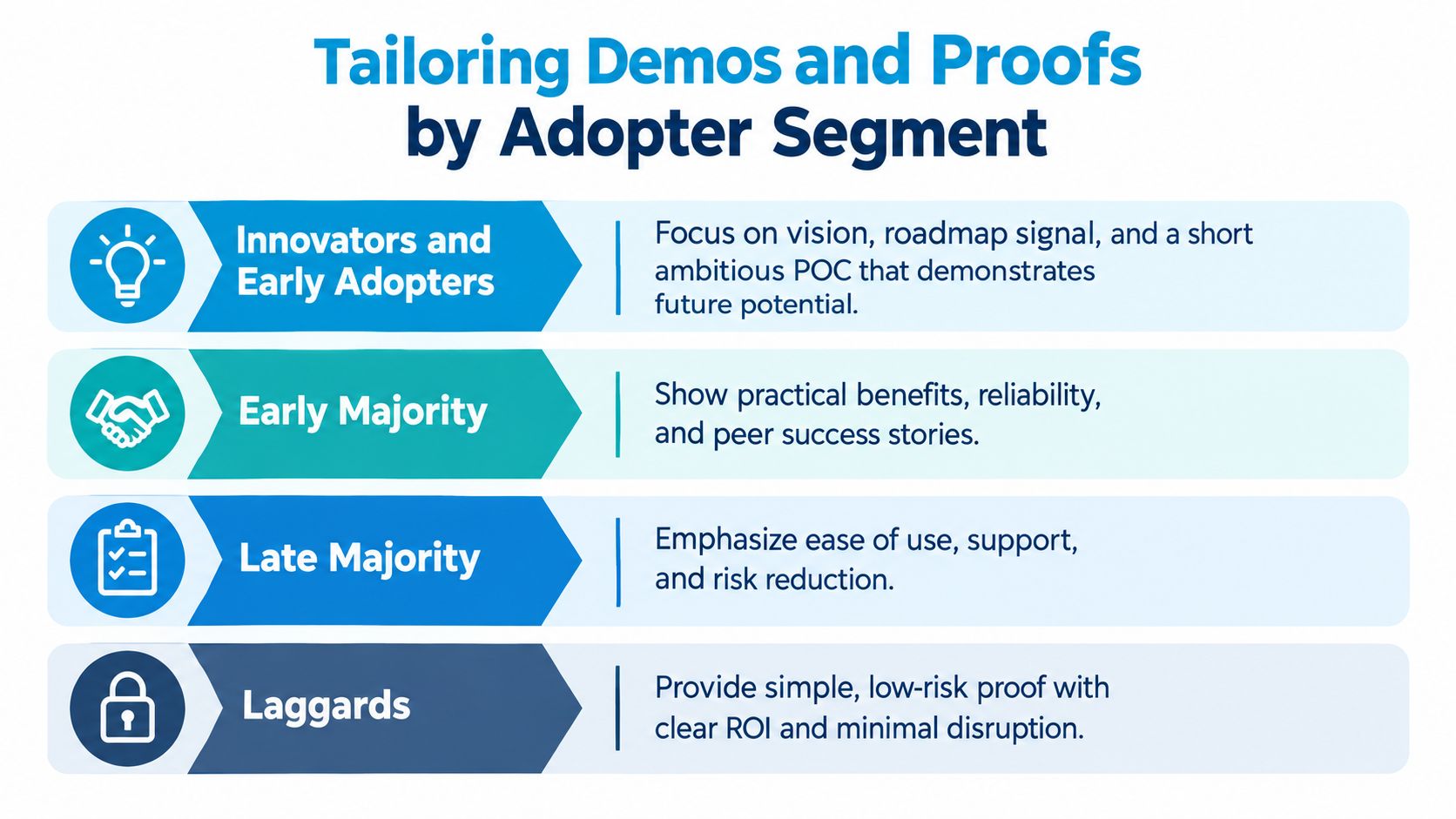
Demo and POC Adjustments by Adopter Segment
| Adopter Segment | Demo Emphasis | Primary Proof | POC Scope | Risk Framing |
|---|---|---|---|---|
| Innovators and early adopters | Vision, capability edge, roadmap signal | Ambitious pilot, direct access to product thinking | Short, focused, forward leaning | Managed experiment with clear learning goals |
| Early majority | Workflow fit, practical benefits, reliability | Reference architecture, peer stories, defined outcomes | Structured evaluation plan | Proven path with known implementation steps |
| Late majority | Ease of use, integration, support | Security evidence, operational proof, peer pressure | Narrow, low disruption scope | Risk reduction and predictable rollout |
| Laggards | Stability and continuity | Mature references, support model, dominant acceptance | Conservative pilot with rollback | Minimal change, clear safety net |
Consider a hypothetical early adopter call with a forward leaning CTO. She asks how your architecture will evolve, wants to test an advanced use case, and accepts that some admin features are still maturing. Give her a tight POC around strategic potential. Let her shape success criteria. Don't drown her in basic onboarding material.
Now take a hypothetical late majority call with an operations director under audit scrutiny. He asks about access controls, reporting, training load, and what happens during peak volume. Roadmap vision won't move him. Show integration behavior, support escalation, and a rollout plan that protects daily operations.
Demo rule: Show the future to buyers buying advantage. Show the safety net to buyers buying certainty.
Both demos can be honest and technically strong. They just answer different questions. If you need a baseline for structure, use a clear software sales demo approach, then branch it. The right demo is the one discovery earned. It isn't the one your team rehearsed most often.
Building a PreSales Motion That Serves Every Segment
Segment awareness won't scale if every SE improvises it deal by deal. Standardize the branches.
Build three reusable paths. A visionary path for innovators and early adopters. A reference driven path for the early majority. A stability first path for late majority and laggard leaning buyers. Each path needs its own discovery prompts, demo flow, proof artifacts, POC template, and objection responses.
What managers should standardize
- AE and SE handoff fields: Require segment hypothesis, evidence threshold, named blockers, and prior change history before demo prep starts.
- Demo library: Tag flows by segment, not just by product area or industry.
- POC templates: Include ambitious, structured, and conservative scopes with different success criteria.
- Reference library: Sort customers by maturity and credibility type, not only by logo size.
- Deal reviews: Ask which segment each stakeholder represents and what proof remains missing.
Timing matters too. Bring the SE in before the AE promises a generic demo date. If your team still treats SEs as demo support, revisit what a Sales Engineer actually does across the cycle and clarify ownership early. A late SE can still present well, but they can't recover discovery that never happened.
Measure the effect. Track technical win rate, POC duration, and stall reasons by segment mix in the account. Don't just count demos delivered. A team that wins early adopters and loses operations has a branching problem, not a presentation problem.
Consistent branching beats heroic customization. When an SE recognizes the segment in the first call, they can choose the right path in minutes. That protects capacity for unqualified RFPs, generic demos, and open ended POCs. Teams that want outside help building those habits can evaluate enablement as a service for PreSales teams or compare options through guidance on choosing PreSales training.
When Laggards Are Not Resistant, Just Rational
Sometimes delayed adoption is the smart move. Stop treating laggards early adopters as a maturity ranking with winners at the front and failures at the back.
The image below is a reminder that caution often comes with accountability. People who carry legal, operational, or budget risk should ask harder questions.

Recent enterprise AI research reports that 16% of decision-makers use AI less than weekly, with workplace restrictions, budget constraints, slow-adopting industries, and low trust named as major causes, and manufacturing and retail lag because of more complex physical operations, according to the Wharton and GBK enterprise AI adoption report. The same verified research summary notes that advanced economies may adopt technologies 20 to 80 years before the global average, while parts of Africa adopt some technologies 10 to 50 or more years later.
Those gaps reflect infrastructure, skills, financing, regulation, and physical operations. They aren't character flaws. If deployment depends on plant downtime, frontline staffing, connectivity, or local compliance, waiting can protect the business.
Your response should change accordingly. Don't push urgency. Specify prerequisites, readiness milestones, language and accessibility needs, and risk controls. Ask what condition would make adoption rational later. Sometimes the right recommendation is a smaller pilot, a later start, or no POC yet.
That honesty builds trust. It also keeps you from burning weeks on a deal that can't implement successfully today.
Discovery Wins the Deal, Not the Demo Slide
If you can't tell which adopter segment sits across from you, you can't choose the right demo or scope the right POC. You'll keep polishing slides while the actual objection stays hidden.
Train your team to spot segment signals in the first serious conversation. Standardize the branches in your demo library. Measure technical wins against the segment mix in your pipeline, not just deal count.
Discovery quality decides deals. Demo polish only matters after discovery has told you what this buyer needs to believe. Start there, and book a discovery call to pressure test your current motion if your team keeps running one flow for every stakeholder.
If your SEs can present well but can't read buyer risk, tailor proof, or protect the technical win across different adopter segments, get structured help. PreSales Unleashed GmbH runs the Trusted Advisor Academy for Solution Engineers (SEs) and PreSales leaders, with live practice on active deals, reusable discovery and POC assets, and coaching tied to measurable behavior change. Visit the site, review the academy path that fits your team, and start building a motion that branches by buyer instead of defaulting to one demo.