
Your newest Solution Engineer (SE) started three weeks ago. They've clicked through forty product slides, completed every compliance module, and sat in on six customer calls without a briefing beforehand. On call seven, an Account Executive asks them to jump straight into a live demo without discovery. The demo misses the prospect's real pain, the buyer goes quiet, and the AE decides it's faster to pitch solo next time.
That breakdown happens when leaders treat onboarding team members like an IT access ticket paired with a playlist of recorded product tours. In B2B SaaS PreSales, product familiarity isn't field readiness. A Solution Engineer has to run structured discovery, defend qualification boundaries, manage proof-of-concept scope, and earn the technical win alongside sales.
Role complexity dictates ramp length. As SHRM's guide to designing an effective onboarding strategy notes, roles like project managers and project engineers rely on a 90-day onboarding program, whereas less technical roles often run closer to three weeks. Solution Engineering combines technical depth, stakeholder alignment, and live deal execution, so a three-week orientation leaves new hires guessing on revenue calls. The fix is a staged 90-day capability build anchored by observable gates tied directly to live opportunities.
The 90-Day Onboarding Plan at a Glance
Structured onboarding directly shapes whether new hires stay and contribute. Nearly one-third of new hires leave within their first six months, while research summarized in SHRM's guidance on good onboarding found that employees who completed a structured onboarding program were 58% more likely to remain with their organization after three years. Organizations running a standard onboarding process also reported 50% greater new-hire productivity.
Honesty matters here. Onboarding alone won't rescue a bad hire, weak compensation, broken territory design, or an absent manager. Hiring quality and day-to-day leadership carry equal weight in retention and revenue output. Structured onboarding is the piece of the system you control the moment a candidate signs the offer, turning early goodwill into repeatable deal habits.
Instead of tracking slide views, build your 90-day plan around four phases with a named owner and an observable exit gate for each stage.
| Phase | Focus | Owner | Exit gate |
|---|---|---|---|
| Before day one | Outcomes, access, named manager, peer contact | Hiring manager | Written role outcomes and working access on day one |
| Days 1-30 | Role clarity, product and process knowledge, supervised work | Manager and peer buddy | Explains architecture, qualification boundaries and handoffs |
| Days 31-60 | Progressively harder real tasks with written feedback | Manager | Runs a scoped discovery or demo segment with feedback |
| Days 61-90 | Independent performance and next development plan | Manager and new hire | Supports a defined opportunity independently and agrees next plan |
Six Metrics That Keep the Ramp Honest
A table gives you structure, but you still need operational proof that the ramp works across cohorts. Track six measures alongside your four phases: time to productivity, 90-day retention, new-hire satisfaction, role clarity, manager effectiveness, and completion.
Watching these six together prevents blind spots. Completion alone only confirms that someone finished a course in your LMS; it won't tell you if they froze during a technical qualification call. Pairing role clarity and manager effectiveness with time to productivity reveals whether a slow ramp stems from a hiring miss or from missing internal support.
Pick one Solution Engineer role on your team today, write its four exit gates on a single page, and send that document to your next hire before their laptop ships.
Sharing the gates early removes guesswork for the new hire, their peer buddy, and the AEs they'll support. Everyone knows what readiness looks like before the first customer meeting hits the calendar.
Set Role Expectations and Access Before Day One
Most first-week chaos starts before a new hire ever opens their laptop. The SHRM Foundation guide to onboarding new employees identifies role clarity, resources, encouragement, and scheduled check-ins as core manager responsibilities during the first month, and Atlassian notes that a written team charter streamlines ramp by documenting roles, purpose, and objectives. In complex B2B deals, fuzzy boundaries create duplicated prep, late SE pull-ins, and unsupported technical commitments.
Run a five-step preboarding sequence before day one so your new hire logs into clarity rather than waiting on tickets.
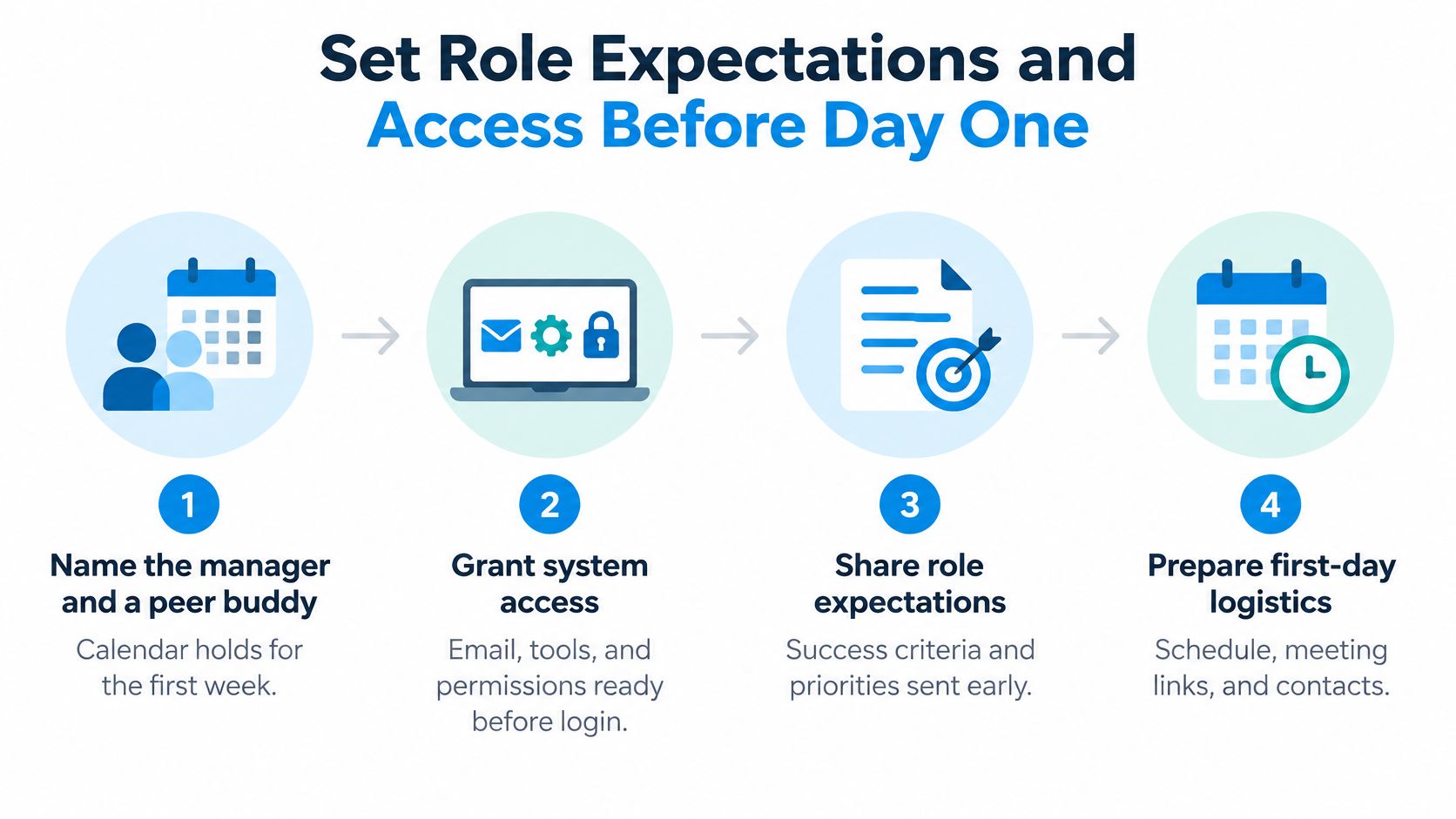
- Assign the hiring manager and a peer buddy early. Put recurring calendar holds across the first 30 days before the start date arrives. Teams often pick a buddy casually on day two, leaving the new SE unsure who can answer everyday workflow questions without interrupting deal work.
- Publish a written team charter. Spell out what a Sales Engineer owns versus the Account Executive across discovery, demo strategy, security questionnaires, POC scope, and technical validation. Leaders skip charters because everyone assumes the split is obvious, right up until an AE volunteers an unvetted custom build during a call.
- Complete the full system access checklist by day zero. Provision CRM seats in Salesforce or HubSpot, call libraries like Gong or Chorus, demo tenants, architecture docs, pricing and packaging guides, and Slack escalation channels ahead of login. Opening IT access tickets on day three burns half of week one on idle waiting.
- Write day-90 outcomes in plain language. Replace vague ambitions like "learn the platform" with specific target milestones the new hire can repeat back to you, such as owning discovery and technical qualification for mid-market opportunities in one product line.
- Send a structured first-week agenda. Lock in manager check-ins on days 1, 5, and 10 alongside focused shadowing blocks so the new hire sees a deliberate rhythm rather than an empty calendar or back-to-back coffee chats.
The First-Call Readiness Test
Apply one practical check before your new SE joins a live customer call. Ask them to pull up your team's operating rules and name the exact owner for security reviews, demo environment resets, and technical escalations.
If they can find those rules in under a minute and name the right contacts, they're ready to observe or support a call. If they hesitate, fix the documentation gap before putting them in front of a buyer.
Build a Learning Plan That Moves People to Live Work
The highest-risk onboarding mistake is mistaking information transfer for capability development. According to research compiled in Doitify's onboarding statistics overview, only 12% of employees strongly agree their organization does onboarding well, even though reported research links strong onboarding with 82% higher new-hire retention and more than 70% higher productivity. Treat those retention and productivity figures as directional associations across different study designs, not guaranteed outcomes, and pair your learning path with short pulse surveys at days 7, 30, 60, and 90 to spot missing access or unrealistic workload early.
A working learning plan moves a Solution Engineer from understanding the product to executing in live deals. Sequence the work in four strict steps so knowledge turns into muscle memory.
Start with company, ICP, and customer context, covering product architecture, buyer personas, and qualification rules. Move next to tools and internal workflows, including CRM hygiene, demo tenant resets, and technical escalation paths. Third, rehearse high-stakes behaviors in low-risk scenarios, beginning with mock discovery calls because discovery quality, not demo polish, decides deals (no discovery, no demo). Finally, transition to supervised live segments on real opportunities.
Run every rehearsal through a four-part deliberate practice loop: pick one realistic customer scenario, run a timed rehearsal, deliver written feedback against a clear rubric such as a structured discovery call guide, and schedule a second attempt before the hire touches a live buyer. Effective Sales Engineering training follows this same field-first principle, where members apply frameworks to their current deals and receive feedback on their own discovery calls, demos, and POCs.
Four Pitfalls to Audit Against Today
Before your next hire starts, check your current onboarding doc against four common failure modes:
- Overloading week one with LMS modules: Cramming dozens of recorded videos into five days produces fatigue and near-zero recall once live calls begin.
- Leaving the manager passive: Treating self-paced content as a substitute for manager-led deal context forces new SEs to guess what matters to real buyers.
- Measuring completion instead of competence: Counting green checkmarks in a training portal hides whether the hire can handle a tough architecture question or push back on an unqualified demo request.
- Cutting support after week one: Stepping back right when customer calls start leaves new hires isolated at the exact point where stakes climb.
Practical Habits for Distributed and Global Teams
Remote and hybrid setups amplify weak prioritization. A 2025 TalentLMS and BambooHR survey of 1,156 U.S. employees found that only 61% of fully remote hires felt onboarding accelerated their ability to contribute, compared with 73% for hybrid and 69% for in-person hires, with information overload ranking as remote hires' top obstacle. In that same survey, team welcome led belonging drivers at 53%, ahead of manager support at 48%.
To prevent overload across regions, keep one shared learning path per role, run one live practice session per week rather than daily drills, and block separate calendar time for reading versus doing. Standardize core exit gates and checklists globally while letting local leads adapt customer examples, languages, compliance notes, and time-zone schedules. Open your current onboarding folder this week and cut anything that falls into the four pitfalls above.
Coach Each Week and Define the Manager's Role
Telling a PreSales manager to "check in regularly" isn't an operating plan. Manager involvement is a measurable mechanism: Gallup's research on effective onboarding programs reports that employees are 3.4 times more likely to rate onboarding as successful when their manager takes an active role. Employees who describe their onboarding as exceptional are also nearly twice as likely to feel fully prepared and 2.3 times as likely to say the job meets or exceeds expectations.
Put manager time on the calendar before day one rather than assuming enablement videos will coach your hire into deal readiness.
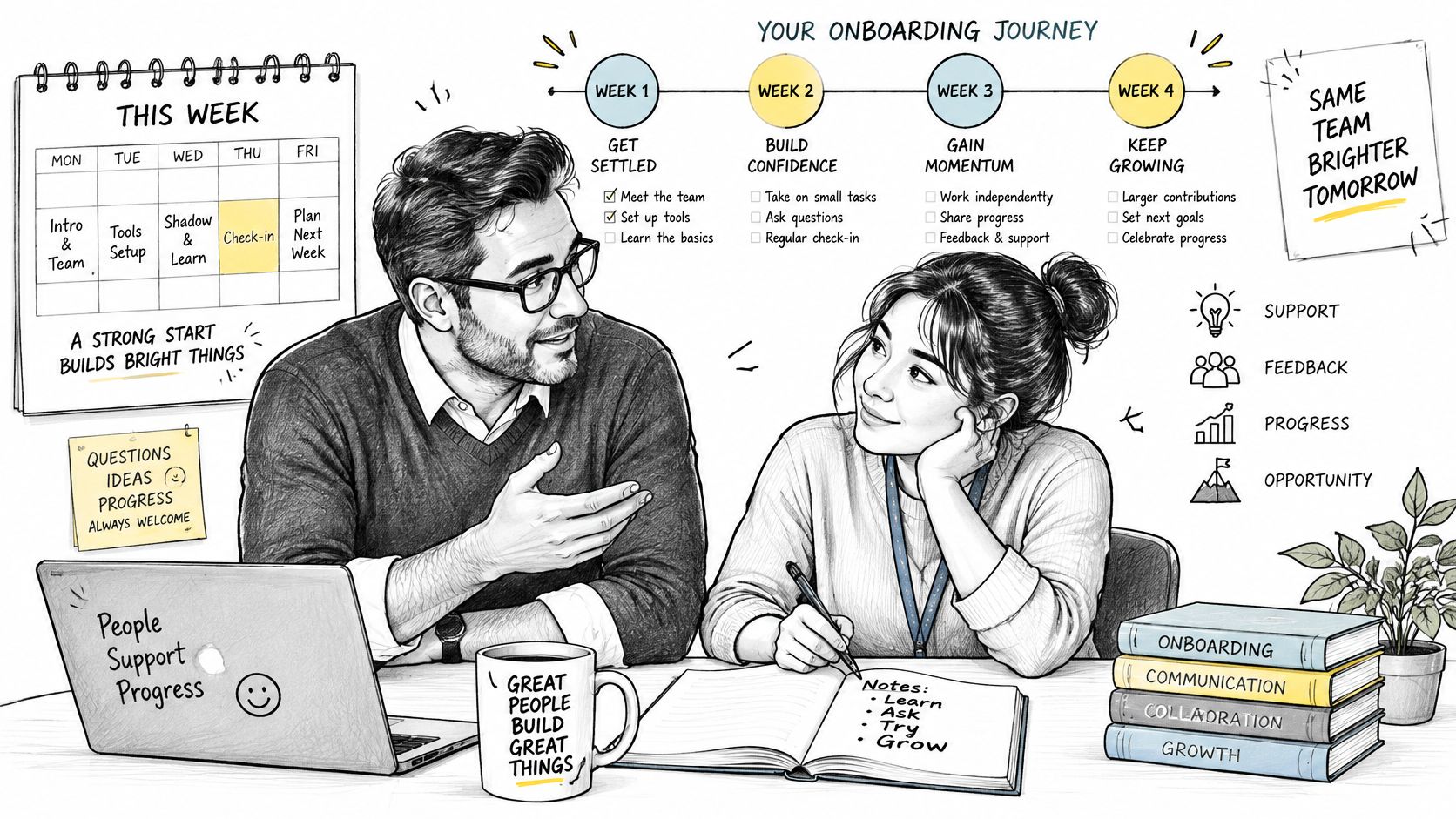
A Week-by-Week Coaching Rhythm
Benchmarking cited in TeamOut's employee onboarding statistics puts median time to full productivity at about 65 days, which means manager coaching has to evolve across all three months instead of fading after week two. Structure your calendar in three distinct cadences:
- Weeks 1-4 (weekly 30-minute check-in): Focus strictly on removing blockers, confirming access, and setting the top three priorities for the week.
- Weeks 5-8 (fortnightly work-sample review): Pull two call recordings, discovery notes, or demo prep sheets and give direct feedback grounded in structured sales coaching for managers.
- Weeks 9-12 (monthly gate review): Assess live deal execution against your written exit standards and map the next quarter's skill priorities.
Across every phase, your job as hiring manager is translation. Turn general company enablement into explicit field rules: name the exact discovery calls your SE will attend, clarify how technical qualification moves a deal forward, state what "ready to demo" requires, and explain how you'll score performance. Watch early friction signals like time to complete a first independent task, the sharpness of the hire's questions, and how quickly they build relationships with AEs and product specialists.
Boundary on early autonomy: Don't chase early independence at all costs. Carefully staged dependence with clear decision rights and frequent feedback builds faster, more durable deal execution than pushing a new hire into an unstructured "quick win."
Coaching also sticks faster when the entire group reinforces the same language. Sustainable behavior change happens when the full team joins the enablement rhythm together, including the lead, so tenured peers model the exact discovery and qualification habits you expect from new hires. The walkthrough below breaks down practical coaching habits PreSales leaders can apply during those weekly sessions.
Five Weekly Manager Actions
Keep your weekly involvement concrete with five repeatable habits:
- Pre-brief one live call so the new SE knows their exact role before dialing in.
- Debrief one recorded interaction using two strengths and one focused adjustment.
- Verify AE alignment by asking both partners whether discovery and demo ownership feel clear.
- Clear one operational blocker before the hire loses momentum waiting on another department.
- Log one piece of evidence against the upcoming 30-, 60-, or 90-day gate so reviews never rely on memory.
Progress Gates That Prove Field Readiness
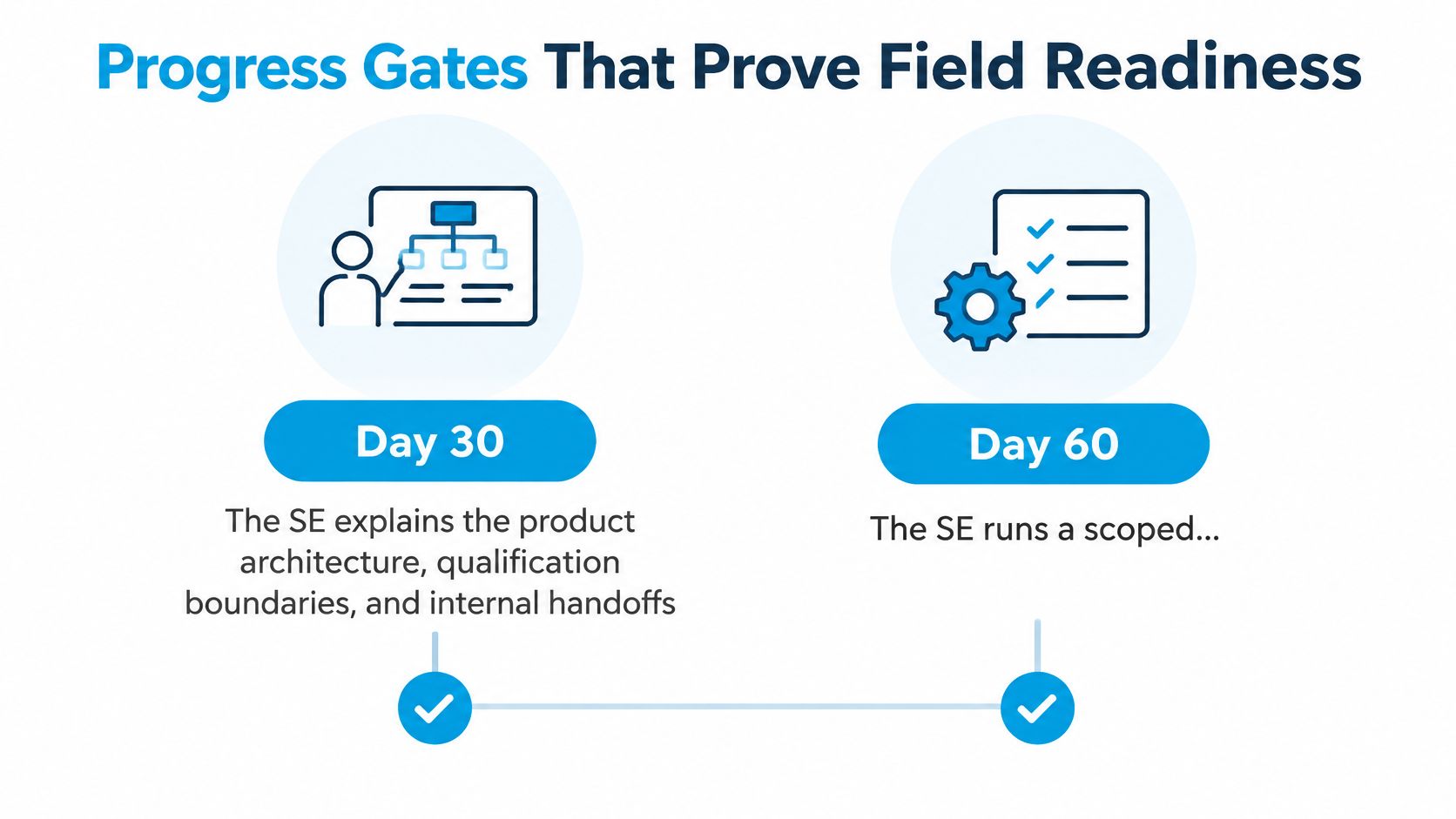
Completion certificates measure attendance, not readiness for a competitive enterprise evaluation. Instead, run observable gates at days 30, 60, and 90 that verify real deal capability.
| Checkpoint | Observable proof | Evidence to review |
|---|---|---|
| Day 30 | Explains product architecture, qualification boundaries and internal handoffs | Team charter walkthrough and recorded mock discovery |
| Day 60 | Runs a scoped discovery or demo segment with feedback | Call recording and written feedback from the manager |
| Day 90 | Supports a defined opportunity independently within the deal process | Deal records, CRM notes and stakeholder log |
As illustrated below, the first two checkpoints shift a new hire smoothly from internal fluency to supervised live execution before granting full opportunity ownership.
Running the 30-Minute Gate Review
SHRM's guidance on multi-month onboarding recommends dedicated conversations at 30, 60, and 90 days to surface roadblocks while corrections remain inexpensive. Run each gate as a focused 30-minute review grounded in artifacts rather than gut feel. Bring the team charter, call recordings, written demo notes, and CRM deal records, and evaluate qualification rigor using explicit entry and exit criteria alongside frameworks like MEDDPICC for Solution Engineers.
Use these reviews to revisit territory coverage, escalation paths, CRM hygiene, sandbox stability, and AE partnership habits. To catch quiet role confusion that call recordings miss, pair your checkpoint review with targeted new hire role clarity survey questions from MyCulture.ai.
Avoid measuring your team against a single universal ramp number. As SurveyMonkey's guide to onboarding success metrics shows, technical ramp estimates vary sharply by background, running roughly 4.8 months for technical hires overall, 15 weeks for same-sector hires, 32 weeks for cross-sector hires, and 40 weeks for new graduates. Set an internal baseline for each SE job family and track cohort-over-cohort improvement.
Keep practice safe while keeping field gates strict. When you use outside enablement platforms, team-level and anonymized adoption reporting lets leaders monitor engagement without exposing how a named individual performed in a role-play. Save individual scoring for live deal artifacts at your 30-, 60-, and 90-day reviews.
What to Do When a Gate Fails
A missed gate isn't an automatic performance warning; it's diagnostic data. Follow a three-step response whenever a new hire falls short:
- Name the exact gap in writing: Specify whether the issue is architecture knowledge, discovery sequencing, or CRM follow-through.
- Set one retest date: Book a follow-up check 10 to 14 days out with one targeted practice assignment.
- Audit your system before blaming the hire: Confirm that broken demo tenants, skipped AE prep calls, or fuzzy escalation rules didn't cause the miss.
A gate only earns trust when managers fix internal process gaps as quickly as they coach individual skill gaps.
Confirm the Team Charter This Week
Reading another onboarding framework won't change your next hire's first quarter. Writing down your operating rules will. The minimum move that pays off immediately is drafting the team charter and four exit gates for one Solution Engineer role, then booking the day 1, 30, and 60 check-ins before your next start date hits.
Your Seven-Day Launch Checklist
Keep the scope tight so it ships this week:
- Draft the team charter with your Account Executive lead. Put discovery ownership, demo qualification rules, security response duties, and POC boundaries on one shared page.
- Block the manager's coaching cadence on the calendar. Reserve recurring 30-minute weekly check-ins for month one and biweekly call-recording reviews for month two before the offer converts to a start date.
- Select one live practice scenario for month one. Pull a real anonymized opportunity from last quarter so your next SE can rehearse discovery and qualification before facing a live prospect.
Building every discovery rubric, practice session, and leader cadence from scratch takes bandwidth most growing PreSales teams don't have. Several Enablement-as-a-Service customers have made the Trusted Advisor Academy part of standard onboarding, so every new SE runs the twelve months as part of getting up to speed. If your team wants structured year-round enablement tied directly to active deals, review the Trusted Advisor Academy or schedule a PreSales enablement discovery call to align the ramp with your revenue goals.
Next quarter, judge your entire process by one simple field test: can your newest Solution Engineer run discovery on a live deal without the manager in the room, qualify the technical path accurately, and move the opportunity toward a technical win? If they can, you didn't just complete an onboarding checklist; you built real PreSales capacity.
PreSales Unleashed GmbH helps B2B SaaS PreSales teams turn onboarding and ongoing skill development into repeatable live-deal execution through the Trusted Advisor Academy, weekly coached practice, and the Trusted Leader Academy for SE managers. If you want every new Solution Engineer ramping on shared discovery, demo, and POC habits from day one, explore how PreSales Unleashed GmbH builds year-round PreSales enablement for growing teams.