
Most Solution Engineers have already sat through the slide. In a Gartner survey, 77% of B2B buyers described their latest purchase as the most complex they had made, per the Gartner newsroom. That is the figure I would put on the table before anyone argues about MQLs, SLAs, or who owns the demo.
Complexity is not a mood. It means more people, more technical scrutiny, and more ways a deal dies before a deck opens. These sales and marketing alignment statistics only help if you can defend them in a pipeline review. Each item below states what the figure supports, where it stops, and one move for your next discovery call or forecast.
Two of the eight are operating practices, not published benchmarks. They are labeled that way so an internal technical win rate never gets pasted into a board deck as industry data.
If you are writing the alignment memo, pair buyer complexity with shared revenue goals with Fypion Marketing. Shared goals without a discovery gate still dump generic demos on the SE bench. The list starts here.
1. 77% of B2B buyers say their latest purchase was the most complex they have made
The heading figure supports a process change, not a slogan. More stakeholders and more technical questions show up before anyone earns a demo. A rep who arrives with a generic product pitch will struggle to hold a seat in that process.
It cannot prove that every opportunity on your board is the buyer's hardest purchase, or that complexity itself lifts win rate. Gartner did not hand you a qualification score. You still have to write one.
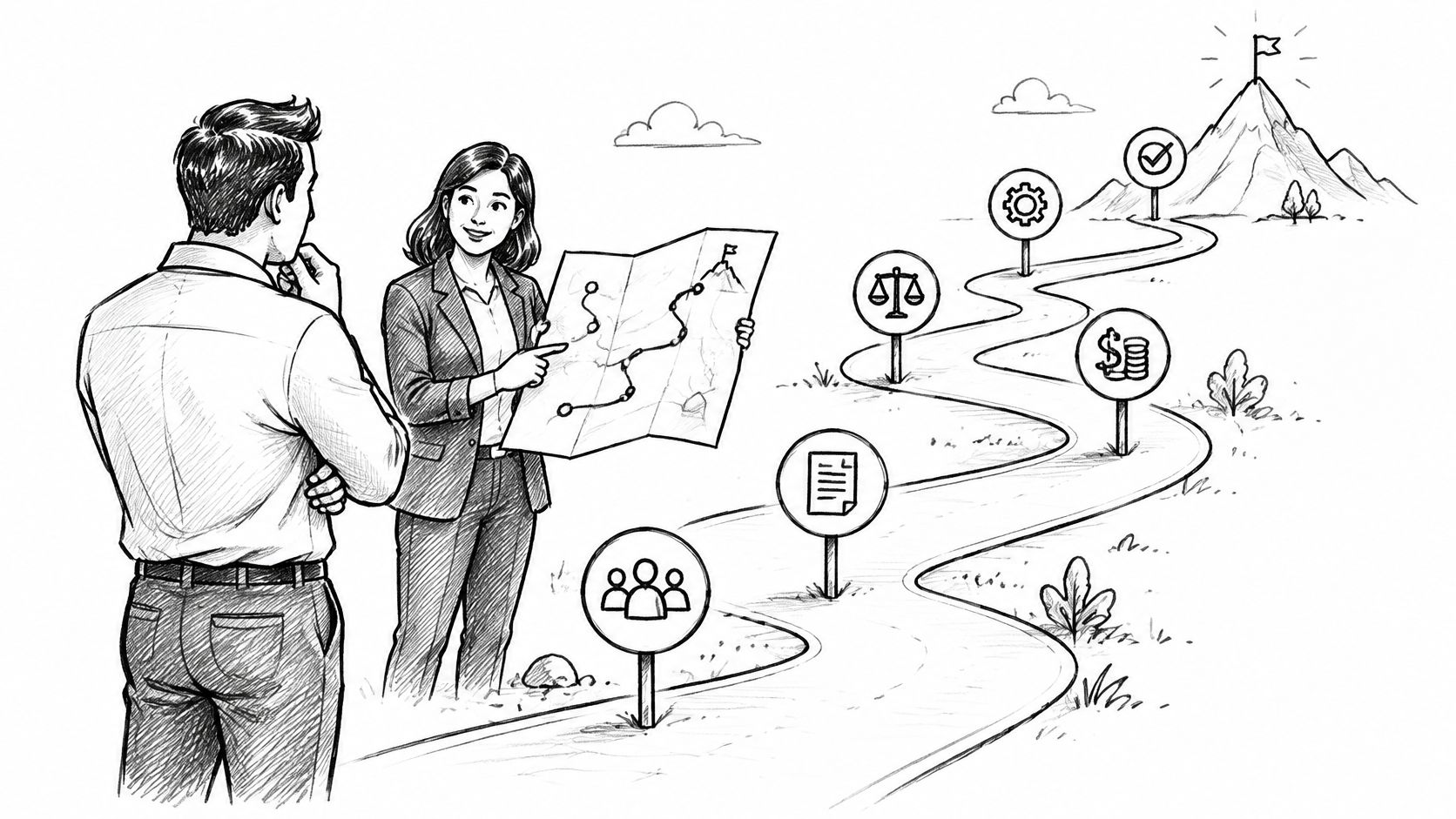
What to change before the next demo
Quote the finding in the alignment meeting, then attach your own entry rules so it lands as a process, not an opinion. No discovery, no demo. Discovery quality, not demo polish, decides whether you belong in a complex purchase.
Practical rule: If the AE cannot name the technical question the session must answer, the demo is not scheduled.
Say a leadership review is hypothetical and you are the SE arguing for a gate. You use the finding to add a discovery step before any demo is booked. Marketing keeps the narrative. Sales owns the commercial thread. You refuse the calendar hold until pain, use case, and the open technical question are written down.
- Pair it with qualification: Put business fit, buying context, and the technical question on one checklist the AE and you both sign.
- Use a structure built for a committee: The discovery call guide is a workable agenda when the purchase is already crowded.
- Review one live deal: In the next pipeline meeting, mark which opportunities skipped discovery and which of those are now stuck in a generic demo.
2. B2B purchases are decided by a group, not a single champion
Gartner's buying research describes a committee, not a lone decision maker. Finance asks about cost. IT asks about security and integration. Operations asks about rollout. An AE can hold the commercial thread. The technical objections usually sit with people the AE has never met, and the SE is the one equipped to answer them.
How large that group is depends on the deal in front of you. Count stakeholders in your own pipeline rather than trusting a published average.
A Gartner peer-community survey named separate funnels as the most frequently selected reason for sales and marketing misalignment, cited by 47% of respondents, and said lead generation was the business area most hurt by the relationship, selected by 44%. Separate funnels mean the committee you meet in discovery was never the audience marketing targeted. That survey cannot prove your CRM stages are the cause. It can tell you to check whether marketing, sales, and PreSales share one definition of "ready."
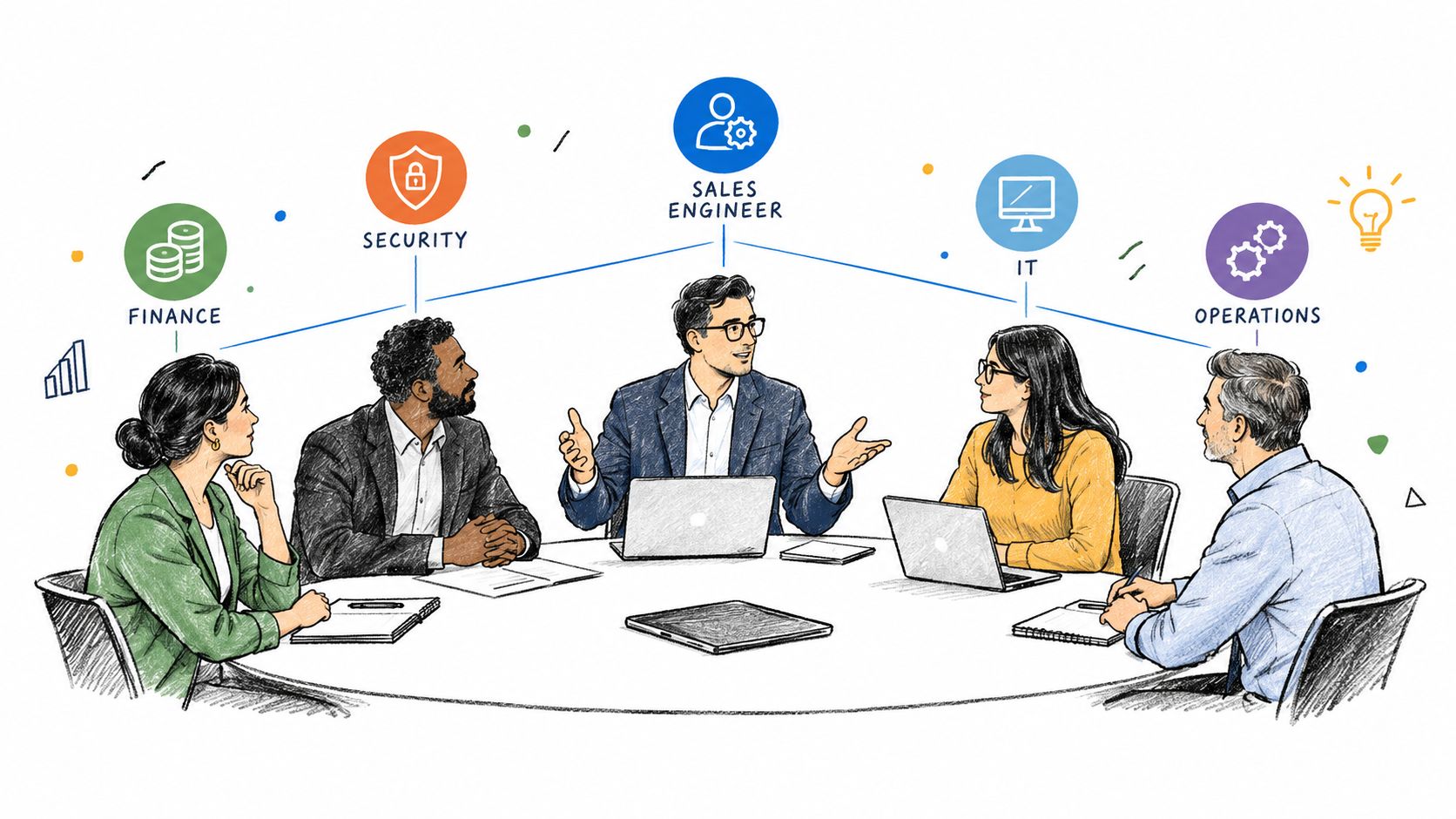
Map the room before you agree to a demo
Hypothetical. You map the buying group in discovery and find the security reviewer has never been on a call. You book a technical session before proposal, with their questions written in notes the AE can see. The deal stops depending on whether your champion can relay an answer correctly.
- Ask who else evaluates: Do this before you accept a demo date.
- Log role and open question: Share that list with the AE the same day.
- Make the decision path explicit: MEDDPICC for Solution Engineers forces the economic buyer and the process into the open.
- Practice the committee conversation: The stakeholder chaos episode is useful prep when the buying group is larger than the champion's slide suggests.
3. B2B buyers spend about 17% of their purchase time meeting with suppliers
Gartner's buying research suggests supplier meetings take up only a small share of a buyer's total purchase time. The rest goes to internal debate, independent research, and consensus building your team never sees. Your window is small. A session that fails to advance a decision, answer a technical question, or surface a risk the buyer had not named is time you will not get back.
That share of time is a warning about scarcity, nothing more. It cannot prove shorter meetings win, and it cannot tell you the right meeting length. Buyers are doing real work without you, so the hours you do get are the expensive ones. What the research does is price a generic product tour as a poor use of a rare slot.

Open every meeting with the decision the buyer must make before they hang up.
Hypothetical. You scrap a 12-slide product tour and replace it with the three questions the committee still cannot answer. The hour becomes a working session. You leave with an owner for each open risk and a dated next step on the calendar.
Send a short pre-read so the buyer can prepare. Scope the SE role against the PreSales definition so marketing does not treat you as a demo vendor and sales does not treat you as unpaid support. If the pre-read already answered the buyer's question, cancel the meeting and give the slot back.
4. About 61% of B2B buyers prefer a rep-free buying experience
Gartner's 2025 research says a majority of B2B buyers prefer a path that does not require a sales rep at every stage. Websites, content, peer references, and trials carry them to a shortlist. Reps and SEs get called later, often to validate, not to teach. Your value is judgment about their technical context. A webpage cannot supply that.
The figure cannot prove buyers never want a human, or that content can replace discovery. It cannot prove your site is accurate. Plenty of "self-serve" journeys still hand you a late, poorly framed POC.
There is a second gap inside the building. In Forrester's 2024 Priorities Survey, 82% of C-level B2B business and technology professionals said product, sales, and marketing were aligned, including 41% who called them highly aligned. Forrester's Q2 2024 Sales and Marketing Alignment Survey found that 65% of sales and marketing professionals believed their organizations lacked alignment between sales and marketing leadership, as covered on the Forrester blog. Executive confidence is not operational alignment. The contrast cannot prove your team is misaligned. It can stop you from trusting a leadership pulse instead of pipeline behavior.
Start discovery where the asset stopped
Hypothetical. Marketing publishes an architecture guide. Buyers read it before the first call. You open on the questions the guide left open, not on a recap of page one.
- Audit the pre-call assets: Ask marketing which pages prospects read most, then check them for technical accuracy.
- Write questions into the gaps: If the guide skips identity, data residency, or failure modes, those are your discovery prompts.
- Document the handoff: Note where self-serve ends and an SE begins, and share that line with the AE. The sales engineer role guide keeps that line from turning into "whoever is free."
5. Sales reps spend a minority of their week in active selling
Salesforce's State of Sales research has described sellers spending only a minority of the week on selling. The rest goes to admin, internal coordination, and research. I will not pretend that research published a single number you can drop into your forecast. The useful point is narrower. Every unclear qualification rule and every unnecessary demo request eats time that should have been a customer conversation.
When you and the AE share acceptance criteria, both of you protect selling time. When you do not, both of you lose it. The pattern cannot prove that your team's admin load matches anyone else's, or that a new tool will give the hours back.
A ZoomInfo compilation of MarketingSherpa reported that 61% of B2B marketers send all leads directly to sales, while only 27% of those leads are qualified, and that only 56% of B2B organizations verify valid business leads before the pass. That is a routing failure, not a personality clash. It cannot set your qualification threshold. It does explain generic demos and open-ended POCs.
Protect SE hours with a gate
Hypothetical. The team adopts one checklist. AEs stop requesting SE support when the first criteria fail. You measure, for one quarter, how many SE hours still land on opportunities that miss the gate. Bring that count to the pipeline review. Do not bring a vibe.
Agree the checklist with the AE team before the meeting, not during it. AI sales automation tools can clean routing and reminders. They will not invent your acceptance rules. If the tool passes every lead because nobody defined "qualified," you have automated the waste.
6. Forrester's Demand Unit Waterfall shared stage definitions across marketing and sales
The Demand Unit Waterfall, built at SiriusDecisions and now part of Forrester, maps how a prospect moves from unknown to a qualified opportunity. Its value is shared stage names, entry criteria, and handoff points. It does not ship a benchmark you can cite as "good." If your argument is "Forrester says our stage 2 converts at X," you do not have that number. You have a vocabulary. Most alignment fights are fights about vocabulary.
A SiriusDecisions benchmark of 400 B2B companies from 2006 to 2014, summarized by Icaro Iasbeck, associated sustained alignment across sales, marketing, and product with an estimated 5% to 36% of organizational growth. Companies that held alignment grew revenue up to 19% faster and were up to 15% more profitable than less-aligned peers. Market growth still explained 48% to 79% of company growth. The study is correlational. It cannot prove alignment caused your quarter, and the window is old. It can justify treating alignment as an operating system, not a kickoff workshop.
Write the SE entry page
Hypothetical. You and demand gen agree an SE is assigned only when documented pain, a named economic buyer, and a timeline are in the opportunity. Deals that skip the page get called out in the weekly review.
- One page, three signatures: Sales, marketing, and PreSales leaders sign entry criteria before you enforce them.
- Catch the bypass: Track opportunities that reach a demo with blank criteria. That count is the alignment metric.
- Fix titles before criteria: The sales engineer, solutions engineer, and solutions consultant guide stops you writing rules for three job names that mean three different scopes.
- Put exit rules next to entry rules: Entry and exit criteria keep a stage from meaning "someone updated a date field."
7. Shared pipeline credit for SE influence (practice, not a published benchmark)
Credit is where alignment usually breaks. If the AE owns revenue and you own the demo, nobody is paid to bring you in early. Tracking SE influence, whether or not you own the opportunity, is an operating practice. It is not a published benchmark. Do not quote it as one.
The point is visibility. Leadership can see that you changed the deal at discovery, not after someone promised a demo. The practice cannot prove a universal conversion lift. Your CRM will not match another company's, and a field labeled "SE involved" is useless if people tick it after the fact.
Norwest's benchmark write-up makes the sharper distinction. Most organizations say they share data. Only about half coordinate on go-to-market plays and change strategy from shared feedback. In a study of 105 companies, 36% had an effective handoff but still had a large share of sales audiences outside marketing's targeting. Only 11% combined an effective handoff with high audience overlap. A clean handoff cannot prove you are aimed at the same accounts. It cannot prove your SE was in discovery.
Aligned around which decision, at what stage, and with what behavior you can see in the opportunity?
Hypothetical. You add an SE involvement stage to the CRM. In your own pipeline, deals with SE discovery before the demo convert at a higher rate. You report that as internal evidence, with the sample size and the definition attached. You do not call it an industry statistic.
Agree attribution rules with sales leadership before the first report. Start with one field for the stage you joined. Expand only after people fill it accurately. If marketing's promise, the AE's qualification, and your discovery still describe three different problems, the field is theater.
8. Technical win rate as a shared alignment metric
The technical win is the outcome PreSales owns. The buyer's technical evaluators agree that the solution fits their requirements and their risk tolerance. Tracking it gives sales and marketing a shared read on PreSales that is not "bookings, eventually." This is a measurement approach, not a sourced benchmark. There is no industry percentage hiding under the label.
Its value is directional. It shows whether discovery quality is producing deals the team can realistically win. That is the belief under the metric. No discovery, no demo. A rising technical win rate cannot prove marketing's targeting is right, and a falling one cannot prove the SE "lost" a deal the AE mis-qualified. Pair it with discovery completion or you will argue about the scoreboard instead of the work.
Read the measurement design in the technical win rate north star before you publish a number. Write a one-line definition and get sales leadership to sign it. Track discovery completion beside it as the leading indicator.
Hypothetical. You define a technical win as written agreement from the technical evaluator on requirements and success criteria. You count it only when discovery notes exist. Deals that reach "technical win" off a slide tour do not count. That rule will annoy people for a month. It will also stop the metric from becoming a courtesy checkbox.
How each statistic and practice compares on source, evidence type, and SE use
| Item | Source | Evidence type | Best use for SEs | Verify before quoting |
|---|---|---|---|---|
| 77% of B2B buyers say their latest purchase was the most complex they have made | Gartner, B2B buyer survey press release (2019) | Buyer survey statistic | Make the case for structured discovery before a demo | Check the original survey edition, wording, and sample details |
| B2B buying groups commonly include six to ten stakeholders | Gartner, B2B buying research | Buying-group research | Support stakeholder mapping and multi-threaded technical evaluation | Check the current figure and how buying-group size is defined |
| B2B buyers spend about 17% of their purchase time meeting with suppliers | Gartner, 2025 B2B buying research | Buyer survey statistic | Set focused meeting agendas tied to buyer decisions | Confirm the exact figure and survey scope |
| About 61% of B2B buyers prefer a rep-free buying experience | Gartner, 2025 B2B buyer preference research | Buyer preference statistic | Position SE conversations around complex questions and validation | Confirm the figure, wording, and survey scope |
| Sales reps spend a minority of their week in active selling | Salesforce, State of Sales research | Seller time-use survey | Support qualification gates and reduce avoidable coordination work | Check the current edition, percentage, and definition of selling time |
| Forrester's Demand Unit Waterfall: shared stage definitions across marketing and sales | Forrester, formerly SiriusDecisions | Stage and handoff framework | Align teams on opportunity readiness and when to engage SEs | Confirm current framework terminology and licensing or usage guidance |
| Shared pipeline credit for SE influence (practice, not a published benchmark) | Operating practice; no published benchmark stated | Internal operating practice | Make SE contribution visible and encourage earlier involvement | Agree attribution rules; no external benchmark to quote |
| Technical win rate as a shared alignment metric | SE Rockstars internal measurement framework | Internal measurement approach | Track buyer-confirmed technical fit beyond activity counts | Standardize the technical-win definition; this is not a third-party statistic |
Turn the Numbers Into a Shared Alignment Agreement
Pick one figure from this list and test it against your own pipeline this quarter. Do not test all eight. A single comparison you can explain will beat a slide full of borrowed percentages.
Bring the result to your AE and your marketing lead with two written lines. The first is the SE entry rule. The second is your definition of a technical win. If either line is still "we'll know it when we see it," you do not have an alignment agreement. You have a meeting.
The commercial case for doing this work is older than the current tooling wave, and it was never "alignment is the whole story." Treat the SiriusDecisions range as a reason to manage shared definitions, not as a forecast you can book. Your own stage conversion, cycle time, and technical win rate are the numbers that should move.
The Trusted Advisor Academy covers discovery, demos, sales alignment, POC management, and value articulation, with live practice on active deals (Trusted Advisor Academy). Mutual Evaluation Plans can reduce sales cycle length by up to 5% through clear milestones and binding follow-up agreements. ROI calculators and business cases can reduce discounting by up to 7%. Those are program outcomes, not industry benchmarks, and they only matter if you baseline the same KPIs and re-measure them.
If you want to pressure-test your assumptions against your funnel before you change the process, book a discovery call. For the revenue-leader view of the same operating problem, Grou's playbook for predictable pipeline growth is a fair companion read. Then come back to your board and defend one number you measured yourself.
PreSales Unleashed GmbH runs the Trusted Advisor Academy and Enablement-as-a-Service for B2B SaaS PreSales teams that need SEs in discovery early, with shared entry rules and a technical win sales and marketing can both see. The work is built around live practice on active deals, not a one-off workshop that fades the next week. Visit PreSales Unleashed GmbH when you are ready to turn these alignment numbers into a gate your pipeline review will enforce.