
A sales engineer resume doesn't get rejected for lacking skills. It gets rejected for lacking proof that the skills changed a deal.
Skills-based hiring hasn't retired the document. TestGorilla's resume statistics reported that 85% of employers used skills-based hiring in 2025, while 67% used resumes in their hiring processes. The resume stopped being a biography and became the place where a claimed skill has to survive contact with evidence.
That's the standard I'd apply to every line. Read it once as a sales leader who needs a number, once as a technical evaluator who needs a design decision. A keyword earns its place only when a measurable example backs it somewhere else on the page.
Resume Layout and What Each Section Must Prove
A sales engineer resume has to carry two arguments in the same line: the technical judgment that made a solution work, and the commercial result that followed. That's the actual shape of the job. The BLS sales engineer occupational profile describes the occupation as selling products and services that require technical expertise, and projects employment growth of 3% from 2025 to 2035, with roughly 3,800 openings each year. This is a career, not a stopgap between engineering roles.
Layout is where proof gets organized or lost. Here's the structure that survives both readers, and the job each block has to do.
| Section | Length | What it must prove | Common failure |
|---|---|---|---|
| Headline | One line | Target role and two or three focus areas | Generic Technical Professional label |
| Summary | Three to five lines | Technical credibility linked to a commercial outcome | Tool list with no result |
| Experience | Four to six bullets per recent role | Discovery, design, demos, POCs and deal outcomes | Responsibilities without results |
| Skills | Short grouped list | Tools that match proof shown in experience | Keyword cloud of thirty or more items |
| Education and certifications | One line per entry | Relevant technical credentials only | Unrelated course lists |
Headline. One line, naming the target role plus two or three focus areas. "Solution Engineer | Discovery, Technical Validation, Enterprise Demos" tells a reader what you do in under a second. "Technical Professional" describes a few million people and tells a hiring manager nothing.
Summary. Three to five lines tying technical credibility to a commercial outcome, ending on the outcome you own: the technical win, the point where a buyer accepts that your design solves the problem. A summary that lists eight tools and skips the result wastes the most-read paragraph on the page.
Experience. Reverse chronology, four to six bullets per recent role, and the order inside the section matters. Put discovery work before demo work, because discovery quality decides deals and demo polish rarely does. A resume that opens with demo volume and closes with a customer's business problem has the sequence backwards.
Skills. A short grouped list. Every tool should already appear in experience with a result attached, so the block reads as an index rather than a claim. Anything that appears only in the skills list is a keyword you can't defend in an interview.
Education and certifications. One line per entry, and only credentials a technical evaluator would recognize as relevant. A list of unrelated courses reads as filler and pulls attention away from your deals.
Titles shift between companies. Candidates appear as Solution Engineer, Sales Engineer, PreSales Consultant or Solutions Architect, sometimes for near-identical work. Match the title used in the posting and keep the layout identical; a recruiter outside the function won't assume the family. The PreSales overview is a fair primer if you're moving between titles.
Specificity is the gap employers report. TestGorilla's 2025 recruitment statistics found that 51% of employers struggled to determine whether candidates had the required technical skills, which is one more argument for naming the technical work and its result instead of asserting competence.
The filter: if a block doesn't prove something a buyer, a sales leader or a technical evaluator would act on, it's taking space from a block that would.
Two supporting reads help. Mojolin's tech resume guide covers the formatting mechanics that apply to any technical resume, including section order and how to keep a skills block readable. And if you're weighing whether to apply one level up, this guide to the sales engineer career path sets out what changes between mid-level and senior work, which changes what your bullets should lead with.
Achievement Statements That Show Commercial Impact
An achievement bullet has three parts: the action, the technical context, and the commercial result. The third part is what separates a sales engineer resume from a support engineer resume. Most of the drafts I read stop after part two.
"Led technical discovery for enterprise accounts" is a responsibility. "Led technical discovery for six enterprise accounts, disqualifying two before the demo stage" is evidence, and it tells a sales leader exactly where to look. That distinction is the whole game, and it's why commercial fluency isn't a nice extra on this resume. O*NET's occupational profile for sales engineers rates customer and personal service at 89 and sales and marketing at 84 on its knowledge scale, which puts buyer communication alongside the technical side of the job rather than behind it.
A bullet like that comes out of a drafting and review exercise, done on paper before anything reaches the template.

| Evidence category | Metric to use | Example bullet (hypothetical) |
|---|---|---|
| Customer discovery | Qualified pipeline created, discovery-to-opportunity rate | Ran discovery with twelve mid-market accounts for a cloud security product and moved nine into formal evaluation |
| Technical solution design | Evaluation time, POC completion rate | Designed a data-platform reference architecture that cut evaluation time from six weeks to four |
| Demos and proof of concept | Demo-to-opportunity conversion, POC win rate | Rebuilt the demo around three buyer priorities, lifting demo-to-opportunity conversion over two quarters |
| Commercial execution | Influenced revenue, average deal size | Partnered with account executives on thirty proposals that contributed to 1.8M EUR in closed-won pipeline |
| Communication | Stakeholder sign-off, sales-cycle reduction | Turned a security architecture into a two-page business case that shortened legal review by three weeks |
Every example above is hypothetical. Replace them with your own verified figures, and don't borrow a number because it reads well.
Two things go wrong with this table. The first is metric sprawl: candidates list every figure they can find and the reader can't tell which one mattered. Pick two or three metrics per role, ideally one per stage of the deal, and let the rest go.
Practical rule: if you can't verify a number, describe the change in words. "Shortened legal review from six weeks to three" is a result. "Improved efficiency" is a wish.
The second problem is definition drift. Discovery-to-opportunity rate, POC win rate, technical win rate, influenced revenue: every company defines them differently, and a hiring manager from another business will read your figure through their own definition. Name the definition inside the bullet. If your discovery-to-opportunity rate only counts opportunities that reached a scoped evaluation, say so. The discovery call guide is a useful check on the qualification criteria that decide whether an opportunity was ever real, and the MEDDPICC for solution engineers guide shows which criteria make a POC winnable before you count it as one.
Influenced revenue deserves its own warning. It's the figure most often inflated and the easiest to disprove in a reference call, so attribute it accurately: "contributed to", "supported", "technical close on". A sales leader who has built a forecast can tell the difference between a deal you carried and a deal you touched twice.
Communication metrics are the ones candidates forget, and they're often the most persuasive. Stakeholder sign-off, the number of security reviews you carried, the cycle time between first demo and signature: all of it is evidence that you shorten deals rather than decorate them. The sales engineer KPI guide goes further on which measures hold up under scrutiny.
Run this test before anything ships. Could a sales leader repeat the bullet to a CRO without translating it? Could a technical evaluator check the architecture it describes? A line that fails the second question is a marketing claim. A line that fails the first is a lab note.
Listing Tools and AI Skills Without the Keyword Clutter
A tool is context. A capability is a claim. Resumes get rejected when the page is all context and no claim, and the skills section is usually where that happens.
| Weak | Strong |
|---|---|
| "AWS, Kubernetes, Python, Terraform, Jenkins, Docker, Git, Linux" | "Designed an AWS and Kubernetes reference architecture that supported 35% faster enterprise deployment" |
Both entries are hypothetical, but the contrast is real. The left column could belong to any engineer in the building. The right column tells a technical evaluator what you decided and tells a sales leader what it changed. Same tools, different document.
Group the skills block by function (cloud, security, data, CRM, integration) and keep it short. Thirty items says you're hoping something matches. Eight items, each traceable to a line above, says you know what the job needs. If a tool can't be traced, either add the line or drop the tool.
AI is where this distinction matters most right now. The useful question isn't whether AI appears on the resume; it's which AI evidence signals work you'll still be doing in three years. Career commentary on the sales engineer role notes that routine tasks such as prospect research, forecasting and record-keeping are the most exposed to automation, while trust-building, live demonstrations and explaining complex technical ideas remain human work. Write the outcome, not the tool:
- Validating research before it reaches a buyer. AI-generated account research checked against CRM records and call notes, then corrected where it's wrong.
- Governing the demo environment. A repeatable evaluation setup where data, permissions and scenarios are controlled, so a POC can't be derailed by a broken tenant.
- Sharpening qualification. Product usage data analyzed to disqualify an opportunity earlier, before the team spends three weeks on it.
- Translating the limits. Explaining model behavior, data handling, privacy and governance to a security reviewer who is deciding whether to trust you.
For regulated buyers, lead with the controls, not the novelty. Human review, data handling and audit trails are what a risk committee scores, and an AI line that skips them reads as a gap in judgment.
"ChatGPT, prompt engineering" with no result attached reads as enthusiasm, not capability. Every tool or AI skill on the page needs one line of proof elsewhere on the resume. The what a sales engineer does guide is a useful cross-check on which capabilities employers expect, so you can tell the difference between a skill worth proving and a skill worth mentioning once.
Common Resume Mistakes and What to Change
The most common failure isn't a badly written bullet. It's a headline that could describe any technical role, followed by ten lines that describe a job rather than a person doing it.
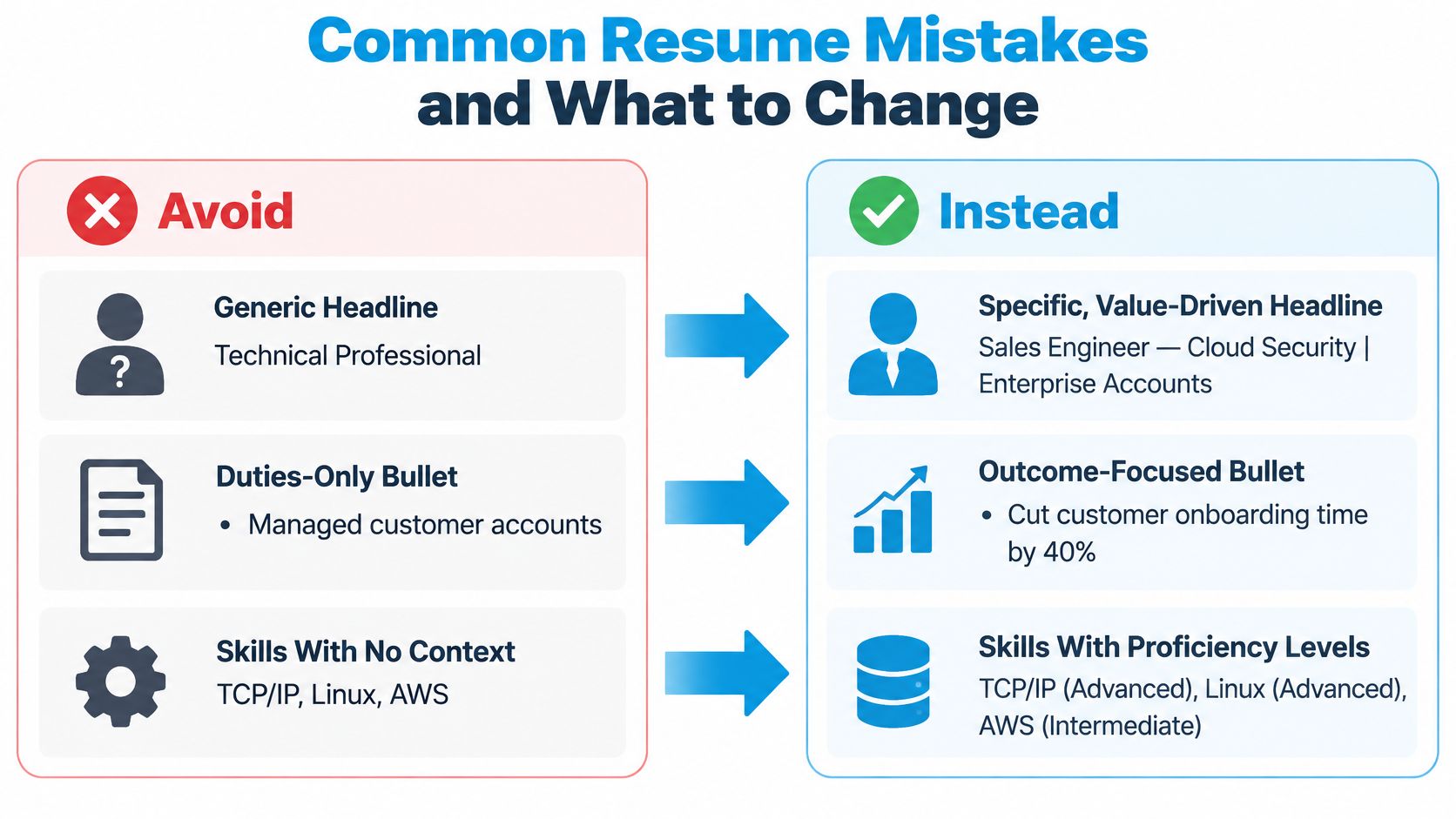
Wording and proof
A generic label becomes a role plus focus areas. "Technical Professional" costs you the first three seconds of a skim. "Sales Engineer, Cloud Security, Enterprise Accounts" buys them back.
Responsibilities become results. "Managed customer accounts" is a job description. "Cut customer onboarding from three weeks to nine days by templating the integration checklist" is a decision a technical evaluator can interrogate.
Keyword stuffing becomes a short grouped list. Twenty-five tools crammed into three lines pushes a reader past the section entirely. Keep the ones your experience bullets already prove.
Unexplained acronyms get spelled out once. POC, RFP, RFI, MEDDPICC, technical win. A recruiter outside PreSales won't know them, and the first time you use one is the right time to define it.
Impressive projects get a buyer attached. The migration you're proud of means nothing until one sentence names whose decision it supported and what happened next. If the sentence can't be written, the project belongs in an interview answer, not on the page.
Three achievements in one bullet become three bullets. If a line carries two "and"s and a semicolon, split it. Each result deserves its own sentence and its own space.
Here's the review pass in motion, if you'd rather watch the edits than read them.
Layout and length
Length gets cut. A resume a sales leader won't finish is a resume that gets skimmed by someone in a hurry. Two pages is normally enough for ten years of PreSales work, and the third page is where your best material goes to die.
Repetition goes. A summary that restates the experience section word for word wastes the one paragraph guaranteed to be read. Use the summary for the argument, and the bullets for the evidence.
Most of these show up in other fields too, which is why it's worth comparing notes with guidance written for technical candidates generally. Common resume mistakes to avoid catalogs the phrasing and formatting traps that recur across engineering and technical applications, and a scan before you send costs five minutes.
Tailor the Resume to One Posting and Test It
One posting, one version. That's the entire method, and it takes under an hour once you've done it twice. Here are the four moves, then the detail behind each.
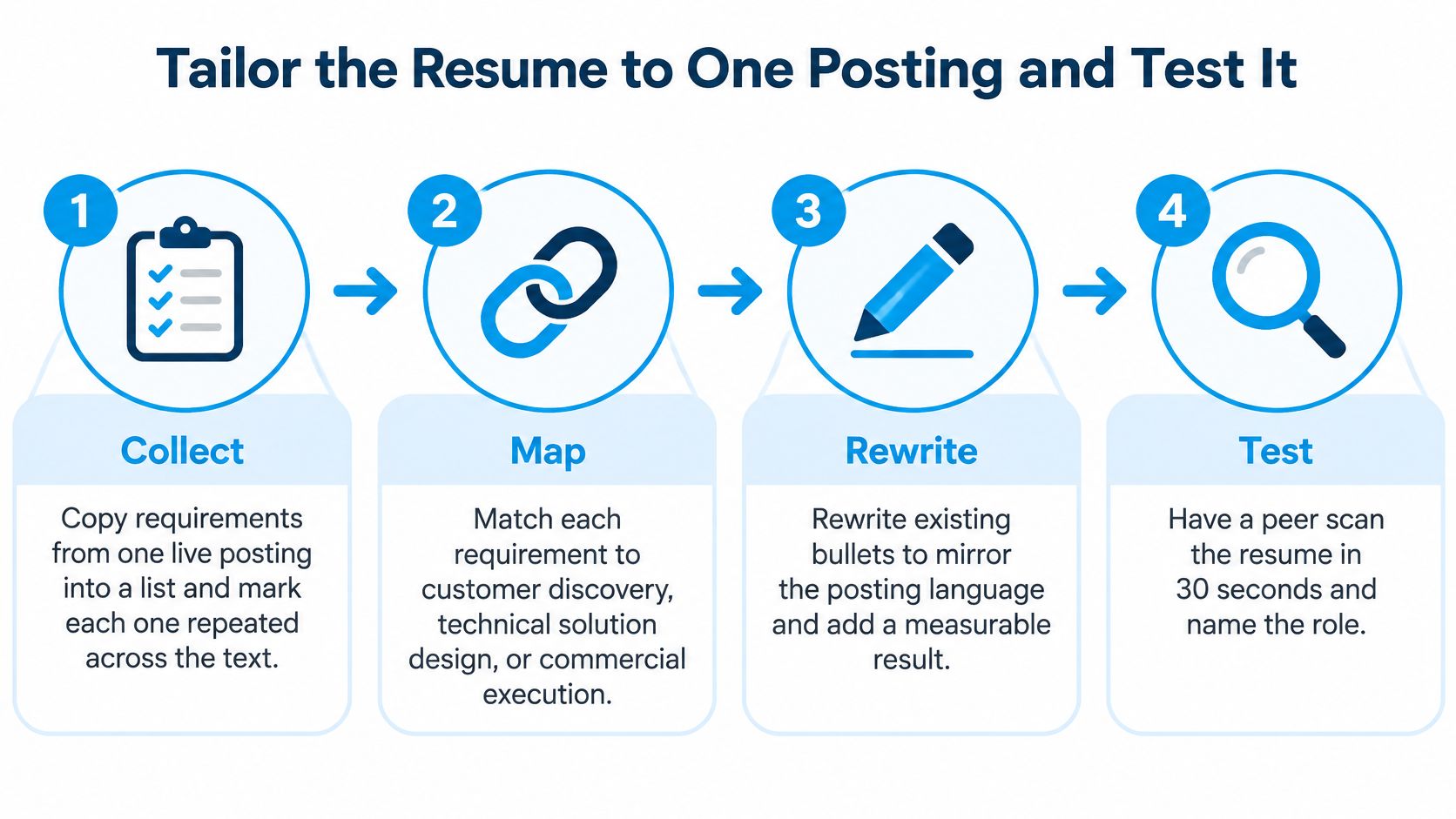
- Collect from one live posting. Copy the requirements into a list and mark every requirement that appears more than once across the text. Repetition is the employer telling you what it will screen on, sometimes without realizing it.
- Map each requirement to one of four evidence types. Customer discovery, technical solution design, commercial execution, communication. O*NET's role summary for sales engineers describes the work as assessing customer needs, configuring solutions, preparing proposals and presenting technical products, so a real posting's requirements will land in those four buckets. If one doesn't, it's boilerplate you can ignore.
- Write one bullet per requirement. Name the problem, the design choice, and what changed commercially. One bullet, one requirement, no merging two requirements to save space.
- Pass one, mirror true language. Use the posting's own terms where they're accurate: technical discovery, product demonstrations, proof of concept, RFP/RFI, enterprise sales. An analysis of 82 large-company sales engineer postings cited by ATS Resume AI found "product demos" in 51.2% of postings and "proof of concept" in 28%, which tells you which words carry weight. A keyword only counts when a measurable example supports it. Otherwise it's noise the interviewer will test you on.
- Pass two, subtract. Cut keyword stuffing, dense skill clouds, unexplained acronyms, and any responsibility with no outcome attached. Cut the project nobody bought, or add the sentence that attaches a buyer to it.
- Read it twice, as two different people. A sales leader should find the commercial result inside the first five words of each bullet. A technical evaluator should find the design decision behind it and be able to defend that decision in a room you won't be in. Hiring managers say something similar when surveyed: Resume Genius findings published by Apollo Technical in 2025 indicated that 89% prioritized problem-solving skills and 88% prioritized technical or hard skills on resumes. Those two readers are scanning for exactly those two things, and a bullet that shows one without the other reads as half a candidate.
Second-reader test: hand the draft to a peer for thirty seconds and ask which role it's for. If they hesitate, the headline isn't doing its job, and neither is anything below it.
Check your work against step one. Can you point to one line in the draft for every requirement you listed? If a requirement has no line, either you have the experience and buried it, or you don't have it and should stop applying to that posting. Both answers save you time.
Keep one version per role type
A Solution Engineer applying to a data platform writes about architecture, evaluation criteria and reference designs. A Sales Engineer applying to industrial equipment writes about commissioning constraints, integration risk and total cost of ownership. The proof lines stay identical because they're true. The nouns change because the buyer changed.
The people writing postings aren't always precise, either. Some requirements are copy-pasted from a template written three years ago. What a good head of solution engineering job ad looks like is a useful contrast case: it shows which requirements signal a role someone is hiring for, and which are decoration you can stop tailoring around.
Tailoring collapses under deadline pressure, which is why step one is the one people skip. Our founders have coached 350+ Solution Engineers since 2024. Build the habit on a role you don't desperately want, so it's automatic on the one you do.
When a line still isn't landing, get a second read before you send. Book a discovery call and walk through how you'd describe your own deals; the resume problem is usually a discovery problem wearing a formatting costume. For ongoing practice, the Trusted Advisor Academy runs weekly live roleplays and deal sparring, so the story behind each bullet gets rehearsed rather than improvised.
Send the customized version only when every line passes both readers. Anything less asks a hiring manager to do the translation work for you, and they won't.
PreSales Unleashed GmbH runs the Trusted Advisor Academy, a 12-month program built for Solution Engineers, Sales Engineers and PreSales Consultants who want structured practice rather than a two-day workshop: on-demand lessons, ready-to-use templates and KPI tools, and up to four live sessions a week where you rehearse discovery, demos and the deal stories your resume has to prove. A resume can only report a technical win you ran, so the fastest route to stronger bullets is stronger discovery and evaluation work behind them. Visit PreSales Unleashed GmbH to see how the Academy and the Enablement-as-a-Service program fit you or your team.