
The most popular advice in sales leadership development is to send new managers to a better workshop. I'd ignore it. A workshop can teach vocabulary. It doesn't change what a manager inspects on Monday, how a deal review runs on Thursday, or whether a weak POC gets stopped before it eats three weeks.
Treat the program as an operating system instead. You need a coaching cadence managers can run, shared definitions everyone uses the same way, and measurement that shows behavior changed. If you can't observe it on a calendar or in a deal record, you haven't developed it yet.
Core Competencies Sales Leaders Must Build First
The promotion trap is predictable. You promote your strongest Solution Engineer (SE), and that person keeps doing the work. They jump into demos, rescue discovery calls, and answer technical questions for the team. It feels helpful. It also means nobody else gets better, and the new manager never builds a team that can work without them.
Leadership in PreSales is a role change, not a promotion. Your program has to teach that shift directly, which is why the move from top performer to first-line leader deserves explicit attention in the first cohort, not a slide in onboarding.
Why attendance proves nothing
In 2024, only 33% of surveyed sales professionals rated their organization's sales training and development as extremely or very effective for improving sales performance and productivity, according to RAIN Group's continuous-learning research. That's the gap you're designing against. A standard workshop rarely changes manager behavior on its own, so each competency below needs an observable weekly habit and evidence you can check without asking the manager whether it happened.
Sales leadership competencies, observable behavior and evidence
| Competency | Observable behavior | Evidence you can check |
|---|---|---|
| Deal inspection | Asks for the next step, buyer decision criteria and open technical risk on every review | Deal reviews show named risks and dated actions |
| Coaching cadence | Runs scheduled observed discovery and demo reviews instead of ad hoc check-ins | Calendar shows protected sessions; reps can name the last feedback they acted on |
| Qualification discipline | Declines evaluations and POCs that lack success criteria or a named decision process | Share of evaluations with signed success criteria |
| Technical win ownership | Defines what a technical win means for each deal and tracks it by stage | Technical-win rate reported by deal stage |
| Cross-functional alignment | Brings SEs into deals before the demo and agrees the discovery plan with the AE | Share of opportunities with SE involvement at discovery |
| Forecast accuracy | Tests technical close criteria before a deal moves into commit | Variance between forecast and actual close by stage |
Two rows need shared definitions before you start. Use the technical close criteria in MEDDPICC for Solution Engineers so forecast accuracy means the same thing across teams, and define measurement the way the North Star technical win rate article does, by stage, so technical win ownership isn't a feeling.
Pick competencies you can watch in a working week, not traits you can only describe in a review.
Each competency in the table maps to a metric later in the program, so you're never teaching a skill you can't follow into the numbers. Choose no more than three for the first cohort. Programs that try to build six at once tend to build none, because managers run out of coaching time before any single behavior sticks.
How to Build the Program in Five Phases
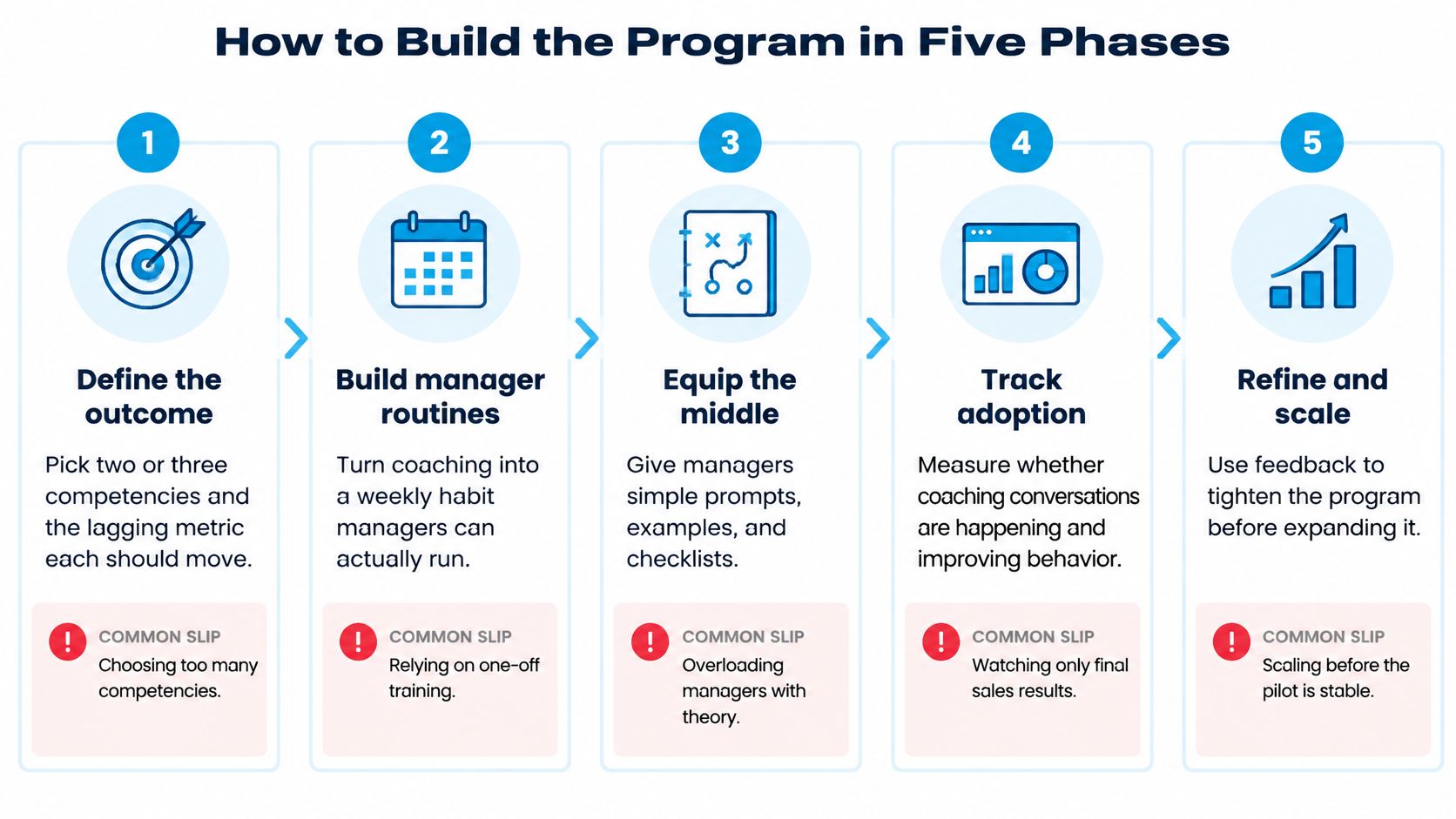
Sequence matters more than content volume. Build sales leadership development in five phases, in this order, and don't let a later phase start until the earlier one produces something you can point to.
The sequence
-
Define the outcome. Pick two or three competencies and name the lagging metric each should move, such as technical-win rate or sales-cycle length. Define close criteria in plain language before you pick any training content. The common slip is setting the goal as attendance, which tells you the program ran and nothing else.
-
Set a baseline. Capture current deal-review behavior and win rate for the last two quarters before any training starts, using your agreed technical win definition. One quarter is too noisy, and memory is worse. The common slip is skipping the baseline, which makes impact impossible to prove later no matter how good the coaching gets.
-
Segment by role. Frontline managers coach individual SEs on live deals. Leaders of managers own the operating rhythm, hiring standards, and coaching frameworks. Those are different jobs and they need different practice. The common slip is giving both roles one generic curriculum, so frontline managers get theory they can't use and senior leaders get deal tactics they don't need.
-
Build the coaching system. Fix the cadence, the observation rules, and one shared discovery and demo checklist. The discovery call guide gives you the checklist content, so you don't need to write your own from scratch. The common slip is writing a coaching checklist nobody uses, usually because it's too long to open during a real review. Keep it to what a manager can check in ten minutes.
-
Launch with one team, then reinforce. Start with a single team, then revisit the behaviors through role-play, deal reviews, and periodic retrieval over months. Spaced practice beats concentrated instruction for skills that must stay available in the field. The common slip is treating launch day as the finish line, then wondering why behavior reverted by quarter-end.
What phase five should look like
You'll know phase five is working when managers run observed reviews from the calendar without being chased, and SEs raise deal questions without being prompted. The manager doesn't need a reminder from enablement. The SE doesn't wait for the one-to-one to surface a technical risk.
Practical rule: If a phase has no owner and no date, it's a wish, not a phase.
Write the five phases into a one-page plan with an owner and a date for each. One page forces trade-offs. If the plan needs an appendix to explain who does what, the managers in the cohort won't be able to explain it either, and they'll run their own version instead.
Coaching Systems Managers Will Actually Run
Training that reaches salespeople without manager coaching tends to fade. That pattern shows up in ATD's summary of sales-management training measurement, which covers 213 companies employing more than 200,000 salespeople and 25,000 managers and found that only 51% measured the effectiveness of sales-management training. Organizations that measured it achieved 13% greater revenue-target attainment and 19% greater profit-goal achievement than non-measuring peers. Measurement doesn't cause that on its own, but it separates programs run as business interventions from programs run as events.
What coaching actually is
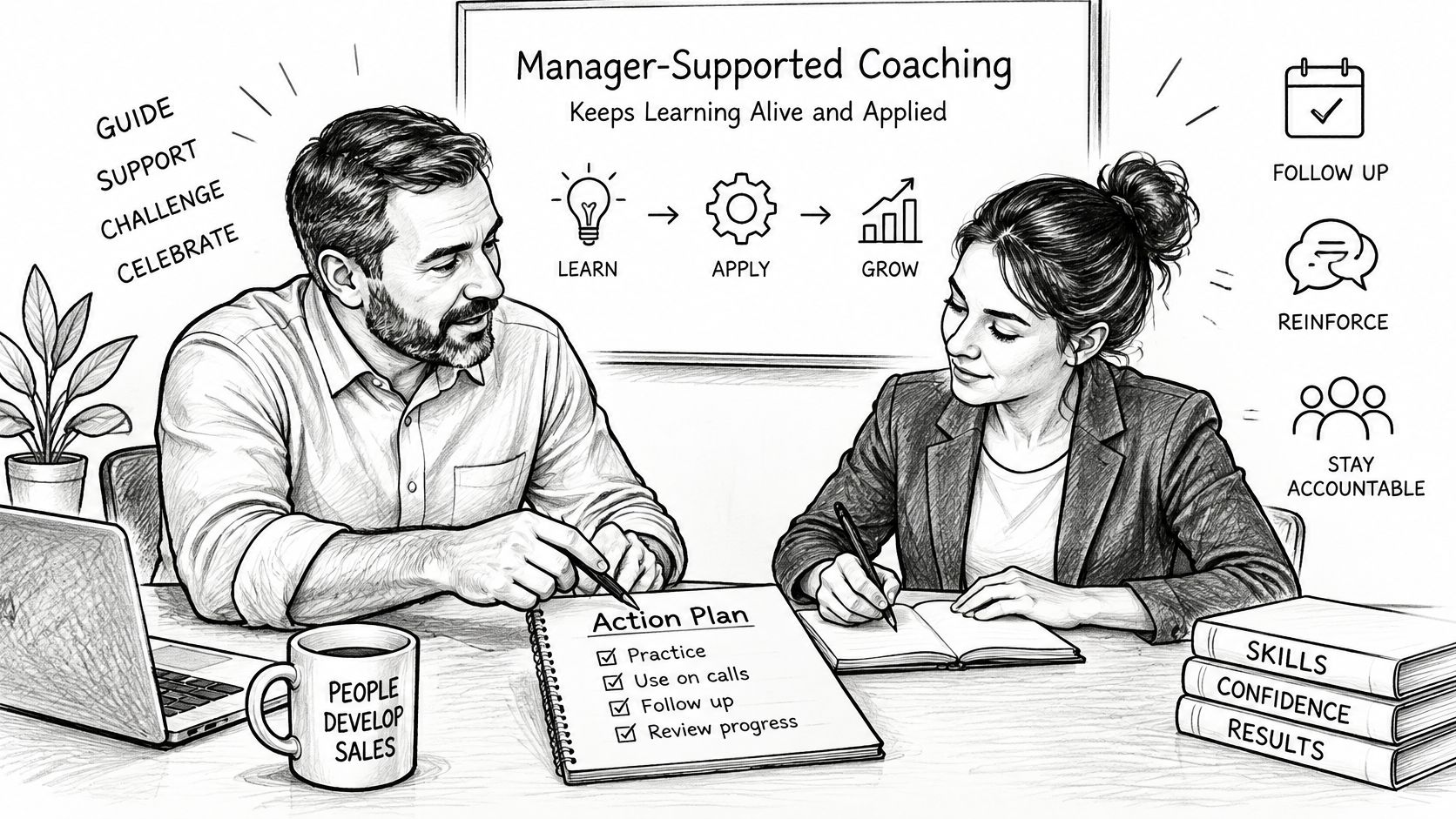
Coaching is demonstration, rehearsal, observation, and targeted correction tied to work the SE must perform. Encouragement isn't coaching. A status check-in isn't coaching either. Both feel supportive and change nothing, because neither puts the SE in front of the actual behavior with feedback against agreed criteria.
Use two levers. First, specific feedback against criteria you agreed before the call, not a general reaction after it. Second, role-modeling, where the manager shows the discovery sequence before the SE attempts it, so the SE has a reference performance to copy and adapt. The guidance in sales coaching for managers covers how to run that loop without turning it into inspection theater.
Here's a hypothetical example. A manager models a discovery sequence on a live call. The SE rehearses it in a deal sparring session that week, the manager observes the next real call, then gives feedback against three agreed criteria. One behavior, one deal, one next attempt. That's a loop a busy manager can run.
The weekly structure
- Deal sparring: Test discovery and technical validation on active opportunities before the customer call, not after it goes wrong.
- Observed call reviews: Watch a real discovery or demo segment and score it against the shared checklist.
- Monthly one-to-one: Build it around live deals and one development behavior, not pipeline status the CRM already shows.
Treat coaching time as a scheduled, budgeted commitment. Set hours per manager in advance, put them on the calendar, and track them against plan. If coaching is what happens after forecast calls, pipeline reviews, and internal escalations, coaching won't happen.
Keep each session to a short checklist: the one behavior, the deal, the observed evidence, and the next attempt. Four fields. If your coaching log needs more than that, managers will fill it in retrospectively and you'll be measuring paperwork.
Test it this week. Can each manager name what each SE changed in the last two weeks? If not, the coaching isn't happening yet, whatever the calendar says. That's not a motivation problem. It's a system problem, and it's fixable.
Mastermind and Peer Formats That Make Skills Stick
A single workshop fades because skills decay unless they're retrieved, applied, and reviewed again over the months the behavior must last. Set the spacing as a design principle: the interval between reinforcement should match how long the behavior must stay available in the field. A discovery habit you need all year needs reinforcement across the year, not a strong Tuesday in January.
Each format below has one job. Problems start when you ask one format to do three.
Leadership development formats compared
| Format | Typical cadence | Group size | Best use |
|---|---|---|---|
| One-to-one coaching | Weekly or biweekly | One manager and one SE | Correcting a specific behavior on live deals |
| Deal sparring | Weekly | Three to six SEs with the manager | Testing discovery and technical validation before a call |
| Monthly mastermind | Monthly | Six to twelve managers | Solving peer problems such as forecast misses and coaching capacity |
| Roleplay lab | Every two weeks | Four to eight people | Rehearsing executive demos and objection handling |
| Playbook drop | Quarterly | Whole team | Rolling out new discovery or POC standards |
Give the mastermind the manager problems
The mastermind's job is peer problems for managers: forecast misses, hiring gaps, coaching capacity, a team that won't decline unqualified POCs. It isn't a deal update meeting with better branding. If you're setting one up, the case for why PreSales leaders need a peer group also covers how to keep it from sliding into status reporting.
A hypothetical example shows the difference. At a monthly managers' mastermind, one manager brings a forecast miss. The group pushes on the deal's technical close criteria and finds they were never tested before commit. Each manager then commits to one change before the next session, and the group checks it next month.
A mastermind needs a case, a decision, and a follow-up owner. A status meeting needs none of those, which is why it changes nothing.
The roleplay lab handles what live deals can't give you safely: executive demos and objection handling, where an SE can fail in the room instead of in front of a CIO. The quarterly playbook drop handles scale, rolling out new discovery or POC standards to the whole team at once so local versions don't drift apart.
Set the cadence for the first twelve months up front, and place the heavier formats away from quarter-end. Masterminds in the second week of the month survive. Masterminds in the last week of the quarter get cancelled twice and then fade. Protect the rhythm by scheduling around the selling calendar, not against it.
Measure Leadership Impact Beyond Completion Rates
Completion rates and satisfaction scores tell you the program ran. They don't tell you managers coach differently. If your dashboard stops there, you're reporting effort to people who funded outcomes, and they'll notice.
Build the measurement sequence in five steps. Define the leadership behaviors tied to the sales strategy, covering inspection quality, coaching cadence, forecast accuracy, and qualification discipline. Capture a baseline before training. Measure learning through assessments or observed simulations. Measure behavior through manager activity and seller feedback. Then connect those changes to lagging outcomes such as quota attainment, win rate, sales-cycle duration, and margin.
Leadership impact measurement ladder
| Level | Example metric | Data source | Review cadence |
|---|---|---|---|
| Learning | Assessment score or observed simulation result | Assessments and roleplay scoring | After each module |
| Behavior | Share of deals with a documented discovery plan | CRM fields and deal reviews | Monthly |
| Manager activity | Coaching sessions held per manager against plan | Calendar and coaching log | Monthly |
| Seller feedback | Rep rating of coaching usefulness | Short pulse survey | Quarterly |
| Lagging outcome | Win rate, sales-cycle length and quota attainment | CRM and finance reporting | Quarterly |
| Revenue impact | Attainment and margin by manager cohort compared with a baseline | Finance reporting | Quarterly |
Put leading indicators between training and revenue
Revenue moves too slowly to steer a program. Leading indicators sit between training and revenue: earlier SE involvement, discovery completeness, technical-win rate, POC qualification, and time spent on low-probability evaluations. If discovery completeness rises and technical win rate follows, you have a story you can defend. If neither moves, revenue won't save you.
Don't trust manager self-reports on coaching frequency. Managers aren't lying, they're estimating, and estimates drift toward intention. Compare what managers report with calendar data and coaching logs, and use seller feedback as the third check. When those three disagree, believe the calendar.
Set the review rhythm to match the ladder: behavior and manager activity monthly, seller feedback and lagging outcomes quarterly. Review attribution at the operating-system level, not only per seller, because a manager's coaching cadence affects the whole team's deals. Scoring it seller by seller hides exactly the effect you're trying to build.
Be honest about the limit. Revenue attribution stays partly anecdotal, because pricing, territory, and product timing all move at once. State the claim the program can support, such as behavior change with a matching move in leading indicators, and the claim it can't, such as sole credit for a revenue number.
Build one dashboard this quarter: one row per competency, one leading indicator, one lagging outcome. That's enough to run a real review. A forty-metric dashboard gives every viewer a reason to pick the number that flatters them.
Scale Leadership Behaviors With AI and Human Coaching
AI does not replace manager feedback. Specific, concrete guidance from a human manager builds a seller's willingness to apply advice. Broader, higher-level guidance travels better from AI. A 2025 study on AI and manager coaching in the Journal of Personal Selling & Sales Management found that manager coaching with specific, concrete guidance improved salesperson self-efficacy and willingness to apply the advice. The same low-level approach was less effective when delivered by AI, where psychological distance made broader guidance more effective. Treat that split as an operating rule.

Give AI pattern detection across calls, practice simulations, call preparation, and flags for weak technical discovery or excess demo time. Keep managers on deal context, customer politics, the seller's development needs, and accountability. AI can count questions. It cannot tell you the champion went quiet because procurement changed the decision process.
A typical flag makes the split concrete. AI flags that an SE ran a 60-minute demo on a deal with no confirmed decision process. The manager decides whether to cut the demo and rebuild discovery with the AE. The flag is cheap. The judgment is the job.
Run the split on a cadence. AI flags land in a weekly manager queue. Managers use them in one-to-ones. Monthly calibration sessions check whether two managers coach the same flagged behavior the same way, backed by shared playbooks and manager-of-managers reviews. Before scaling, set the operating model: data quality, consent, bias, coaching calibration, and escalation to a human manager. More automation raises the bar on manager coaching judgment. It does not lower it.
Launch Your First Leadership Cohort This Quarter
Start small enough to finish. Choose one team and one cohort of managers, take the baseline from the build sequence, and pick no more than three competencies from the first table. Attach one leading indicator and one lagging outcome to each, so the cohort knows what success looks like before the first session.
Set the first coaching cadence on the calendar before the first workshop, not after. If the cadence waits until managers feel ready, ready never comes, and the workshop content has nowhere to land. Calendar first, content second.
Hold the house rule throughout: no discovery, no demo. Discovery quality, not demo polish, decides deals, and a leadership program should coach that rule into the team until managers enforce it in deal reviews without thinking about it. A manager who lets an SE demo without discovery is coaching the opposite of what the program teaches.
If you want structured support for the cohort, the Trusted Advisor Academy overview describes the program, and the Trusted Leader Academy for SE leaders includes a monthly mastermind and quarterly playbook drops. Those formats match the cadence this article recommends, so you're not bolting a one-off event onto an operating system. If you'd rather talk through your team's situation first, book a discovery call before you commit to anything.
Do one thing this week. Write the one-page plan with an owner and a date for each phase, and send it to the managers in your first cohort. Not a draft for review in a month. The plan, with names on it, this week. That single page does more for sales leadership development than another quarter of discussing which workshop to buy.
If you're building a first leadership cohort for SE managers, PreSales Unleashed GmbH runs year-round academy programs that combine structured content, live practice on active deals, and leader formats such as monthly masterminds and quarterly playbook drops. Visit PreSales Unleashed GmbH to see how the program fits your team's coaching cadence, then pick your first three competencies and put the baseline in place this quarter.