
Most advice about B2B sales coaching starts in the wrong place. It tells Solution Engineers to polish demos, tighten slide transitions, and speak with more confidence. Those skills matter, but they rarely explain why a technically strong opportunity stalls.
The harder problem appears earlier. The SE enters a deal without enough business context, accepts weak qualification, builds a demo around assumptions, and then inherits an evaluation with no agreed success criteria. No discovery, no demo. The technical win depends on how well you shape the buying process before you show the product.
Why Most SE Coaching Programs Fail
Many PreSales leaders coach the visible moment instead of the decisive one. A manager watches a demo, comments on pacing, and suggests a cleaner explanation of the architecture. The next demo improves. The deal may still lose because nobody established the buyer's technical constraints, decision process, or definition of success.
That pattern turns the Solution Engineer into technical support. The SE gets called in to answer questions, build slides, and rescue late-stage opportunities rather than acting as an equal commercial partner with the Account Executive. Pipeline quality suffers because technical involvement starts after the customer has already framed the problem too narrowly.
A useful overview of what a sales engineer does makes the broader responsibility clear. The role includes customer-facing discovery, technical judgment, solution design, validation, and alignment across the buying group. Coaching should reflect that full operating role.
Presentation quality is a lagging indicator
A polished demo can hide weak qualification for a short time. It can't create urgency where the buyer has no agreed business outcome, and it can't compensate for an architecture that doesn't fit the customer's environment.
Coach the moments that determine whether a demo deserves to happen:
- Business context: Can the SE explain why the customer is acting, what changes if they do nothing, and which teams feel the impact?
- Technical qualification: Has the SE identified architecture constraints, integrations, security requirements, data flows, and operational ownership?
- Stakeholder mapping: Does the opportunity include the people who will evaluate, approve, implement, and eventually use the solution?
- Success criteria: Can the customer describe what a successful pilot or evaluation must prove?
The TekRecruiter sales engineering recruiting resource is useful context for leaders defining the capability they need to hire and develop. Recruiting for technical fluency alone misses the commercial behaviors that let an SE guide a complex deal.
Practical rule: Review the first meaningful discovery conversation before reviewing the demo. The demo is usually a consequence of what the SE learned, missed, or failed to challenge.
Coach the structure of the deal
A strong coaching conversation asks what the SE knows and how they know it. “The customer needs an API” isn't enough. The coach should ask which workflow requires it, who owns the integration, what constraint makes it necessary, and how the buyer will validate the result.
Use call recordings, CRM notes, and opportunity artifacts together. Look for missing evidence, not just awkward phrasing. If the SE can't connect a technical requirement to a customer outcome, the opportunity needs more discovery before solutioning.
A practical discovery call guide can give teams a shared standard without forcing every SE into a scripted conversation. The aim is consistent thinking, not identical wording. Once the team adopts that standard, the coaching question changes from “Did you present well?” to “Did you earn the right to present this solution?”
Structuring a Realistic Coaching Cadence
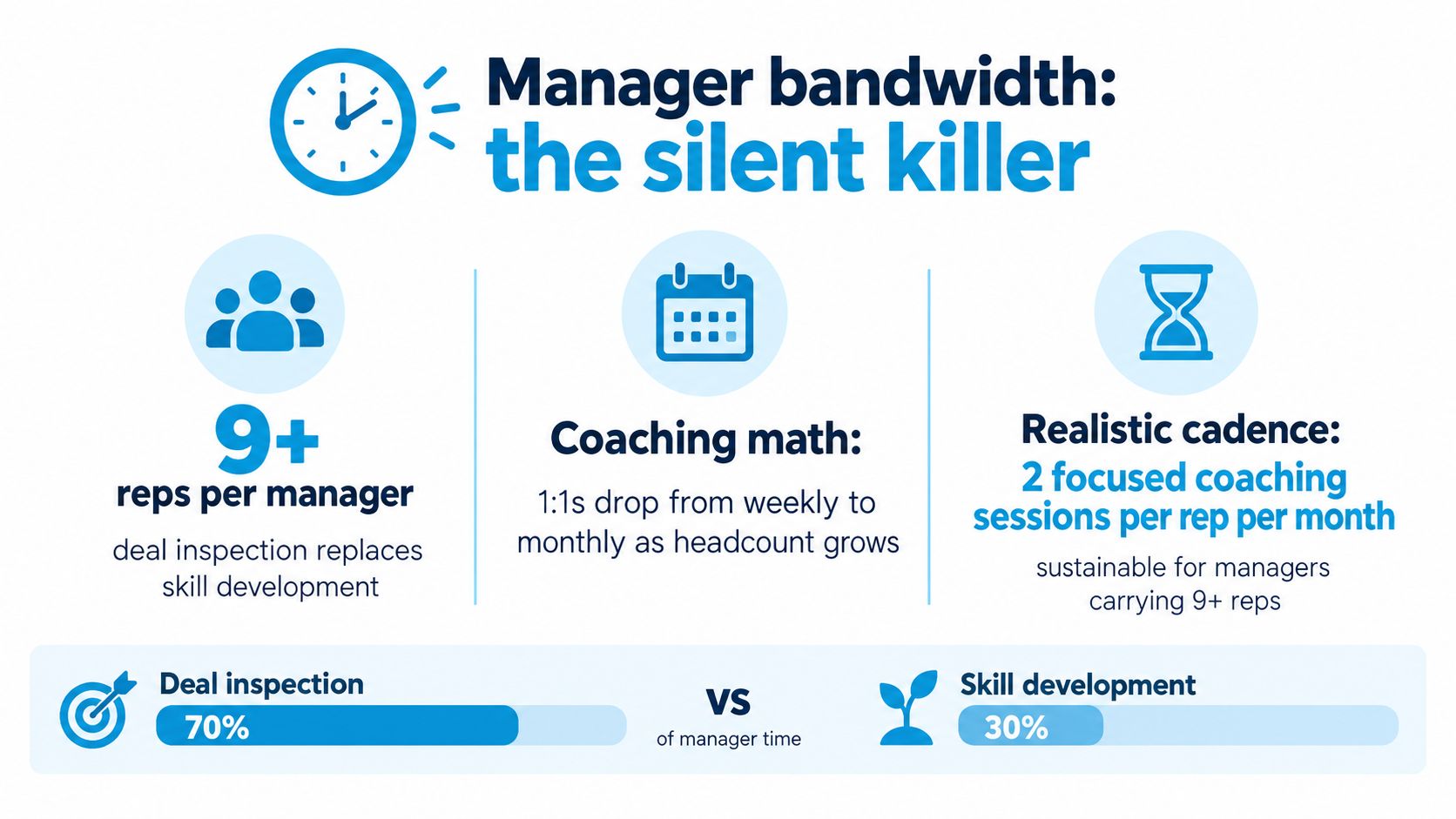
Manager bandwidth is where most coaching plans fail. Leaders often intend to develop skills but spend their available time inspecting deals, updating forecasts, and handling escalations. When a manager carries a large team, inspection feels immediately useful while deliberate skill development feels easier to postpone.
A 2026 sales-practice benchmark reports that managers average 9.7 reps, while remote teams report weekly coaching at only 19%. The same benchmark found that only 31% of reps report weekly coaching, which points to a gap between what managers believe they provide and what reps experience. These figures come from Hyperbound's 2026 sales-practice report.
Separate inspection from development
Pipeline review asks whether an opportunity is healthy. Coaching asks whether the SE can perform a repeatable behavior under pressure. Combining both often produces a forecast conversation with a few vague suggestions attached.
Protect separate time for each purpose:
- Deal inspection: Review stage, risk, stakeholders, next action, and technical evidence.
- Skill coaching: Rehearse one observable behavior, such as a qualification question, an architecture explanation, or a response to an objection.
- Application review: Return to the live opportunity and identify where the SE will use that behavior.
The session doesn't need to be long to be useful. It needs a narrow objective, an actual practice attempt, and a follow-up tied to a real deal. A manager can ask the SE to replay a discovery exchange, replace one weak question, and explain what evidence the new question should produce.
A cadence built around spaced repetition for sales skills helps the team revisit behaviors before they disappear from active use. Repetition works best when each return adds difficulty or applies the skill to a different customer situation.
Defend weekly coaching with evidence
A 2026 survey of more than 3,700 sales professionals reported 76% quota attainment for teams coached weekly, compared with 47% for teams coached quarterly or less. The 29-point gap was tied to coaching frequency, while 41% of reps were never or rarely coached and only 28% received weekly coaching, according to My Sales Coach's sales coaching statistics.
That evidence doesn't mean every SE manager must create a calendar full of meetings. It does show why quarterly workshops are a poor substitute for recurring practice. Weekly contact creates a faster feedback loop between behavior, live execution, and review.
A sustainable rhythm for a manager with a large team might include:
- Weekly team practice: One shared technical scenario, such as discovery for a security review or objection handling around implementation risk.
- Individual deal sparring: Focused sessions for opportunities with significant technical uncertainty or stakeholder complexity.
- Monthly pattern review: Inspect recurring gaps across calls, demos, pilots, and CRM records.
- Quarterly system review: Decide which skills, assets, and manager routines need adjustment.
The precise calendar should fit the team. The principle shouldn't change: pipeline inspection and skill development need different objectives, evidence, and follow-through.
Core Content Areas for Technical Execution
Generic sales coaching breaks down when the product requires architecture decisions, integrations, security review, data migration, or a proof of value. An SE needs practice in the exact technical and commercial motions that move a complex opportunity forward.
A presales process commonly runs through discovery, qualification, solution mapping, validation, and alignment on success criteria before commitment, as described in Highspot's presales process overview. That sequence gives a coach a practical structure for reviewing execution.
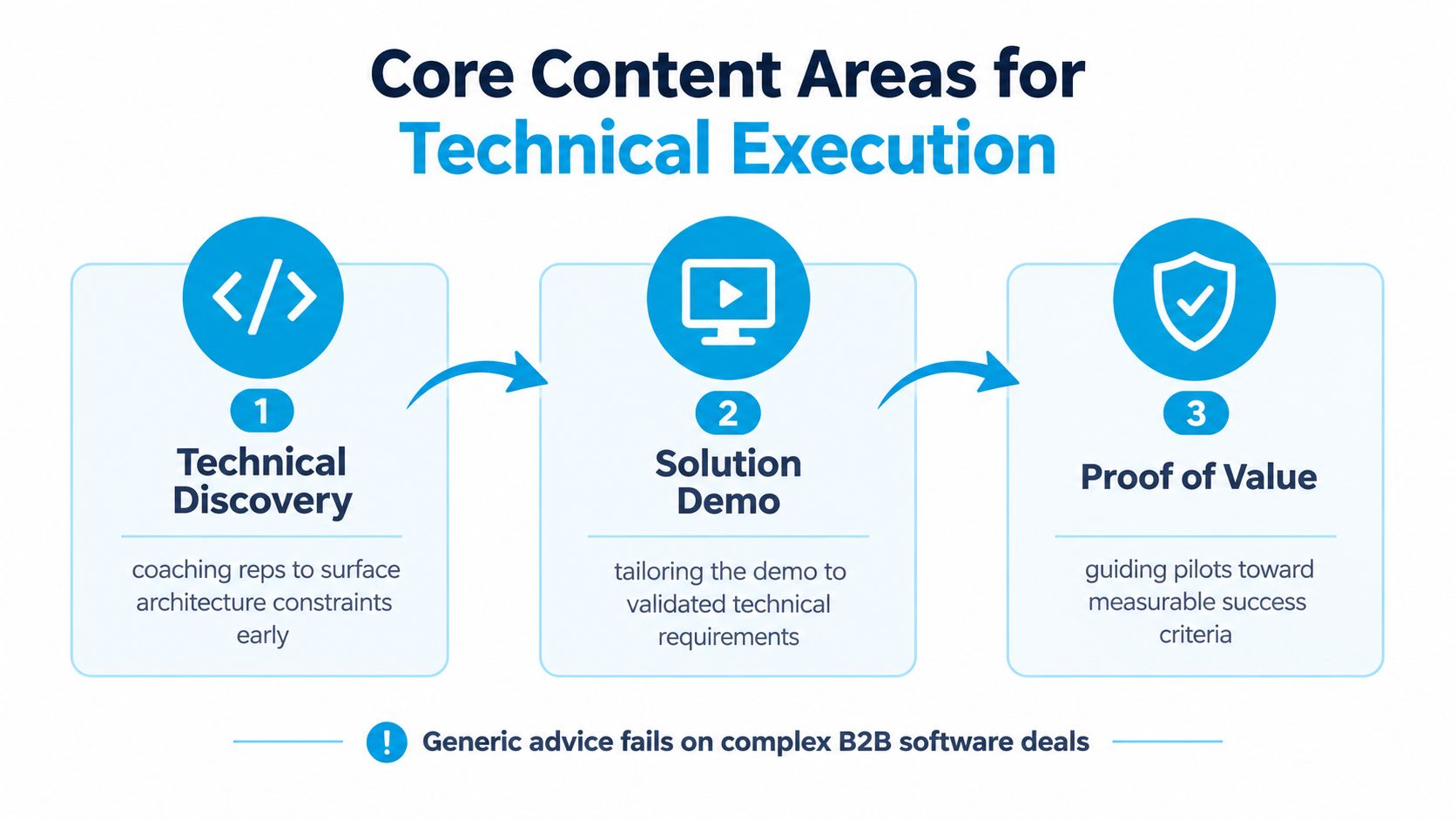
Technical discovery
Start with the customer's environment, not the product's feature list. The SE should uncover the current workflow, architecture, constraints, stakeholders, and desired business change. PreSales and Sales jointly use discovery to understand customer pain points, business objectives, organizational structure, and the customer's value hypothesis, as outlined in the PreSales Handbook selling journey.
Coach discovery in three passes:
- Before the call: What does the SE already know, and what remains unverified?
- During the call: Which answers expose a constraint, decision risk, or missing stakeholder?
- After the call: What belongs in the CRM, what changed in the solution hypothesis, and what must happen next?
Review transcripts for depth rather than question count. A shallow question asks whether the customer needs an integration. A stronger conversation explores the system involved, the data that must move, the owner of the integration, the security review, and the consequence of failure.
Solution mapping and demo design
The demo should be a response to validated requirements. If the discovery conversation reveals a complex approval workflow, the demonstration should make that workflow visible. If the technical concern is deployment control, the SE should show the relevant operating model and explain the limits plainly.
Use a simple review test:
- Name the customer requirement.
- Identify the evidence that confirms it matters.
- Connect the requirement to a product behavior.
- State what the buyer should be able to judge after the demonstration.
This prevents feature tours. It also gives the manager something concrete to coach. The demo skills training guide can support teams that need to improve presentation mechanics, but mechanics should follow discovery rather than replace it.
Validation and proof of value
Open-ended pilots consume SE capacity and leave buyers unsure what they proved. Coach the SE to define the evaluation before technical work begins. The plan should identify the use case, participants, data or environment required, test actions, evidence to collect, and decision that follows.
A useful evaluation plan answers:
- What must be true? State the technical and business outcomes.
- How will the buyer test it? Define the workflow, users, data, and conditions.
- Who signs off? Name the technical evaluator and the business owner.
- What happens after validation? Agree on the decision path and remaining risks.
The coach should inspect whether the SE captured these details in the CRM so the AE and SE share one view of requirements and next steps. Discovery outputs that remain in a private notebook can't guide the wider deal team.
Choosing Between Group and Individual Formats
Group coaching and individual coaching solve different problems. A group session creates a common standard and lets experienced SEs learn from varied approaches. A one-on-one session creates the privacy and context needed for a sensitive communication issue or a high-stakes opportunity.
The mistake is choosing a format based on convenience. Choose it based on the behavior you need to change.
Coaching Format Decision Matrix
| Skill Area | Group Format | Individual 1:1 |
|---|---|---|
| Discovery framework | Compare approaches using the same hypothetical customer brief | Review the SE's call and isolate missed evidence |
| Technical qualification | Practice identifying architecture, security, and integration risks | Prepare questions for a specific account and buying group |
| Demo structure | Rebuild a feature-heavy demo into a requirement-led flow | Rework the next live demo around one customer's priorities |
| Objection handling | Run rotating roleplays with different buyer objections | Explore the SE's personal response pattern and phrasing |
| Stakeholder mapping | Map a shared scenario and compare assumptions | Plan influence paths for the actual opportunity |
| Proof of value | Design an evaluation plan as a team | Resolve scope, success criteria, and political risk in a live pilot |
| Communication blind spots | Collect peer observations in a controlled exercise | Give direct feedback without the pressure of an audience |
| Playbook adoption | Introduce the standard and practice it together | Diagnose why the SE isn't applying it in active deals |
Use group sessions for shared execution
A strong group practice session starts with a realistic scenario, not a lecture. Give the team a customer context, a technical constraint, and an incomplete discovery record. Ask one SE to lead the conversation while another plays the buyer and a third observes for evidence.
The observer should track behaviors such as:
- Did the SE establish the business reason for change?
- Did the SE test the technical assumption?
- Did the SE ask who owns implementation or approval?
- Did the SE earn a next step tied to a decision?
Rotate roles so experienced SEs aren't always performing and newer team members aren't always observing. The debrief should focus on the reasoning behind each question, not on personality or presentation style.
Group formats work particularly well for competitive scenarios, qualification standards, discovery language, and playbook adoption. They create useful variation without requiring every manager to repeat the same lesson across multiple one-on-ones.
Reserve individual sessions for deal judgment
One-on-one coaching earns its place when context matters. Use it to prepare for a strategic discovery call, challenge an untested solution hypothesis, or rehearse a difficult conversation with an executive stakeholder.
The manager should arrive with evidence. Review the call transcript, opportunity notes, architecture diagram, or evaluation plan. Then ask the SE to make a decision and defend it. That creates judgment practice, which is more valuable than merely telling the SE what the manager would do.
Measuring the Technical Win and Coaching Impact
Training completion is easy to report and weak as proof of impact. A completed module doesn't show whether an SE improved discovery, qualified technical risk, or helped a buying group reach a decision.
Define the technical win as a buyer-confirmed decision that the proposed solution satisfies the agreed technical requirements and can proceed through the customer's evaluation or approval path. The exact definition may vary by business, but it must appear in the CRM as an observable milestone rather than a subjective feeling.
Put the technical win into the CRM
Create fields and required evidence that match the buying process:
- Technical requirements: What must the solution support?
- Validation status: Which requirements have been demonstrated or tested?
- Success criteria: What does the customer need to prove?
- Technical stakeholders: Who evaluates, implements, approves, or influences?
- Open risks: Which concerns could stop progression?
- Technical win status: What customer evidence supports the current stage?
This structure lets leaders distinguish SE activity from SE impact. A high number of demos may indicate demand, or it may indicate that the team is demonstrating too early. A lower number of demos can be healthy if discovery quality improves and unqualified evaluations are filtered out.
Track stage conversion with SE involvement, movement through validation, evaluation completion, and the share of opportunities with documented technical criteria. Pair those indicators with qualitative call reviews so the team doesn't optimize the CRM while behavior remains unchanged.
Report outcomes a CRO can use
A practical monthly report should connect four layers:
- Capability activity: Coaching sessions, roleplays, call reviews, and practice topics.
- Observed behavior: Discovery depth, requirement capture, stakeholder coverage, and evaluation planning.
- Deal movement: Technical validation, stage progression, risk reduction, and next-step quality.
- Commercial outcome: Technical wins, closed opportunities, lost reasons, and time spent on low-fit work.
Historical research by Integrity Solutions and the Sales Management Association found that firms effective at sales coaching achieved sales objectives 9% higher than other firms, while ineffective firms lagged by 6%. The figures appear in the Integrity Solutions sales coaching research brief.
The point isn't to claim that coaching alone causes every revenue result. It is to give leadership a disciplined way to test whether stronger execution corresponds with better opportunity movement. The sales engineer KPI guide can help teams choose measures that reflect the SE's actual contribution rather than activity volume.
Building a Continuous Coaching Operating Model
A workshop can introduce a method. It can't maintain a behavior by itself. Recent guidance on B2B coaching notes that managers may spend only 5% to 8% of their working time coaching, while 80% of training is forgotten within 30 days without reinforcement, according to Hyperbound's guide to online sales coaching platforms.
That creates a clear operating requirement. Coaching must appear in the normal work of the PreSales team, attached to active deals and repeated through manageable practice loops.
Build the operating rhythm
Use a repeating cycle that connects learning to execution:
- Monthly skill sprints: Choose one competency, such as technical discovery or evaluation planning, and apply it to current opportunities.
- Live deal reviews: Inspect real calls, requirements, demos, and pilots rather than discussing abstract best practices.
- Manager-led micro-coaching: Use brief, focused sessions to rehearse one behavior and assign a specific field application.
- Reinforcement loops: Revisit the skill through roleplay, quizzes, peer feedback, and CRM evidence.
The system should also include a shared repository. Store discovery checklists, qualification prompts, demo planning templates, evaluation plans, call-review rubrics, and examples of strong CRM notes in one accessible location. Update assets when the team encounters a new objection, architecture pattern, or buying-process risk.
Run the cycle across the year
A year-round model doesn't mean every month feels the same. Early in the cycle, establish standards for discovery, technical qualification, and the technical win. Later, apply those standards to competitive deals, executive conversations, pilots, and cross-functional alignment.
Managers need their own coaching system as well. Give them session guides, observation rubrics, escalation rules, and a way to compare coaching activity with behavior change. Without manager capability, the program depends on a few naturally strong coaches and becomes fragile when priorities shift.
The operating model can combine on-demand learning with live practice. The Trusted Advisor Academy from PreSales Unleashed GmbH provides structured PreSales development through on-demand lessons, reusable assets, live practice, roleplays, office hours, and learning paths tied to discovery, demos, sales alignment, and POC management.
The SE Rockstars community can also give practitioners a place to exchange scenarios and compare approaches. Peer learning works best when it supplements, rather than replaces, manager feedback on live opportunities.
A continuous model keeps the focus where it belongs: observable behavior, customer evidence, and the technical win.
If your team needs a more structured path, review how to choose PreSales training against the operating requirements above. Look for live deal practice, manager support, repeatable assets, and measures tied to technical execution, not isolated attendance.
PreSales Unleashed GmbH helps B2B SaaS teams build these habits through structured PreSales enablement, live practice, reusable tools, and development paths for Solution Engineers and their managers. Visit PreSales Unleashed GmbH to connect your coaching cadence to discovery quality, technical wins, and active deals.