
You're probably living this right now. The prospect asked for a demo, the AE wants momentum, and the room looks polite while everyone already has a private opinion about your product. By the time you share your screen, the buying group has often done part of the work without you, which is why a polished tour can feel strong and still lose. Strong pre-call planning helps, but planning only matters if it changes the next live interaction.
The fix isn't to become friendlier or talk less about features. It's to help the buyer finish the job they're trying to do, then tie every question, demo step, and proof point to that job. If you want a practical lens on how support teams think about buyer help across the journey, insights for support teams can be useful context, because the same pattern shows up there, too. Customer centric selling, for SEs, means you're not presenting a product, you're moving a decision forward.
Why Your Demo Loses Before You Share Your Screen
A lot of demos fail before the first tab opens. The buyer has already read vendor comparisons, formed a shortlist, and decided what “good enough” looks like, so your generic walkthrough arrives late and sounds like category wallpaper. Salesforce's State of Sales research says 81% of sales representatives reported that buyers increasingly research before contacting them, which explains why repeating homepage facts wastes the meeting Salesforce State of Sales.
The better move is to treat the live call as a decision support session, not a feature tour. If the buyer has already built a mental model, your job is to test it, correct it, and complete it. That means your first questions should expose the decision job, the risk, and the missing evidence, not restate the product story.
The demo starts with the buyer's unfinished job
Customer centric selling works when you understand what the buyer is trying to complete right now. Sometimes they need problem clarity. Sometimes they're comparing approaches. Sometimes they're trying to get internal consensus after they've already picked a front-runner.
A simple rule helps:
- If the buyer is still naming the pain, stay in discovery.
- If they're comparing options, frame trade-offs and boundaries.
- If they're validating fit, show only the proof that answers their criteria.
- If they're building consensus, give them artifacts they can reuse internally.
Practical rule: never open with your best demo slide until you know which decision the customer is trying to make.
That's also why sales-engineer content that focuses on internal alignment matters. What a Sales Engineer does is broader than product explanation, because you're shaping the buying process as much as the product conversation. If you don't know the job the buyer is trying to finish, your demo becomes a broadcast.
What Customer Centric Selling Really Means for SEs
A buyer opens the call with a problem, a half-built shortlist, or a stack of internal questions. Customer centric selling starts by helping them finish that job. The roots go back to the 1950s marketing concept, which argued that companies should understand and satisfy customer needs before pushing what they already built Springer article on customer orientation. That line of thinking later turned into market orientation and customer orientation. Kohli and Jaworski's 1990 work framed market orientation around generating market intelligence, sharing it across functions, and acting on it. Narver and Slater described the same era through customer orientation, competitor orientation, and interfunctional coordination.
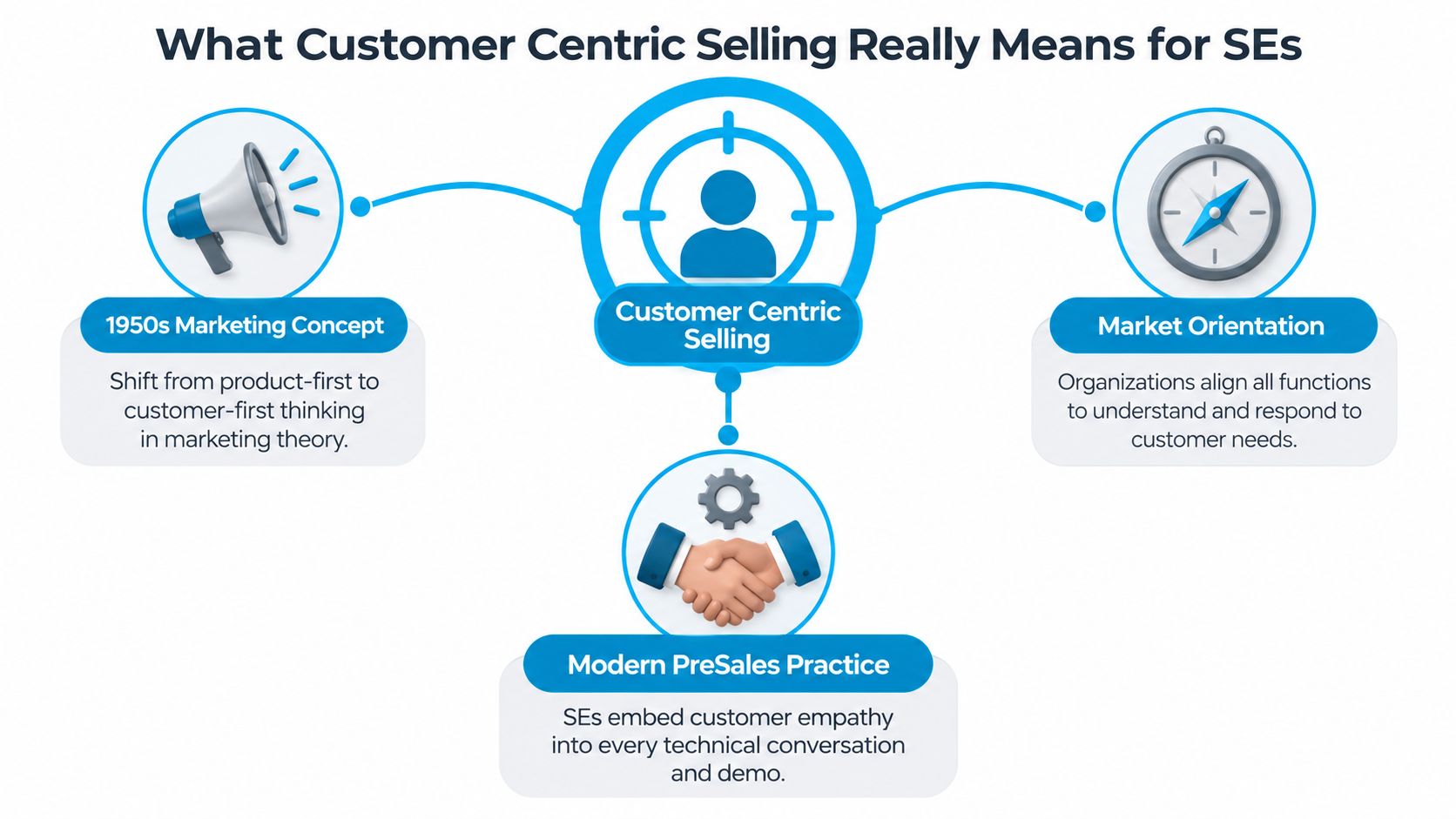
It's an operating model, not a personality trait
For SEs, that means discovery, demo, proof, and handoff all connect. Customer centric selling is not just being agreeable or asking more questions. It is the way you turn buyer input into the next decision the team has to make. Literature reviews have traced customer orientation across marketing, organizational behavior, and psychology for nearly 40 years, which puts this work in a mature research field, not a passing sales slogan Springer article on customer orientation.
The practical move is simple and hard at the same time. Translate buyer problems into choices about value, technical fit, implementation risk, and commercial outcome. Discovery notes stop being CRM cleanup and become the input for the demo, the proof-of-concept, the security conversation, and the implementation handoff.
Customer centricity shows up when the seller responds to what the buyer said, not what the seller planned to say.
Generic “customer first” language does not help in PreSales. Buyers care whether you can reflect their context, keep the demo tied to their decision, and avoid making them repeat the same story to every person on the team. Over-customizing for every account can waste time and blur the point, so the goal is fit, not theater. AI-shaped buyer assumptions create another risk, because the buyer may arrive with a polished but incomplete view of the problem, and SEs have to test that view instead of accepting it at face value.
Map Your Work to the Six Buying Jobs
Gartner defines six buying jobs that B2B buyers have to complete, problem identification, solution exploration, requirements building, supplier selection, validation, and consensus creation Gartner buying journey. Buyers don't move through those jobs in a neat line. They loop back, especially when new stakeholders appear or a technical risk surfaces. That's why a one-pass funnel mindset fails in complex deals.
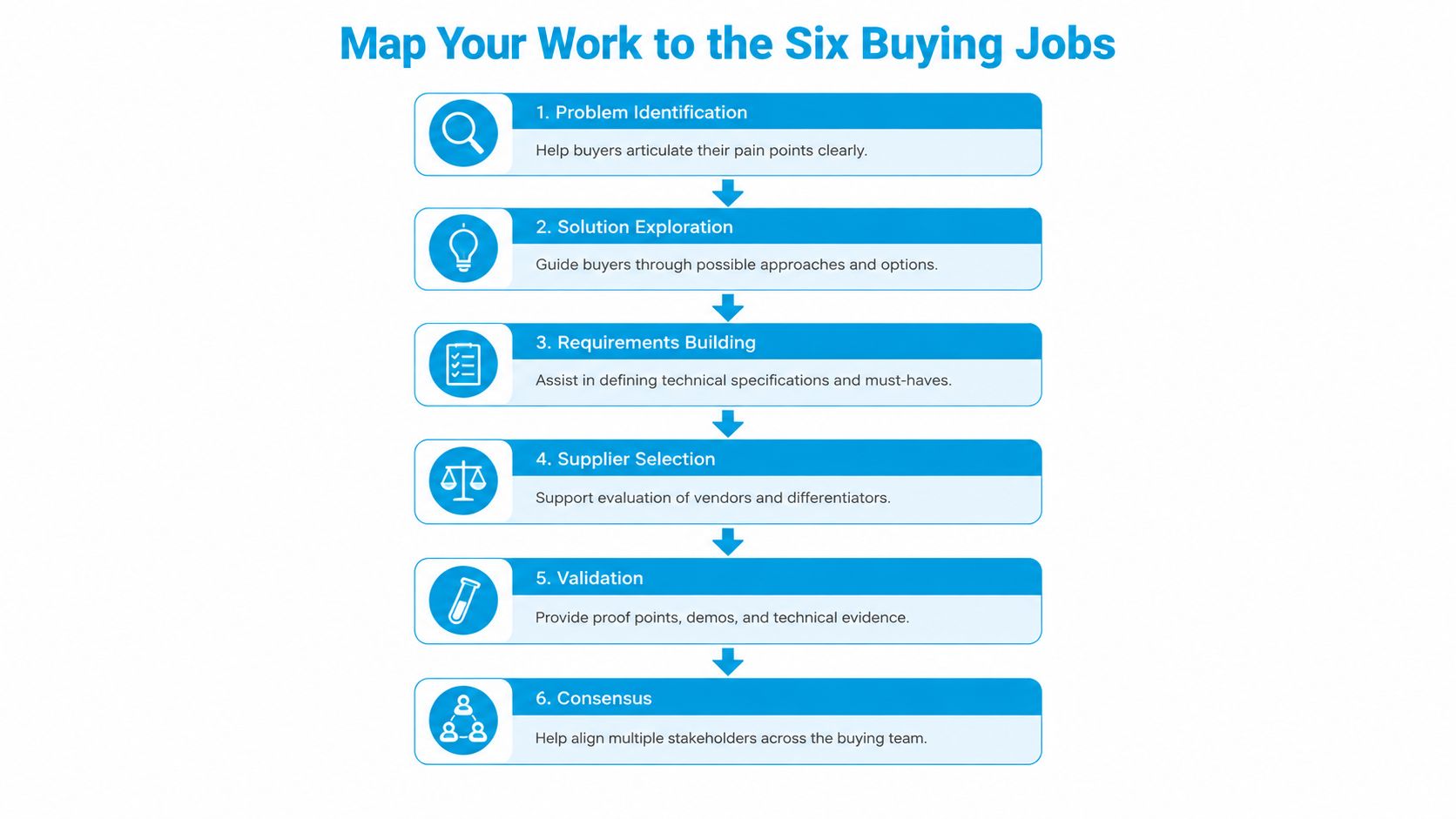
Match your SE motion to the active job
Start every serious opportunity by naming the job the buyer is trying to finish. Then make your interaction help them finish that job faster.
- Problem identification. Help the buyer describe the pain in business language.
- Solution exploration. Compare approaches without rushing to your platform.
- Requirements building. Turn vague wants into testable criteria.
- Supplier selection. Show why your approach fits better than the alternatives.
- Validation. Prove the thing works in their environment.
- Consensus creation. Give the champion content they can use with finance, security, ops, and leadership.
If you want a structured way to connect that thinking to qualification, value selling training helps frame the business case side of the conversation. The point is not to force every opportunity into the same sequence. The point is to stop giving validation material when the buyer still needs problem definition.
Use the right evidence for the right job
A demo that helps with supplier selection can still fail at validation. A technical walkthrough can make the product look capable while leaving the customer unsure about implementation risk, data fit, or internal alignment. Gartner also reports that 77% of B2B buyers agree purchases have become very complex and difficult, which is why information, not more seller talk, is what moves the process Gartner buyer enablement.
So ask yourself before every touch:
- What job is the buyer stuck on?
- What evidence would help them finish it?
- What's the smallest useful next step?
That's buyer enablement. And for SEs, it beats a broad pitch every time.
Run Discovery Demos and Validation That Prove Fit
The cleanest PreSales motion is simple: discover, narrow, prove. You should know the buyer-defined problem, the success criteria, and the main evaluation risks before you show the product. The demo then becomes a hypothesis test. Validation becomes the evidence pack that helps the buying group say yes with less internal friction.
Build the demo around a hypothesis
A strong discovery call gives you a working theory of how the customer will win. That theory should cover business impact, technical constraints, stakeholders, and what could break during evaluation. Then you redesign the demo around that theory instead of marching through your favorite product path.
A useful check is whether you can explain the demo in one sentence:
“This walkthrough shows how your team would solve the specific problem you named, under the constraints you described, and with the proof you need for internal approval.”
If you can't say that, you're not ready to demo. You're still collecting context.
Generic demo versus buyer enablement
| Generic product tour | Buyer enablement move | Buying job helped |
|---|---|---|
| Walks through standard navigation | Opens with the buyer's stated outcome and risk | Problem identification |
| Shows every major feature | Shows only the paths that support the buyer's criteria | Requirements building |
| Uses one script for every account | Reorders steps based on the deal's main concern | Solution exploration |
| Ends with “any questions?” | Gives evidence the champion can reuse internally | Consensus creation |
| Runs a broad POC with no guardrails | Defines success criteria and exit points up front | Validation |
The difference is discipline. You're not trying to impress the room with breadth. You're trying to reduce uncertainty.
Keep proof tied to the customer's criteria
Many SEs slip here. They prove a capability the buyer didn't ask about and miss the criterion that matters. Tight validation means every artifact answers a specific buyer concern, like implementation effort, integration dependency, security review, or workflow fit. If the proof doesn't help the buyer make a decision, it's noise.
For teams building better technical motions, what is PreSales is a useful baseline if you need to align the AE, SE, and manager on where technical ownership begins. The key point is this: buyer enablement beats feature coverage. The buyer is paying you to reduce decision risk, not to tour your UI.
When Being Extra Helpful Costs You the Deal
More customer focus does not automatically mean more wins. A cross-industry study with triadic data from 56 sales managers, 195 sales representatives, and 538 customers found an inverted U-shaped relationship between salesperson customer orientation and sales performance, while customer attitudes kept improving as orientation increased Journal of Marketing study. In plain English, customization helps until it starts eating your team's time and focus.
Deep help is expensive, so spend it where it pays back
That does not mean you get lazy. It means you qualify harder. When every deal gets the same level of bespoke architecture, you burn presales hours, slow cycle time, and create work that never had a fair chance to close. The sweet spot moves higher when the offer is more individualized, the price point is premium, and competitive pressure is intense.
Use that to segment your effort.
- High-value, complex, strategic deals: go deep on discovery, custom architecture, and evaluation support.
- Lower-fit or lower-value deals: use bounded modules, standard qualification, and a tighter technical path.
- Unclear opportunities: stop and requalify before you build anything custom.
Watch for the signals of over-service
You know you have gone too far when the deal keeps asking for more without narrowing the decision. The symptoms show up fast.
- Unfocused POCs that keep changing scope.
- Repeated rework because the buyer never committed to criteria.
- Slipping cycle time with no added clarity.
- Technical validation that keeps expanding into a free consulting project.
That is where disciplined qualification protects the technical win. A well-run SE motion can improve customer perception even when it stops serving seller productivity, but your manager still has to pay for the hours. If you want to sharpen that qualification muscle, MEDDPICC for Solution Engineers helps you keep the deal honest.
Stay Customer Centric When Buyers Use AI First
A modern buyer often arrives with a head start. A 2025 B2B buyer study found that 90% of buyers research before first contact, nearly two-thirds use generative AI at least as much as traditional search, and 61% begin with a preferred vendor while 45% remain open to switching Responsive buyer study. That changes your first meeting. You're not helping the buyer start thinking, you're helping them check whether what they already think is solid.
Validate the AI output without making the buyer defensive
When the buyer brings AI-shaped requirements, don't mock the brief and don't accept it blindly. Test it. Ask which assumptions came from internal context, which came from AI drafting, and which still need stakeholder validation. That keeps the conversation respectful and gets you to the decision criteria faster.
The best SEs now serve both the person in the room and the buyer's information system. That means you need decision-ready content that can be shared before, during, and after the call. If you want more on how technical teams adapt their skills to this shift, future skills for Solution Engineers and AI is a useful companion read.
Personalize with permission, not surveillance
The personalization trap is real. A global Qualtrics XM Institute study of 23,730 consumers across 23 countries found that 64% prefer companies that tailor experiences to their needs, but 53% are extremely or very concerned about personal-data privacy and only 33% trust companies to use their information responsibly Qualtrics privacy study. That means more personalization is not always more customer centric.
Use this rule set instead:
- Be permission-aware. Don't act like data entitlement is the same thing as relevance.
- Be benefit-linked. Explain why a detail matters to the evaluation.
- Be easy to correct. Let the buyer steer you away from a wrong assumption.
- Separate context from intent. Business context is fair game. Private inference is where trust breaks.
- Offer a less-personalized path. Some buyers will want it, and that's fine.
If you work global deals, this matters even more because acceptable personalization shifts by market. For a useful parallel on coordination across multiple agents and handoffs, Projectify on multi-agent coordination is a solid outside reference. In PreSales, the practical version is simple, don't let AI-generated shortcuts replace direct buyer confirmation.
Make Your Next Deal the Proof Point
No discovery, no demo. That rule still holds because discovery quality decides whether the demo is relevant, whether validation is believable, and whether the buyer can defend the choice internally. If you want a better technical win, pick one live opportunity today and name the buying job it's stuck on.
Then do three things before your next meeting. Write the customer-defined problem in one sentence, define the proof the buyer needs, and decide who else has to be convinced. If you want help turning that habit into repeatable coaching and team systems, aligning content coaching and tools is a useful framing for how enablement sticks.
PreSales Unleashed GmbH helps Solution Engineers and PreSales leaders turn customer centric selling into daily deal work, with training, practice, and coaching built around discovery, demo quality, and technical win discipline. If you want structured support for better discovery, tighter validation, and stronger SE habits, visit PreSales Unleashed GmbH and see how the Trusted Advisor Academy fits your team.