
Ask five SEs what belongs in a pre sales questionnaire and you'll get five versions of the same advice. Make it thorough. Cover the stack, the pain, the budget, the stakeholders, the security posture, everything you might need, so nothing surfaces late. Send it early and get it in writing.
That advice is why so many questionnaires come back half-finished. A buyer who opens a 60-field form on a Tuesday afternoon answers the first eight fields, reaches one that requires a colleague, and closes the tab. You end up with a partial picture and a false sense of coverage.
The version that works is smaller and sharper. It treats the questionnaire as interaction design first and requirements elicitation second, and it assumes part of the buying group has already researched you, your competitors, and the problem before anyone booked a call. That assumption changes what you ask, and it changes what you do with the answers.
Everything below follows one belief. No discovery, no demo. The questionnaire is how discovery survives contact with a real calendar.
What a Pre Sales Questionnaire Is For
A PreSales questionnaire is the structured question set an SE and AE use before or during discovery to capture the buyer's outcome, current state, requirements, decision process, and the evidence needed for a technical win. It isn't an RFP response, a lead form, or a security spreadsheet. Those are different instruments with different jobs, and confusing them is how a questionnaire ends up with forty fields nobody reads.
It does three jobs. It replaces internal guesswork with buyer language, so the demo gets built on the buyer's words instead of your assumptions. It decides whether the opportunity deserves SE time, which is a capacity decision before it is a forecasting one. And it aligns AE and SE before anyone builds a demo, so both of you walk into the same meeting holding the same picture.
Operating rule: No discovery, no demo. The questionnaire extends the conversation. It never replaces it.
The symptoms it prevents are specific and expensive. A demo booked before the technical problem is clear. A POC that runs six weeks because nobody wrote exit criteria. A security review that lands in the final week and stalls a signed deal. A champion who believes in the product but can't defend the choice to their own VP. None of those are selling failures. They're discovery failures that surface late.
Where it sits next to the RFP
An RFP answers the buyer's formal requirements. The questionnaire shapes what you ask and what you choose to prove. Keep them separate: the RFP is a compliance document you respond to, the questionnaire is a thinking instrument you send. If you want the wider view of where this sits in the job, the guide to what PreSales is covers the role and its outputs.
The design heritage is older than software sales. Don Dillman's Total Design Method treated a questionnaire as a complete respondent experience covering wording, layout, personalized contact, repeated follow-up, and easy return, and the published evaluation of that method reports that applying it to mail and telephone surveys commonly produced response rates of about 60% to 70%, against much weaker results from unstructured approaches. Relevance, low respondent effort, credible framing, disciplined follow-up. None of that is new, and all of it still decides whether your form comes back.
Set the first-pass scope small. A short set of high-value questions with follow-up prompts attached, not a fifty-item form.
The Questionnaire Structure at a Glance
Eleven sections cover a full technical evaluation. Nobody should receive all eleven on the same day. The map below is the master structure you draw from, and the last column tells you when each block earns its place.
| Questionnaire section | What it captures | Response format | Send when |
|---|---|---|---|
| Business outcomes | Target outcome, baseline, cost of inaction | Open text plus numeric target | Pre-call or first discovery |
| Current architecture | Systems, data flows, integrations, constraints | Enumeration plus diagram upload | Discovery |
| Users and workflows | Roles, volume, trigger, handoffs, failure points | Numeric ranges plus open text | Discovery |
| Functional requirements | Must-have capabilities and measurable acceptance criteria | Requirement grid with priority | After discovery |
| Non-functional requirements | Performance, availability, scale, compliance, support windows | Numeric ranges plus service levels | After discovery |
| Implementation constraints | Timeline, dependencies, resources, change freeze | Date ranges plus owner | Qualification |
| Security and data risk | Data classes, certifications, incident process, patch commitment | Evidence upload plus contract hook | Before technical validation |
| Procurement and evaluation | Budget line, approval path, criteria, competitor set | Enumeration plus open text | Qualification |
| Sales alignment | Technical win definition, stakeholders, demo decision, next step | Shared AE and SE notes | Before demo or POC |
| AI research audit | Shortlist sources, comparisons, uncertainty, false requirements | Open text with prompts | First call |
| Evidence plan | Proof required, owner, date, acceptance decision | Table with dates and owners | Before demo or POC |
Progressive qualification in practice
The first pass carries only what you need to decide whether to invest SE time: the outcome, the trigger, the first technical constraints, and how the buyer will decide. Everything downstream goes out when the opportunity earns it. A buyer in week one of an evaluation doesn't know their non-functional requirements yet, and asking for them produces guesses you'll later mistake for commitments.
Use controlled response types wherever the answer should be comparable across opportunities: enumerations, numeric ranges, mandatory or optional flags, evidence uploads. Open text stays for unknowns, but pair every open field with a prompt that asks for an example, a threshold, or a consequence. "Describe your data volume" gets you a sentence. "How many records per month at peak, and what breaks when you exceed it" gets you a number and a failure mode.
Response formats that stay comparable
Two fields do more for answer quality than any rewording. Give every stated requirement an owner on the buyer side and a validation method you both accept. That single discipline stops a preference from becoming a committed product requirement, because someone has to say out loud how it will be tested and who signs off.
NIST's supply-chain guidance takes the same posture, emphasizing scoping, identifying requirements, evaluating suppliers and third parties, and prioritizing risk rather than collecting undifferentiated information, as set out in NIST SP 800-161. Apply the same filter to every section you write. If the answer can't change the demo, the qualification, or the technical win, cut the section.
The cut test: every field has to change a decision. If it only makes the file look complete, it's costing you completions.
Discovery Questions That Expose the Real Workflow
Discovery questions fail in a predictable way. They ask about the buyer's wish list instead of the work as it runs today, and the answers come back as adjectives. Three rules fix most of it.
- Ask about work as it runs, not the version the buyer would like to run. Present tense, current state, actual people.
- Ask for an example, a threshold, or a consequence. Every open question gets a follow-up that forces one of the three.
- Ask one question at a time. Double-barrelled questions get one answer, usually the easier half.
| Discovery area | Question | Follow-up that gets specifics |
|---|---|---|
| Workflow | Walk me through the workflow from trigger to finish, as it runs today. | Where does the handoff slow down or break? |
| Volume | How many items, users, or transactions move through this each month? | What is the peak, and what happens when you hit it? |
| Roles | Who touches this process, and who owns the outcome? | Who signs off when it goes wrong? |
| Failure cost | What happens when this step fails or delays? | What did the last failure cost in time, rework, or revenue? |
| Workarounds | Where do people leave the system to get the job done? | Show me the spreadsheet, inbox, or side process. |
| Constraints | What can't change in this environment? | Is that a policy, a contract, or a preference? |
| Systems | Which systems have to stay in the flow? | Which direction does the data move, and how often? |
| Evidence | What numbers do you use to judge whether this is working? | What baseline do you have today? |
| Priority | What would make this project a failure even if the software worked? | Which outcome matters most to the person funding it? |
| History | What have you already tried, and what changed? | Why did that stop? |
Feature questions don't belong in this pass. Functional requirements need acceptance criteria, not adjectives, and they come later when you know which workflows carry the weight.
From answers to a demo storyline
Three answers build the whole narrative: one real workflow, one failure point inside it, one measurable outcome the buyer already tracks. If you can't fill all three from the questionnaire, you don't have a demo yet, you have a product tour with a customer name on the title slide.
The live conversation is where you push on consequence. The discovery call guide covers the structure and the scoring, and the library of technical discovery questions gives you more prompts for the architecture and integration side once the workflow is mapped.
If an answer wouldn't change the demo, it isn't a discovery question for this pass.
Requirements and Acceptance Criteria
Separate three requirement types before you ask anything else. Functional capabilities are what the system must do. Non-functional constraints are how well it must do them. Implementation constraints are the practical limits on getting it live. Buyers mix all three in one sentence, and untangling them is the SE's job.
Give every requirement six fields.
- The requirement itself, written as a capability, not a benefit.
- Business rationale, in the buyer's words, so the demo can lead with it.
- A measurable acceptance criterion, with a number and a test.
- Priority, as must, should, or could.
- A buyer-side owner, by name or role.
- The validation method, meaning demo, sandbox test, reference call, or document.
One rule decides everything else: if a requirement can't be tested, it's a preference, not a requirement.
A hypothetical example that separates requirement from preference
Say a mid-market HR platform buyer tells you payroll has to be fast. That's a preference with a stopwatch attached. The questionnaire turns it into three testable rows.
Functional: a payroll export for 5,000 employees completes in under 15 minutes at month end, tested in a sandbox, owned by the payroll lead. Non-functional: 99.9 percent availability during business hours, written into the proposal as a service level. Implementation: go live before a change freeze that starts December 15, owned by the IT director. Now every one of those can pass or fail in front of the buyer.
Ask for the trade-off too. Which requirement would the buyer drop first if the budget shrank by a third? The answer tells you what the deal is really about, and it tells you what to leave out of the demo.
NIST's Software Assurance Buyer's Guide makes the same demand of vendor questionnaires, recommending coverage of software development, supply chain, deployment, and vulnerability policies, and asking suppliers for a documented service-level agreement on patch application, as described in the buyer's guide presentation. The existence of a process and the measurable commitment attached to it are two different answers.
Keep the first full grid to fifteen rows or fewer and send it after discovery. If you need a starting skeleton for the document itself, these requirements templates from Zemith give you a structure to adapt, and the RFP requirements example shows how the same rows look once a buyer has formalized them.
Qualification Questions That Test Whether the Deal Is Real
Qualification is a capacity decision. Every question you ask should change whether you invest in a demo, a POC, or a security review, and the answers should be blunt enough to use in a live deal review without softening them.
| Qualification area | Question | Strong answer looks like | Red flag |
|---|---|---|---|
| Business impact | Which business number must move, and by how much? | Named metric, baseline, target, owner | No baseline or no owner |
| Priority | What happens if you do nothing this year? | Cost or risk with a date | No consequence |
| Decision power | Who signs, who can block, and who controls the budget? | Named people and sequence | Single-threaded to one contact |
| Funding | Which budget line funds this, and is it approved? | Line item and approval stage | "We will find budget later" |
| Timing | What date is fixed, and what depends on it? | External driver and milestone | Date with no driver |
| Evaluation | How will you compare vendors and decide? | Criteria, weights, process, dates | "We will know it when we see it" |
| Requirements | Which requirements are mandatory versus preferred? | Short must-have list with trade-offs | Everything is mandatory |
| Competition | What would make you choose another vendor? | Named alternatives and criteria | No competition or no alternatives |
| Proof | What evidence makes this a safe decision? | Demo, test, reference, security artifact, business case | Demo-only proof |
| Champion | What will your champion need to defend this internally? | Deck, ROI model, technical note, reference | Champion cannot name the blockers |
Ask about budget as a range and a funding source, never as a price. A named business metric with a baseline beats any amount of pain language, and a champion who can list the blockers by name is worth more than three enthusiastic contacts who can't.
What a red flag actually triggers
A red flag isn't a reason to walk. It's a reason to stop building. Three or more red flags mean no demo build and no open-ended POC until the missing decision is resolved. That's a harder conversation in the short term and a much shorter cycle over a quarter.
Use MEDDPICC as the map for the commercial context and keep the technical win criteria in the buyer's own words, which the MEDDPICC guide for Solution Engineers breaks down field by field. If you want the metric that ties this work to revenue, the technical win rate article explains why it predicts deal outcomes better than demo feedback scores.
A deal with no named decision sequence isn't a deal yet. It's a conversation with a friendly person.
Sales Alignment Questions That Split the Work
A PreSales questionnaire isn't an SE-only artifact. The AE owns the commercial questions, the SE owns the technical and evidence questions, and both need the same answers before anyone books a demo slot. Split by purpose, not by seniority.
- Technical win. The AE asks what has to be true for the approach to be accepted. The buyer names the evidence they'd need to defend it. Artifact: agreed technical win criteria.
- Stakeholders. The AE asks who else is involved and what each person cares about. The buyer names roles, not names. Artifact: a stakeholder map with roles and influence.
- Demo decision. The SE asks what the demo must prove and what decision it has to enable. Artifact: a demo storyline built on one workflow.
- Evaluation plan. Both ask how the buyer wants to run the evaluation. Artifact: a mutual evaluation plan with milestones.
- POC exit. The SE asks what pass and fail look like, and who judges. Artifact: written pass or fail criteria.
- Objections. The AE asks what concerns have already been raised internally. Artifact: an objection log with an owner per item.
- Champion enablement. Both ask what the champion needs to take this to their boss. Artifact: the internal business case inputs.
- Risk and next step. The AE asks what could stop this after today. Artifact: a dated action list in the CRM.
The twenty-minute meeting that makes it work
Run a pre-demo alignment meeting before any build. Review the answers, agree what the demo must prove, assign who asks which remaining question, and delete the duplicates. Two people asking the same question in one call reads as an organization that doesn't talk to itself, and buyers notice.
If the AE and SE roles blur in your org, the breakdown of what a sales engineer does and the comparison of SE, Solutions Engineer and Solutions Consultant titles will help you assign ownership without arguing about labels.
The output of that meeting is one page. A mutual evaluation plan with dates, owners, and pass or fail criteria that both sides have agreed to. The evidence plan sits at the end of it: proof required, owner, date, acceptance decision. It's due before the demo or POC, not after.
Security and Data Risk Questions Buyers Expect
Start with the data-risk profile, not the certificate folder. Which customer platforms does the service connect to, which data classes does it process, and what availability and confidentiality does the buyer require? Those three answers decide which controls matter and which pages of your security package are irrelevant to this deal.
NIST's supply-chain guidance calls for data integrity, confidentiality, and availability requirements to be defined and shared with suppliers, and its procurement guidance says bidders responding to an RFP or RFQ should be evaluated against relevant, critical cyber-supply-chain-risk criteria. It also gives concrete screening questions, including whether a product connects to a customer platform and whether it transmits, generates, maintains, or processes high-value data such as personally identifiable information, protected health information, or payment-card data. The NIST supply-chain risk guidance puts those questions near the front of any questionnaire, because they determine what follows.
- Customer platforms the service connects to and the direction of data flow. Artifact: integration diagram. Contract hook: integration responsibilities.
- Data classes processed or stored. Artifact: data-flow diagram with classification. Contract hook: data processing addendum.
- Independent certifications and their scope. Artifact: certificate and scope statement. Contract hook: security exhibit.
- Vulnerability ownership and patch service level. Artifact: vulnerability policy plus the last 90-day report. Contract hook: patch commitment.
- Incident reporting and closure. Artifact: incident runbook. Contract hook: notification clause.
- Subprocessors and how changes are announced. Contract hook: change notification.
- Customer-side controls. Artifact: shared responsibility matrix.
- Recovery time and recovery point objectives. Artifact: disaster recovery test summary. Contract hook: availability SLA.
From policy to enforceable commitment
For every question, ask for an artifact and a contract hook. That's the difference between "we have a policy" and "you can verify and enforce the control." NIST's supplier-risk work identifies third-party assessments, site visits, and formal certifications as evaluation methods, and recommends establishing cybersecurity requirements in a security exhibit or addendum carried into the master services agreement according to the risk of the relationship, as described in this NIST supplier assessment publication.
ISO/IEC 27036 gives you a lifecycle to hang the questions on, covering relationship scope, responsibilities, monitoring and review, change management, incident handling, termination, and continuous improvement, as summarized in this NIST overview of supplier relationship security.pdf). Ask which controls apply to the service being evaluated, which party owns each one, and what happens when the service, subprocessors, or data flows change.
Keep the first screen short. Send the full package only when the evaluation advances. When you're mapping certifications to actual controls, this compliance guidance for product security teams helps you read a scope statement rather than a logo. The output is a security evidence plan: artifact, accountable owner, review date, and the clause that carries the commitment.
The AI Research Audit Your Questionnaire Is Missing
Assume part of the buying group has already used AI or research tools before your first call. Conventional questionnaires repeat the current situation back to a buyer who has moved past it, and they miss the shortlist logic, the comparisons already made, and the false requirements created by generic research. Recent discovery guidance recommends asking what the buyer asked AI or research tools to compare, which criteria eliminated vendors, and where the research produced conflicting answers, as covered in this AI buyer discovery question set.
Add an AI research audit as its own short section. Eight prompts, all open text.
Eight prompts that surface the research trail
- What did you ask AI or a research tool to compare?
- Which sources did it cite, and did you check them?
- Which vendors did the research eliminate, and on what basis?
- Where did the sources disagree with each other?
- What did the comparison get wrong about your environment?
- Who else in the buying group has seen this research?
- Which claims are you treating as settled, and which are still open?
- What evidence would change your shortlist?
No yes or no boxes here. The value is in the uncertainty, and a checkbox can't hold it. Treat every answer as a hypothesis to test in the first call, not as a fact you plan around. Log it as a hypothesis with the evidence that would confirm or reject it, and keep the open ones visible in the deal notes.
An AI-generated comparison that misreads the buyer's stack creates objections you'll never hear out loud. It just becomes the reason you weren't shortlisted.
The output is short. A list of assumptions to validate, and one correction to send the buyer before the demo. One. Not a point-by-point rebuttal of their research, which reads as defensive and gets ignored. One precise correction, sourced, that fixes the thing most likely to cost you the deal.
This matters most in enterprise software, where a generic comparison can manufacture a technical requirement you don't have, or miss the integration that would have won the evaluation. Asking eight questions is cheaper than discovering the objection in week nine.
Deliver the Questionnaire So Buyers Complete It
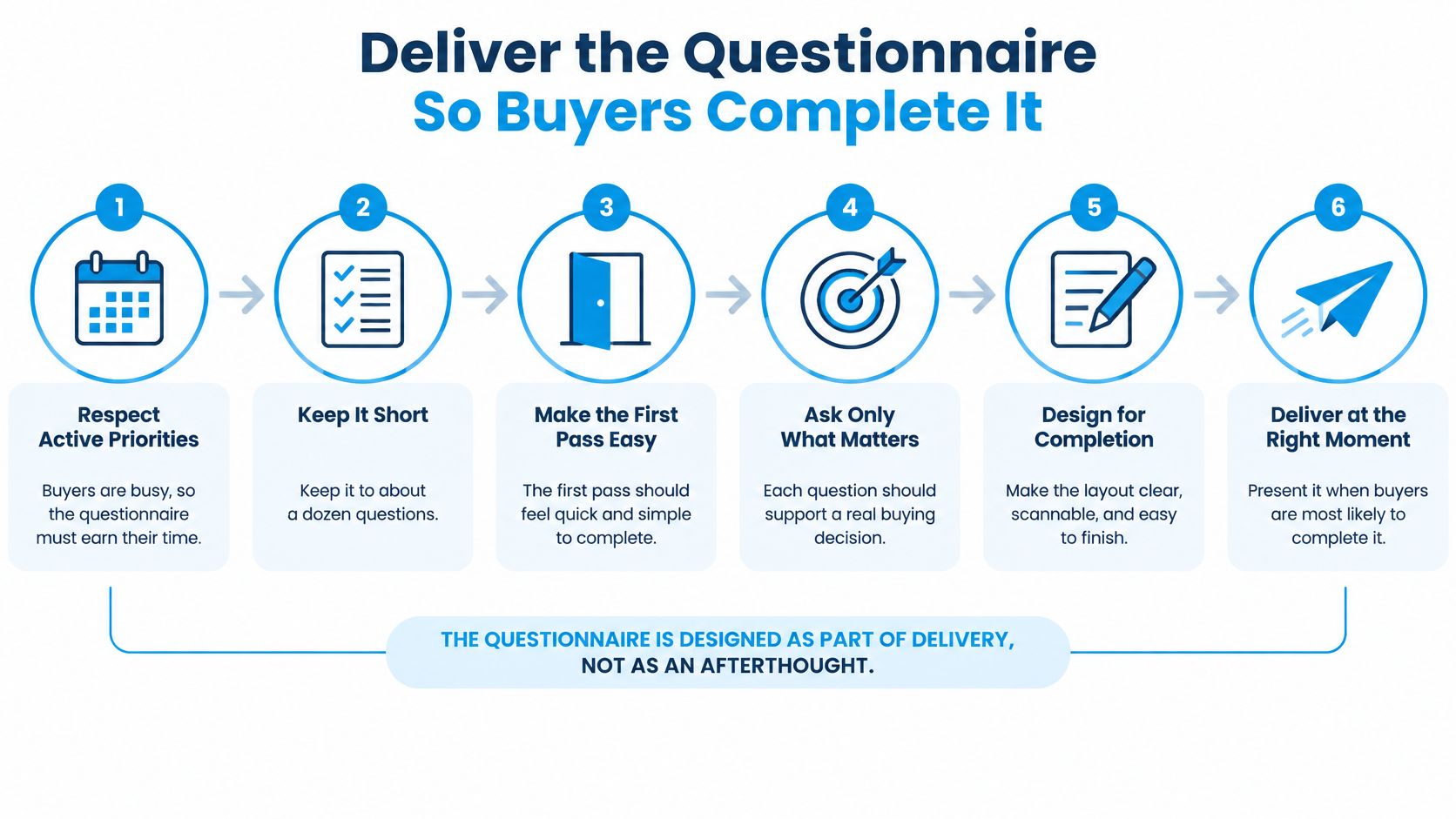
Delivery is part of the design, not the last step after the writing. A buyer questionnaire is voluntary and competes with active work priorities, so the first send has to earn its time.
The channel matters more than most SEs assume. Pew Research Center reports that about 80% or more of respondents selected for its online surveys usually complete the questionnaire, with roughly 99% of people who begin answering at least one item finishing the whole thing, as described in Pew's account of keeping online surveys short. Pew also found that typical U.S. telephone-survey response rates fell to 7% in 2017 and 6% in 2018, after sitting around 9% for several years before that.
Switching modes doesn't fix participation by itself. A randomized physician-survey study in the same Pew analysis recorded comparable response rates of 51.2% for mail-only delivery and 52.8% for a web-push design. What changes completion is scope and relevance, which is why a short, clearly scoped questionnaire in the buyer's preferred format beats a longer one in a format they tolerate.
The send sequence that gets finished forms back
- Send a short pre-call note with the purpose, the number of questions, and the time estimate.
- Send the first-pass form in the buyer's preferred format, whether that's a document, a web form, or a live conversation.
- Hold a 15-minute review call to walk the answers and fill the gaps in real time.
- Send a written summary that assigns every next action to a named owner.
Explain in one sentence why each section matters and how long it will take. Personalize the request by naming the workflow you discussed last time. Set a clear response date and follow up once, not four times.
Before you send anything, check the addresses. Bounced invitations burn the single follow-up you're allowed, and email verification tools catch dead mailboxes before the send rather than after the silence.
Keep the first pass to about a dozen questions covering business outcome, timing, the first technical constraints, and success criteria. Send the deeper security and requirements sections only when the opportunity justifies the extra effort. Asking for too much early produces a half-finished form and a buyer who stops replying.
Failure Modes, Fixes and a One-Page Quality Check
Most questionnaire failures are design failures, not buyer failures. The buyer who abandons the form is telling you something about the form, and the fix is usually structural rather than motivational.
| Symptom | Likely cause | Fix |
|---|---|---|
| Low completion | Questionnaire serves the seller's admin needs | Cut the first pass to 10-14 questions with a clear reason |
| Vague answers | Closed questions with no follow-up prompt | Ask for an example, a threshold, or a consequence |
| Every requirement is mandatory | Buyer was not forced to prioritize | Use must, should, and could, then ask for the trade-off |
| Security review starts late | Risk profile was not scoped early | Ask data classes and integrations in the first call |
| Demo repeats discovery | Answers were not routed into the demo plan | Turn answers into one workflow, one failure, one outcome |
| POC has no exit | Success was not defined before the build | Write pass or fail criteria with an owner and date |
| AE and SE ask the same questions | No shared question bank or handoff | Divide by purpose and share notes before the call |
| Champion cannot sell internally | No evidence plan for internal approval | Ask what the champion needs to defend the choice |
| Questionnaire feels like an RFP | Too many sections sent at once | Use progressive qualification and send deeper sections later |
Triage order when the forms come back thin
Fix completion first, specificity second, routing third. Cutting the first pass raises completion within a week. Adding follow-up prompts to every open question fixes vague answers on the next send. Routing deeper sections later fixes the RFP feeling and protects the relationship.
Then run the one-page quality check before the questionnaire leaves your outbox.
- One stated purpose at the top, in a sentence the buyer would recognize as their own.
- About a dozen first-pass questions, each tied to a decision.
- A follow-up prompt on every open question, asking for an example, threshold, or consequence.
- Required and optional fields marked, so the buyer knows what's blocking.
- A defined response format and a named owner for routing answers.
- A short data-risk screen near the front, before the certificate questions.
- An evidence plan with a date, not a promise to follow up.
Apply it to one live deal this week. Answer four things in writing: the business outcome, the binding technical constraint, the decision process, and the evidence required. Write three hypotheses for the next call. Then revise the questionnaire before it goes out.
If you want help choosing the right development route for your team, the guide on how to choose PreSales training lays out the options. The PreSales Leadership Community is a free peer network of more than 330 PreSales leaders with monthly online sessions and live events in European hubs. Teams that need sustained practice rather than a one-off workshop use Enablement-as-a-Service, a subscription program that develops a PreSales team over months. You can also book a free discovery call, where the team pressure-tests your funnel assumptions against your actual funnel.
The decision to make this week is small and concrete. Pick the live deal with the most at stake, rebuild its questionnaire to the first-pass scope, and send it before the next call.
PreSales Unleashed GmbH runs the Trusted Advisor Academy, a 12-month program that develops Solution Engineers through structured content, weekly live practice, and immediate application to active opportunities, with feedback on your own discovery calls, demos, and POCs. If your questionnaires keep coming back thin, the fastest route is to bring one live deal into a session and rebuild the instrument against it, then test it on the next call. Start at PreSales Unleashed GmbH and bring a real opportunity.