
The most popular advice about technical sales enablement is wrong in one important way. A larger content library won't make an SE better at discovery, a certification won't create technical judgment, and another product workshop won't fix a POC that has no exit criteria.
Enablement works when it changes what a Solution Engineer (SE) does on a live opportunity. The outcome PreSales owns is the technical win, so the system should improve discovery quality, technical qualification, demo relevance, evaluation discipline, and the evidence that feeds a forecast. Attendance and completion can support that work, but they aren't proof that it happened.
Why Most Technical Sales Enablement Fails
Teams still treat enablement as a destination. Someone builds a portal, uploads decks, assigns courses, and reports completion. The SE returns to active deals with the same habits, the same rushed discovery, and the same tendency to start with a demo.
That model ignores how technical selling works. The job depends on applied behavior under pressure: asking better questions, identifying technical risk, connecting architecture to business value, controlling an evaluation, and telling the AE what the evidence means. Product information matters, but information alone doesn't produce those behaviors.
The learning problem is well established. Hermann Ebbinghaus's 1885 work introduced the idea that newly learned information declines without reinforcement. A 2006 meta-analysis by Cepeda and colleagues, which synthesized 839 assessments across 317 experiments, found that spaced practice outperformed massed practice, with longer intervals supporting longer-term retention. The findings are summarized with sales-training context in this overview of spaced practice and reinforcement.
A one-off workshop therefore fails for a predictable reason. It concentrates information at the moment when the team has the least opportunity to apply, inspect, and correct it. The portal fails for a related reason. It asks SEs to search for content when they need a decision, rather than placing the right prompt, checklist, or practice moment inside the deal workflow.
| Dimension | Library Model | Operating System Model |
|---|---|---|
| Primary output | Content consumption | Observable behavior change |
| Unit of work | Course, deck, certification | Discovery, demo, POC, or forecast action |
| Reinforcement | Optional follow-up | Scheduled practice and manager inspection |
| Success signal | Attendance and completion | Technical win and deal progression |
| Ownership | L&D or enablement | SE leadership with sales alignment |
| Improvement loop | Content updates | Evidence from live opportunities |
Practical rule: If an enablement activity can't be connected to something an SE does differently on a live deal, it's education, not an operating system.
This distinction changes the reporting conversation. Track whether discovery records improve, whether technical qualification happens earlier, whether demos earn a credible next step, whether POCs reach an agreed decision, and whether SE input makes the forecast more reliable. Those measures tell you whether the team is applying the system.
What Technical Sales Enablement Actually Means
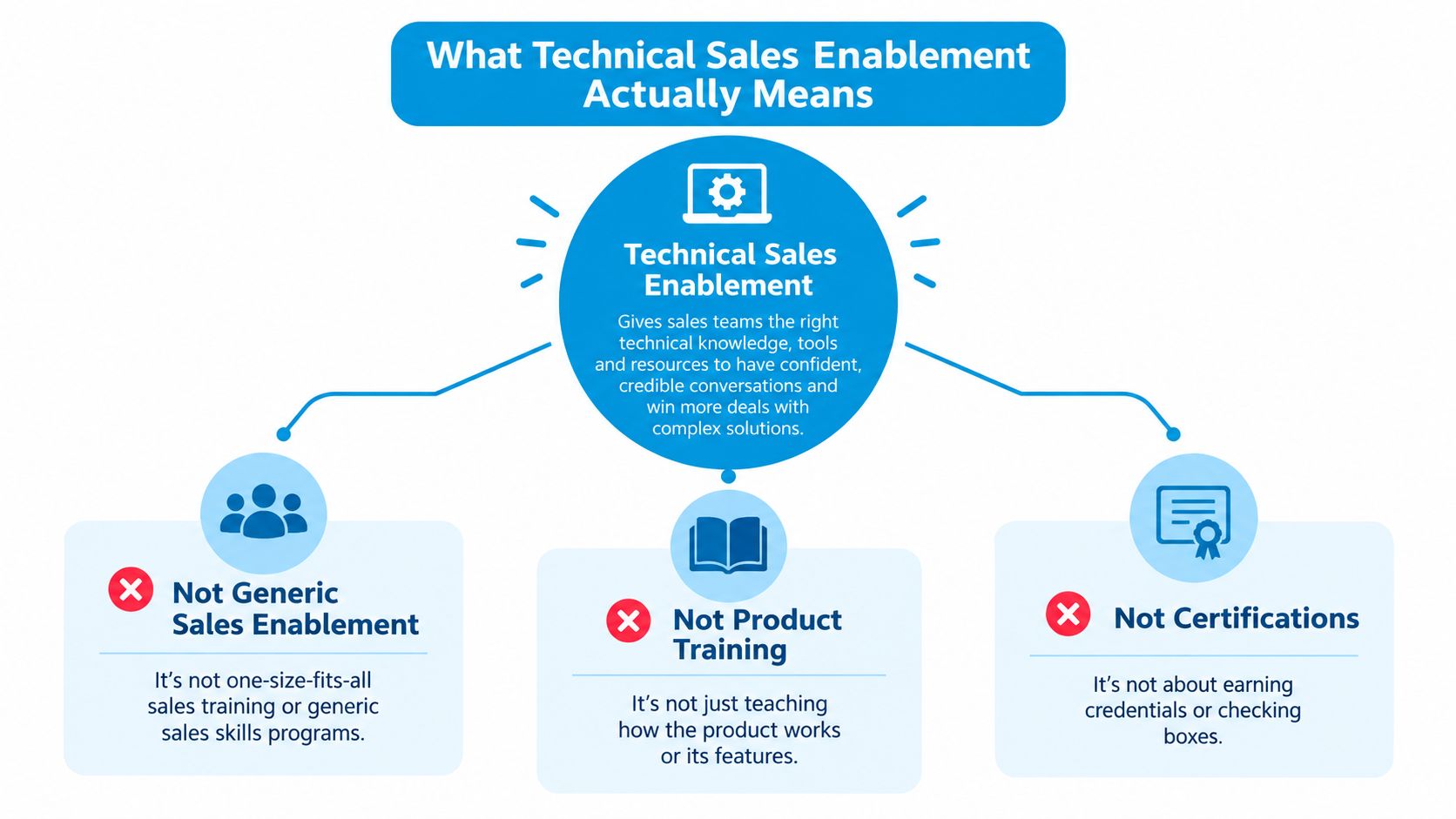
Technical sales enablement is the deliberate design of SE capability, tools, practice, and inspection around complex buying decisions. It isn't generic sales training with technical terminology added later. It isn't product training. It isn't a certification queue.
A useful definition starts with the work an SE must perform:
- Discover the current state. Capture the buyer's stack, workflow, constraints, stakeholders, business problem, and definition of technical success.
- Qualify the technical path. Decide whether the opportunity has a credible reason to proceed, a feasible solution path, and an agreed validation process.
- Tailor the technical story. Shape the demo around the buyer's workflow and decision criteria. No discovery, no demo.
- Control validation. Define the hypothesis, scope, owners, evidence, risks, and exit criteria for a POC or pilot.
- Translate evidence into deal guidance. Tell sales leadership what has been proven, what remains uncertain, and how technical risk affects timing and win probability.
The role itself includes technical discovery, custom demonstrations, architecture and integration review, and POC support. The Solution Engineer role guide provides useful context, while the PreSales overview places those activities in the wider commercial process.
The ownership model matters. L&D can support instructional design and delivery, but SE leadership has to define the behaviors, artifacts, and deal outcomes. Sales leaders should agree on the handoffs and inspection points. Marketing and product teams can provide inputs, yet they shouldn't determine success by content volume.
For small teams, a practical guide to sales enablement for small teams can help establish basic content and process discipline. Larger PreSales organizations need more than a repository. They need role-specific playbooks, manager coaching, deal-review habits, and CRM fields that capture technical evidence.
Technical sales enablement also has to reflect how buyers buy. Gartner describes four recurring buying jobs: problem identification, solution exploration, requirements building, and supplier selection, with validation as a test of whether the apparent answer is suitable. A demo for solution exploration isn't the same as a validation session against agreed requirements. Gartner also reports that 64% of 148 people involved in technology purchases preferred a fully digital buying experience when already familiar with the product or service, as described in its B2B buying journey research.
For a broader distinction between training, content, coaching, and process, see what sales enablement means. The point for SE leaders is simple: build capability around the technical steps that move a buyer toward a technical win.
The Four Pillars of a Working Enablement System
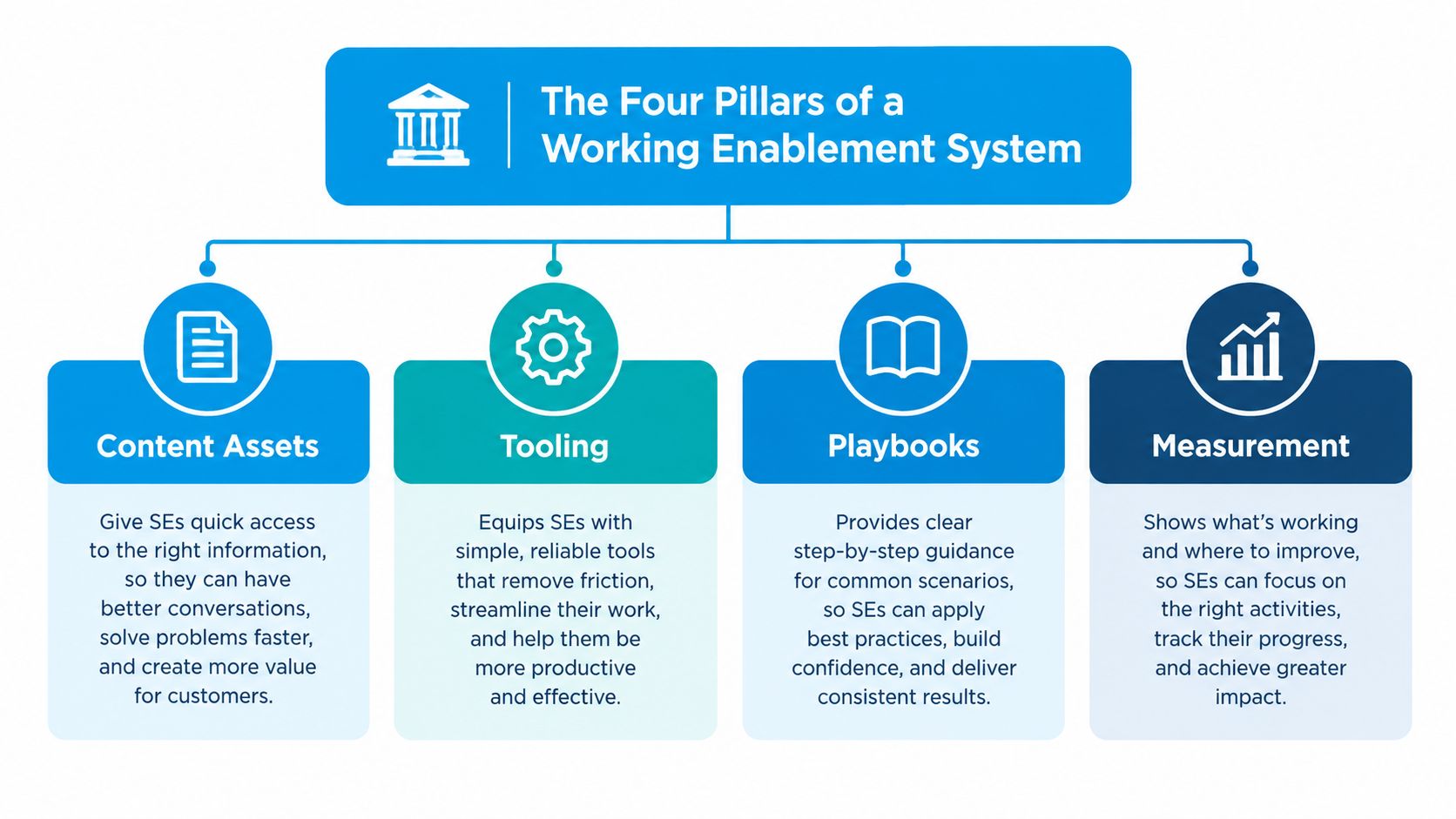
A working system has four connected pillars. Remove one and the remaining three become less useful.
Content assets
Content should help an SE make a decision or perform a task. That means discovery prompts, architecture patterns, objection responses, demo storyboards, technical validation plans, POC templates, and forecast evidence standards.
A feature deck belongs in the system only when it helps the SE connect a capability to a buyer's stated workflow. Otherwise, it remains product information. The useful question isn't “Do we have a document for this?” It's “Can an SE use this document during the next customer interaction without rewriting it?”
Tooling
Tooling removes friction from application and inspection. That may include a reliable demo environment, realistic demo data, screen recording, CRM fields, conversation intelligence, and AI prompts that turn a transcript into coaching input.
Don't add tools because they offer more features. A fragmented stack can make an SE search across systems, copy information between records, and lose the connection between practice and opportunity. Pick the smallest workflow that lets the team prepare, perform, capture evidence, and review it.
Playbooks
A playbook turns judgment into a repeatable sequence without pretending every deal is identical. It should tell an SE what to learn in discovery, when to involve specialists, how to decide whether a demo is earned, how to define a POC, and what technical evidence belongs in a forecast.
The MEDDPICC guide for Solution Engineers is useful when qualification needs a shared language across AE and SE roles. For operating-model context beyond PreSales, this step-by-step GTM engine guide offers a useful way to think about connected processes rather than isolated assets.
Measurement
Measurement connects the other pillars to deal progression. Track whether an asset appears in a live workflow, whether a playbook changes an observed behavior, and whether that behavior correlates with technical win, POC progression, or cycle movement.
A content library without measurement becomes clutter. Measurement without playbooks becomes surveillance. Tooling without a behavior target becomes expense. The four pillars work when an SE can move from prompt, to practice, to live application, to inspected evidence.
Designing a Quarterly Enablement Cycle
A quarter is long enough to change behavior and short enough to keep the work tied to current deals. Run the cycle as assess, build, rehearse, apply, inspect, then repeat.
Assess
Start with active opportunities, not a blank training calendar. Review discovery notes, call recordings, demo outcomes, POC plans, and technical forecast commentary. Look for repeated friction:
- Discovery gaps: The team jumps to capabilities before documenting the current environment and decision criteria.
- Qualification gaps: Technical risk appears late, after resources have already been committed.
- Demo gaps: The presentation is polished but doesn't reflect the buyer's workflow.
- POC gaps: The evaluation has activity but no agreed evidence or decision.
- Forecast gaps: SEs report confidence without separating proven facts from unresolved risk.
Choose one behavior that matters to the next set of opportunities. Don't launch a quarter around “improve technical selling.” Choose “define validation evidence before a POC starts” or “capture technical decision criteria before the demo.”
Build and rehearse
Create the smallest asset that supports that behavior. A one-page discovery map, a POC decision brief, or a demo-customization checklist is often more useful than a long course.
Then rehearse it in several conditions. Use a short retrieval check, a role-play, a deal-sparring session, and a manager review of a real artifact. The spaced repetition schedule provides a useful model for distributing retrieval instead of compressing all instruction into one event.
Apply and inspect
Application is where the system earns its place. Each SE uses the asset on an active opportunity, then brings back the discovery record, demo plan, call excerpt, or POC brief.
The manager inspects the artifact, not just the SE's self-report. Was the buyer's workflow captured? Did the demo answer a stated requirement? Does the POC have a decision after the test? What changed in the opportunity after the technical interaction?
The cycle fails when any stage disappears. Assessment without building produces complaints. Building without rehearsal produces unused assets. Rehearsal without application creates classroom confidence. Application without inspection lets old habits return.
A Hypothetical Quarter Inside an SE Team
Consider a hypothetical mid-market SaaS opportunity. Maya, a Solution Engineer, is asked to support discovery, a customized demo, a POC, and a forecast call. This isn't a real customer story. It illustrates the operating mechanics.

The AE initially brings Maya in after the buyer has requested a demo. That is the first failure. The team uses the discovery guide to recover the context before presenting anything. Maya documents the current workflow, systems involved, technical constraints, stakeholders, and the evidence the buyer needs before approval. The discovery call guide gives the team a shared structure for that conversation.
The resulting demo is narrower than the original request. Instead of walking through the whole product, Maya maps three parts of the buyer's workflow to specific capabilities and identifies what still needs validation. The manager later reviews the call recording and checks whether the demo followed the discovery evidence rather than the standard product tour.
The buyer then requests a POC. Maya refuses to let it become an open-ended implementation project. She writes a brief with the hypothesis, the workflow in scope, data ownership, technical contacts, risks, success criteria, exit date, and the decision that follows a pass or fail result.
That discipline reflects practitioner guidance on bounded evaluations. A technically credible POC should define the hypothesis, limit scope, assign ownership, agree success criteria before starting, and use a time-boxed trial against those criteria, as outlined in sales-engineering POC guidance.
At the forecast call, Maya doesn't say the deal is “technically good.” She separates evidence into proven, partially tested, and unknown. The team can see that integration feasibility is proven, adoption workflow remains partially tested, and a security dependency is still a risk.
The hypothetical outcome isn't a guaranteed win. The enabled process gives the team a better decision. It protects SE capacity, gives the buyer a fair evaluation, and lets sales leadership understand the technical conditions behind the forecast.
Metrics That Prove Enablement Is Working
A useful SE scorecard separates leading indicators from lagging outcomes. Leading indicators show whether the system is being used. Lagging indicators show whether technical work changes deal progression.
Start with the outcome PreSales owns: technical win rate. Define the event consistently, record it at the same stage, and segment it by product complexity, region, cohort, and deal size. Don't claim that training caused movement from one period to another without a baseline and a credible comparison.
A commonly cited CSO Insights benchmark reports a 49% win rate for forecasted deals in organizations with formal sales-enablement programs, compared with 42.5% without them, an absolute difference of 6.5 percentage points, as reported by Cirrus Insight's sales-enablement statistics overview. Treat that as a benchmark for framing measurement, not as a promise for your team.
Track the deal mechanics
| Metric | Type | What it tells you |
|---|---|---|
| Technical win rate | Lagging | Whether technical work supports a favorable deal outcome |
| SE-involved-ahead rate | Leading | Whether PreSales enters early enough to shape the path |
| Discovery quality | Leading | Whether the team captures workflow, constraints, stakeholders, and success criteria |
| Demo-to-next-step conversion | Lagging | Whether technical engagement creates a credible buyer action |
| POC pass rate | Lagging | Whether evaluations meet agreed technical conditions |
| POC time to decision | Lagging | Whether evaluation control reduces uncertainty and drift |
| Forecast evidence quality | Leading | Whether technical confidence rests on observable proof |
Discovery quality needs a rubric, not a feeling. Score whether the record includes the current state, reason for change, technical requirements, decision criteria, stakeholders, risks, and next validation step. A polished call can still produce weak discovery.
POC pass rate also needs a defined denominator and agreed exit criteria. Otherwise, teams may call a POC successful because activity occurred, even when the buyer never made the intended decision.
Keep training metrics in their place
Certification counts, role-play scores, asset usage, and attendance are useful operating signals. They aren't revenue proof by themselves. They become more meaningful when the team can associate them with later outcomes such as technical win rate, quota contribution, POC progression, or cycle length.
A monthly scorecard should answer three questions:
- Did the team practice the target behavior?
- Did managers observe it on live work?
- Did the behavior connect to deal progression within the quarter?
For a practical view of SE measurement, use the Sales Engineer KPI guide. If a metric can't help you decide what to coach, inspect, or change, move it out of the operating review.
Common Failure Modes and How to Avoid Them
Technical sales enablement usually stalls for organizational reasons, not because the team lacks another course.
L&D owns the program without SE ownership. The material may be well designed, but it won't reflect the decisions SEs make in discovery, architecture review, or POC control. Put an SE leader in charge of the behavior targets and require sales alignment on handoffs.
The team builds content but never rehearses it. A discovery template sitting in a portal doesn't improve discovery. Run role-plays against real objections, then review the resulting notes and recordings. If the asset can't survive a live scenario, revise the asset.
Managers inspect completion instead of application. Completion is easy to report and weak as evidence. Ask managers to inspect one artifact from an active opportunity, then coach the specific behavior that is missing.
The playbook doesn't change with deal evidence. A static document becomes fiction as products, buyers, and competitive situations change. Give managers a recurring mechanism to submit failed assumptions, confusing steps, and useful language from calls. Update only what the evidence supports.
Metrics stop at participation. A dashboard full of course completions can create the appearance of progress while technical win remains unchanged. Pair every leading measure with a deal measure, and be honest when the relationship isn't established.
POC discipline disappears under capacity pressure. When the team is busy, SEs often accept vague evaluations to keep momentum. That creates more work, not less. Require a hypothesis, owner, success criteria, and decision before allocating meaningful POC capacity.
SEs are excluded from business-value discovery and forecasting. The 2025 Vivun benchmark reports that 52% of surveyed SEs said they had no involvement in business-value discovery, while roughly three-quarters of SE teams reported no formal forecast. Those figures appear in the State of Sales Engineering 2025 report. The practical response is shared AE-SE qualification and clear evidence standards, not a generic request for SEs to “be more commercial.”
PreSales Unleashed GmbH offers the Trusted Advisor Academy, a year-round program with structured content, live practice, deal sparring, and application to discovery, demos, and POCs. Visit PreSales Unleashed GmbH to see how its enablement approach fits a measurable technical sales operating system.